A new study suggests that the work to reduce equity gaps in higher education doesn't end when students earn their diploma—rather, the transition to the workforce is just as critical for closing equity gaps between higher- and lower-income students.
Using newly released institutional data from IPEDS, this blog post details how community college revenues have changed now that pandemic-related Higher Education Emergency Relief funds have ended.
In this blog post, summer intern Deenika Oladipo writes about the rollout of the simplified FAFSA form, how it was received by students and administrators, and what students can expect this year when filing for FAFSA.
By Clive Belfield, Thomas Brock, John Fink, and Davis Jenkins For the community college sector, the COVID-19 pandemic was not like other economic shocks. Traditionally, economic downturns lead students to enroll in college at higher rates: Fiscal shocks are therefore offset by increases in tuition revenue, and college operations and institutional
By John Fink, Tatiana Velasco, and Davis Jenkins Last week, the U.S. Department of Education (ED) released—for the first time ever—public transfer community college student outcomes data for colleges and universities across the country. ED’s analysis examined federal financial aid recipients who started higher education at a community college
In the latest installment of our COVID-19 blog series, Davis Jenkins, John Fink, and Thomas Brock use Great Recession-era data as a potential blueprint for how community college funding may shift moving forward.
Based on observations following the last major disruption to community colleges, Davis Jenkins and John Fink explore how the COVID-19 pandemic could affect enrollment trends across three groups of students: students aged 25 and over, students aged 18–24, and dual enrollment students.
The IPEDS definition of public-two year colleges no longer fits the community college sector and its students, making it more challenging for policy research to provide an accurate statistical picture of these institutions. In this blog post, John Fink and Davis Jenkins describe CCRC's alternative definition.
Community colleges across the nation are adapting to teaching and learning amid the pandemic. This essay details some of the issues they're confronting during this transition, including maintaining equitable practice and financial stability.
Student support professionals across the country have transitioned to remote advising in the wake of the coronavirus pandemic. Here, CCRC's Andrea Lopez compiles resources for making the change effectively.
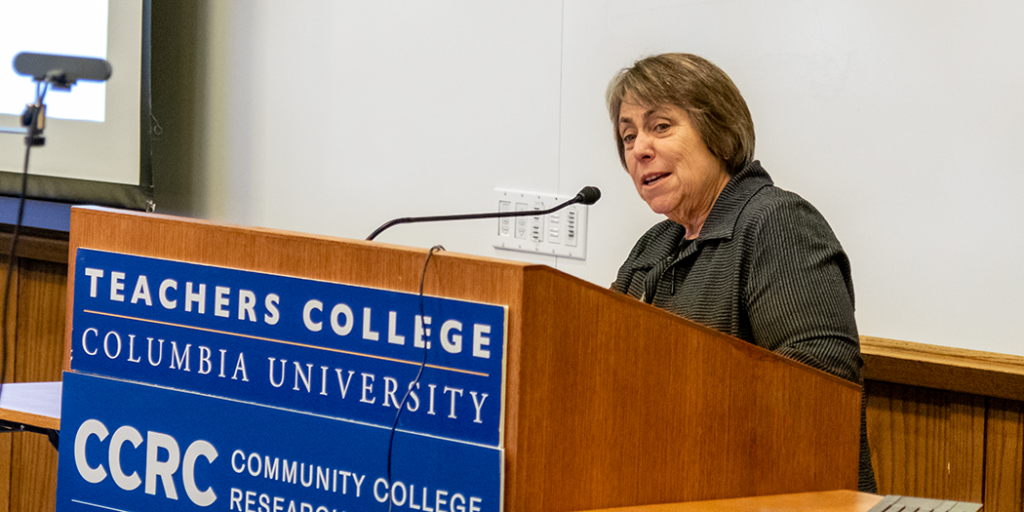
CCRC is deeply concerned about how the coronavirus will affect community colleges and their students. Here, Director Thomas Brock reflects on responses to the pandemic thus far and describes the important role open-access institutions can play as the country rebuilds from this crisis.
In a February talk at Teachers College, the executive director of the College Promise Campaign and the former under secretary of education explained why free college programs must be sustainable, nonpartisan, and evidence-based.
CCRC researchers presented on guided pathways, equity, and more during the 2020 League for Innovation in the Community College annual conference. Check out we happened in Seattle!
In this new blog post, CCRC's Florence Xiaotao Ran describes recent findings on corequisite remediation and poses three vital questions for moving the field forward.
CCRC researchers Amy Brown and Hana Lahr consulted on a new film series focused on the challenges and successes that community college practitioners face when implementing guided pathways.
In this essay for Inside Higher Ed, CCRC Research Affiliate James Jacobs describes three potential unintended consequences of allowing students to apply Pell funds to short-term training programs.
Forthcoming work from CCRC and MIT aims to assess how community colleges can prepare students—particularly those from low-income and first-generation backgrounds—to adapt to and succeed in the evolving workforce.
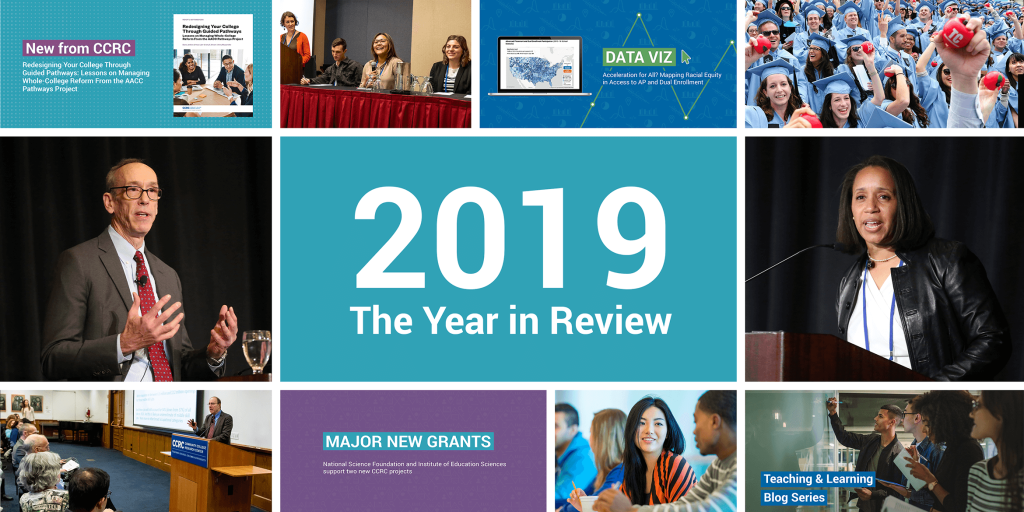
Before 2019 is up, take a stroll down memory lane to check out what you may have missed from CCRC. From presentations and new papers to blog posts and our CAPR conference, it’s been quite the year!
Jothany Blackwood of San Antonio College describes four specific strategies for facilitating strong governance and employer engagement when implementing whole-college reforms.
In the latest installment in our guided pathways blog series, Alison Kadlec, who co-founded Sova, describes five principles for helping higher education institutions build capacity for large-scale change.
Search the CCRC blog
Explore trends in community college outcomes with our interactive data visualizations.