Former research intern Hamnah Malik breaks down the potential benefits and drawbacks of the quarter system and discusses how a similar system of mini-semesters at community colleges could facilitate learning and promote student success.
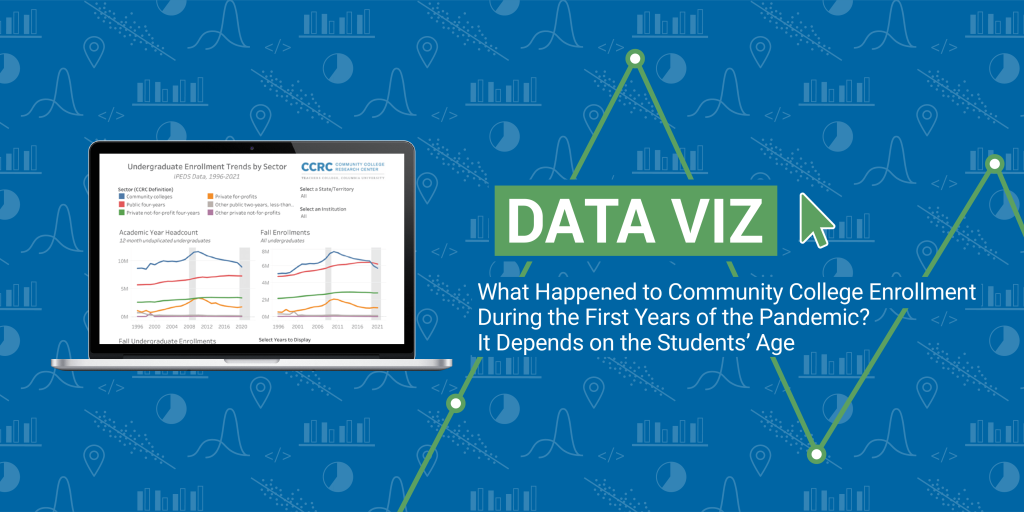
For the first time following the pandemic, we can examine detailed state- and college-level enrollment trends by age group using the latest federal data. Senior Research Associate and Program Lead John Fink examines these numbers and offers three major takeaways on how community college enrollment changed during the pandemic.
This year, loosened social distancing measures allowed a number of opportunities for us to reconnect—a welcomed change from recent years. As 2022 comes to a close, we look back on a year of accomplishments by CCRC colleagues and celebrate their efforts to make a college education more accessible, equitable, and rewarding for students.
Complete College America (CCA) has long been a leading voice in the push for colleges to adopt corequisite support, arguing that the evidence that coreq helps students was strong even when cautious researchers wanted to see more.
In this blog post, Christopher Quarles, a former community college teacher and current PhD candidate at the University of Michigan School of Information, shares findings from his recently published study on student capital, which he defines as the cumulative effect of all factors that account for student success.
The Institute of Education Sciences has selected CCRC to lead the Accelerating Recovery in Community Colleges Network (ARCC Network), which will include research teams from across the country that will study recovery strategies such as enhanced financial aid, innovative workforce programs, improved online and hybrid education, and new course formats.
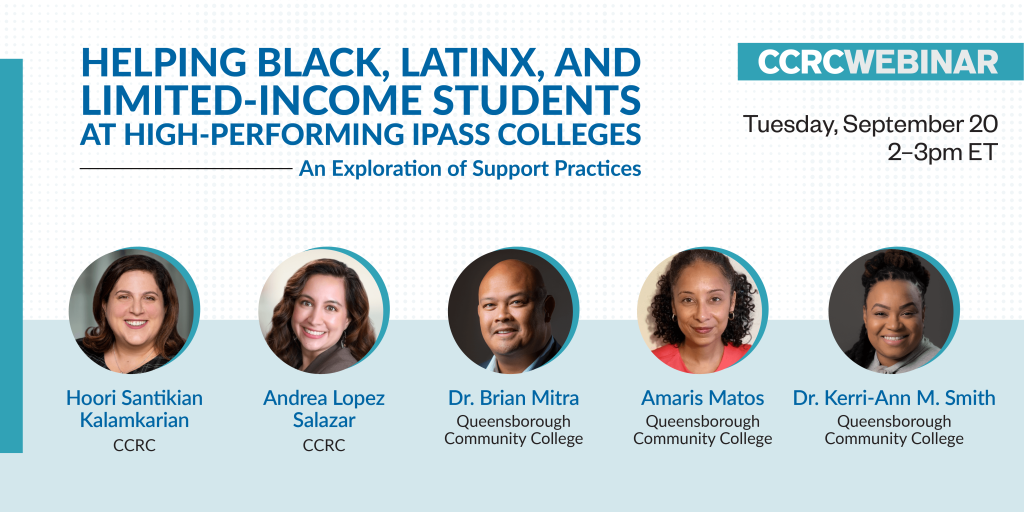
In the webinar Helping Black, Latinx, and Limited-Income Students at High-Performing iPASS Colleges: An Exploration of Support Practices, which took place September 20, 2022, CCRC Senior Research Associate Hoori Santikian Kalamkarian and Research Associate Andrea Lopez Salazar discussed their research at five colleges with some improvements in outcomes among these student groups.
Much is unknown about the nature of first-generation students' personal networks, but a new CCRC study is changing that. CCRC Senior Research Assistant and PEAR Fellow Melissa Herman and Senior Research Associate Hoori Santikian Kalamkarian discuss the impetus for the study and share some preliminary findings in this blog post.
In this blog post, Dean of Allied Health & Nursing Marriya Wright explains how South Puget Sound Community College's shift to admission criteria based on course grades led to huge increases in diversity and student success.
Beginning September 12, CCRC Senior Research Scholar Judith Scott-Clayton will serve one year in the Biden administration as a senior economist at the Council of Economic Advisers.
Looking back at transferring during the pandemic, CCRC intern Nabiha Sheikh discusses her college journey, and CCRC Senior Research Associate John Fink explains how the transfer process can be improved.
Suspended at the height of the pandemic, placement testing is back on the table as an option for determining eligibility for dual enrollment—what should states and colleges do? CCRC researchers John Fink, Sarah Griffin, and Maggie Fay share their recommendations in this blog post.
In this blog post, CCRC Research Assistant Tucker Reyes shares insights gleaned from his master's research into how workforce programs can help socioeconomically disadvantaged students achieve their career goals.
PEAR Fellow Astrid Pineda is interested in studying education policies that improve economic opportunity among disadvantaged students, including in the developing world.
As President of Edison State Community College Dr. Doreen Larson explains, colleges can—and should—take responsibility for enrollment. Larson identifies four tools for doing so: timing, testing, transfer, and tuition.
Search the CCRC blog
Explore trends in community college outcomes with our interactive data visualizations.