A new study suggests that the work to reduce equity gaps in higher education doesn't end when students earn their diploma—rather, the transition to the workforce is just as critical for closing equity gaps between higher- and lower-income students.
Using newly released institutional data from IPEDS, this blog post details how community college revenues have changed now that pandemic-related Higher Education Emergency Relief funds have ended.
In this blog post, summer intern Deenika Oladipo writes about the rollout of the simplified FAFSA form, how it was received by students and administrators, and what students can expect this year when filing for FAFSA.
By Clive Belfield, Thomas Brock, John Fink, and Davis Jenkins For the community college sector, the COVID-19 pandemic was not like other economic shocks. Traditionally, economic downturns lead students to enroll in college at higher rates: Fiscal shocks are therefore offset by increases in tuition revenue, and college operations and institutional
By John Fink, Tatiana Velasco, and Davis Jenkins Last week, the U.S. Department of Education (ED) released—for the first time ever—public transfer community college student outcomes data for colleges and universities across the country. ED’s analysis examined federal financial aid recipients who started higher education at a community college
CCRC is studying how colleges in the Louisiana Community and Technical College System are designing and delivering corequisite models in practice and how students and faculty are experiencing these changes.
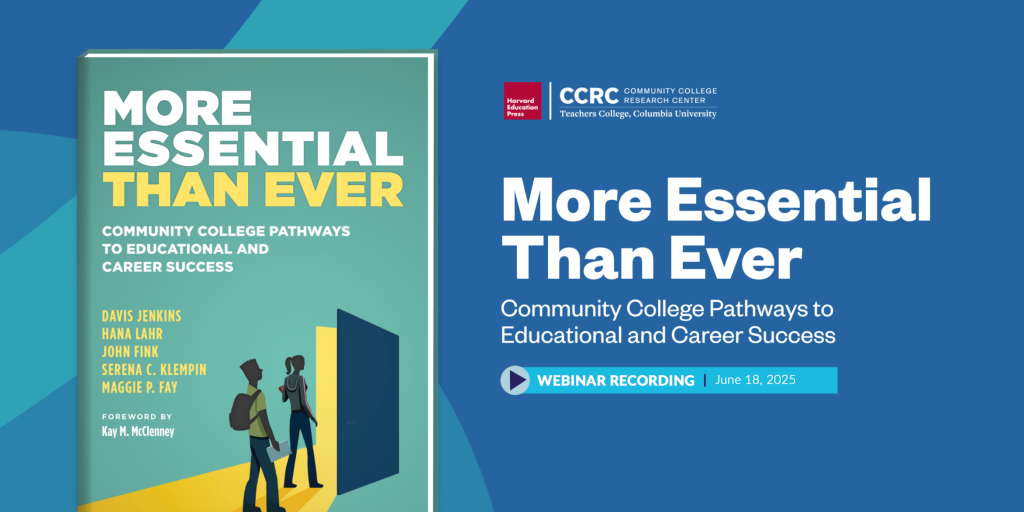
How can community colleges increase the rate at which students complete programs that prepare them for post-completion success, whether that is a living-wage job or efficient transfer into a bachelor’s program? A June webinar explored this question, central to CCRC’s forthcoming book.
CCRC's Nikki Edgecombe spoke with the National Association of College and University Business Officers' Kelli Rainey and Jim Hundrieser to learn more about strategic planning in support of student success.
Across the country, two-year colleges are rolling out innovative programs to mitigate climate-related challenges. Community Colleges and Climate Futures, a webinar series sponsored by CCRC and the Foundation for California Community Colleges, aims to help community colleges strengthen their efforts through storytelling and connection.
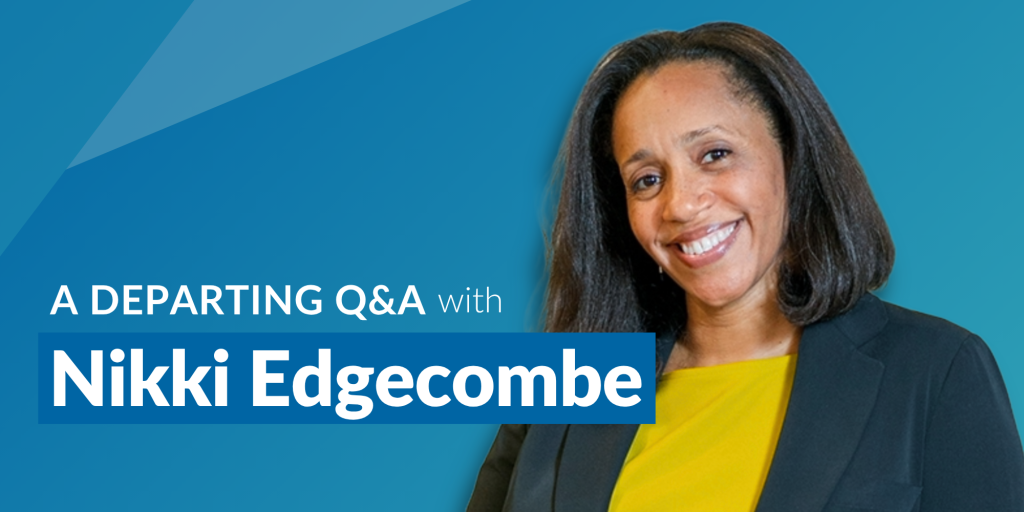
After more than fifteen years at CCRC, Nikki Edgecombe will be joining ECMC Foundation. Elizabeth Ganga had the opportunity to talk with her about her time at CCRC and where she’s headed next.
To facilitate high school students earning college credit, postsecondary and K-12 educators must collaborate to make decisions about dual enrollment course offerings. In a new CCRC working paper, the authors examined variation in dual enrollment partnerships across Texas and estimated how characteristics of these partnerships predict student success.
It’s graduation season again, which means CCRC has something to celebrate! Five staff members earned their advanced degrees from Teachers College, Columbia University while contributing to CCRC research.
As high school dual enrollment continues to expand across the country, an increasing number of students are taking their early college coursework online. In this blog post, CCRC researchers share strategies for implementing online dual enrollment courses in a way that mitigates the risk of sacrificing course quality for access.
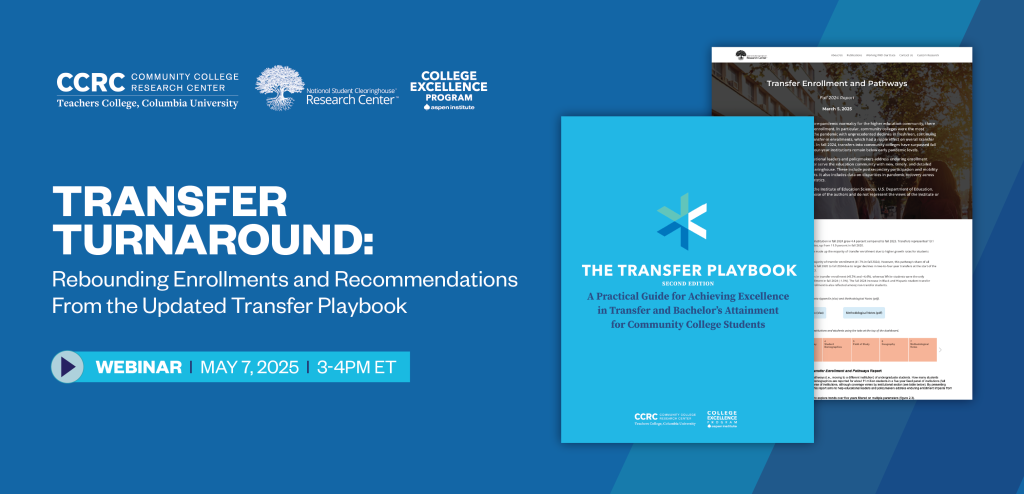
In a recent webinar, researchers from CCRC, the National Student Clearinghouse Research Center, and the Aspen Institute’s College Excellence Program explored data and findings on transfer enrollment, access, and strategies to improve the transfer process.
Five years after the onset of the pandemic, students enrolled in online classes are still reporting a lack of social connection and feelings of isolation. CCRC researcher Akilah Thompson shares strategies in this blog post to help students feel more engaged, confident, and human in their online courses.
This blog post introduces the dual enrollment pathways scale of adoption assessment, a self-assessment tool for colleges and college–K-12 partnerships to compare their current dual enrollment practices against the DEEP framework.
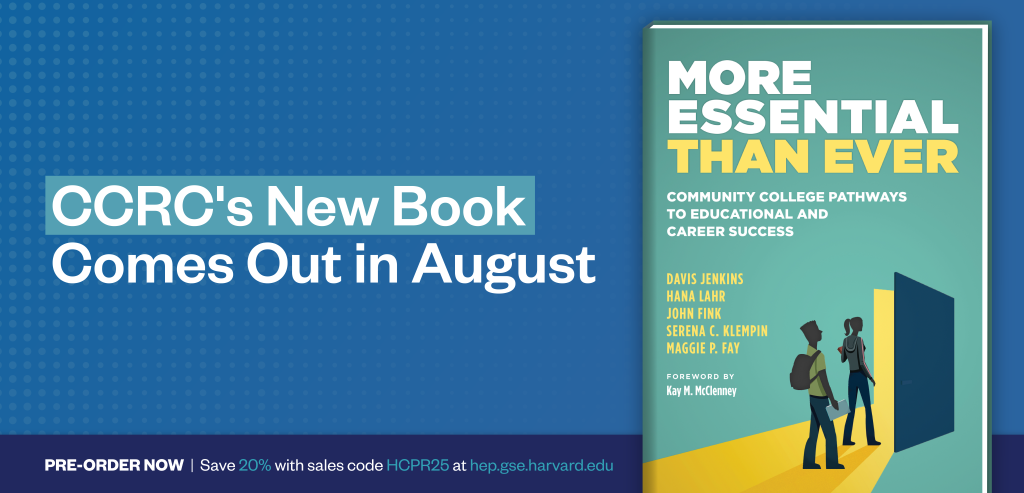
A forthcoming book to be published in August 2025 takes stock of what we have learned over nearly a decade of research on the guided pathways model for whole-college transformation. This blog post, the first in a series, features insights from the book, including practical guidance for community colleges on meeting the challenges they face today.
A new CCRC report examines data on what degrees and certificates community colleges nationally are awarding and which of those programs are more likely to enable students to secure good jobs directly or transfer efficiently to a bachelor’s degree program in students’ major fields of interest.
CCRC's forthcoming book features a chapter on the critical role of teaching and learning in community college efforts to strengthen pathways to post-completion success. This blog post, the third in a series, offers takeaways from the chapter on how community colleges can ensure students gain the practical skills needed for success in employment and future education.
To reimagine program onboarding, colleges must shift its purpose from a process focused on acquainting students with campus policies and procedures to one that helps students choose an initial direction and develop an academic plan to meet their goals.
Search the CCRC blog
Explore trends in community college outcomes with our interactive data visualizations.