

By Davis Jenkins, Hana Lahr, John Fink, and Serena C. Klempin
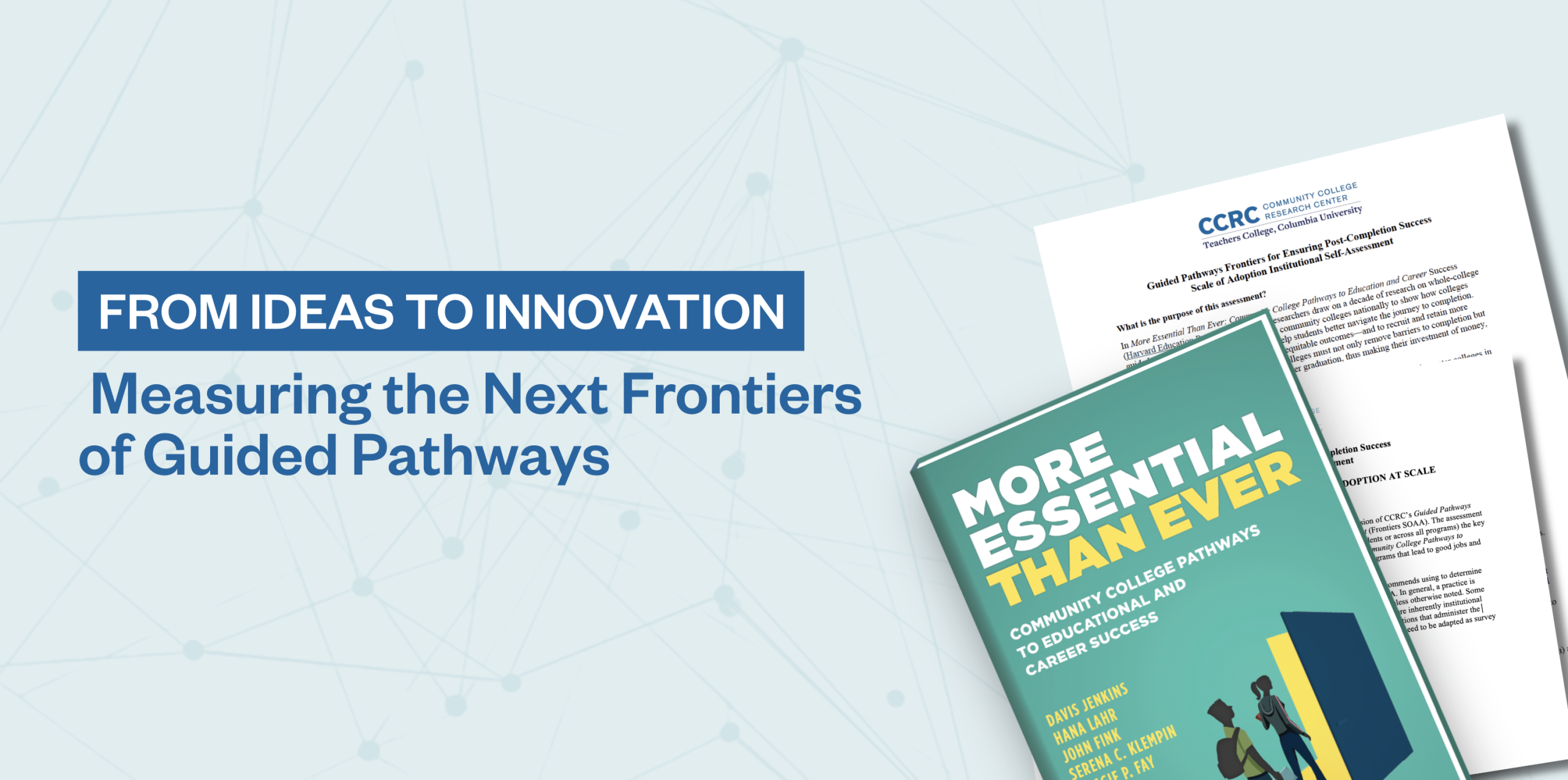
It has been nearly a year since Harvard Education Press published our latest book, More Essential Than Ever: Community College Pathways to Educational and Career Success. We wrote the book to synthesize what we have learned from more than a decade of research on guided pathways whole-college redesign at over a hundred colleges nationally—and to argue that the next frontier for student success is not simply helping more students complete credentials, but ensuring that those credentials lead to meaningful opportunities for further education and careers.
Since the book’s publication, one question has come up repeatedly in presentations and conversations with college and system leaders: How do we know whether we’ve actually implemented these ideas at scale?
Today we’re sharing a new resource designed to help answer that question—a working draft of a self-assessment for measuring the adoption of practices associated with the five frontiers for strengthening pathways to post-completion success described in More Essential Than Ever. Like the original Guided Pathways Scale of Adoption Assessment (SOAA), which evolved through years of collaborative learning with colleges and state systems, we view this resource as a working tool that will improve through use and feedback from practitioners.
The release of the institutional assessment and a companion guide reflects the next phase of our work. Rather than simply describing promising practices, we are working with colleges and state systems to better understand how institutions adopt these practices at scale, how implementation varies across colleges, and which strategies are associated with stronger student outcomes.
Over the past year, we discussed these ideas with practitioners and policymakers across the country through more than three dozen webinars, conference presentations, and statewide meetings. We have been encouraged by the response. More than 8,500 copies of More Essential Than Ever have been sold, and Harvard Education Press recently released an audiobook edition.
Even more encouraging has been seeing colleges and statewide organizations use the book as a framework for institutional improvement. For example, the Ohio and Michigan community college associations have launched the OH-MI More Essential Than Ever Frontiers of Practice initiative to bring together college leadership teams in institutes and learning communities organized around the book’s five frontiers. Similar conversations are taking place in colleges and state systems across the country as leaders consider how to redesign programs, student experiences, teaching, supports, and funding to improve students’ long-term educational and career outcomes.
Our research has continued to build on these ideas as well. During the past year, we, with other CCRC colleagues, released new research on how students choose programs of study and collaborated with the Aspen Institute College Excellence Program on a report examining how 10 vanguard colleges in the Unlocking Opportunity project redesigned pathways to increase students’ access to programs with greater labor market and transfer value. This fall, we will be releasing a new report on strategies for scaling career-connected dual enrollment.
This year we also launched a new research initiative, supported by Ascendium Education Group, focused on the five frontiers. A major goal of this work is to develop practical tools that colleges and researchers can use to determine not simply whether promising practices are present, but whether they have become the normal experience for most students and programs—and ultimately whether implementation at scale is associated with stronger student outcomes.
Earlier this year, we released a research brief and data tool to help colleges determine whether students are enrolled in high-value programs and identify which students have individualized education plans aligned with their educational and career goals. The new institutional assessment extends that work by providing colleges with a structured way to assess how extensively key practices in each of the five frontiers have been implemented.
One lesson from our earlier guided pathways research is that institutional change is rarely all or nothing. Colleges often implement reforms unevenly across programs, divisions, and student populations. Better measures of implementation can help colleges identify where innovations have reached most students and programs, where implementation remains uneven, and where they should focus improvement efforts. They can also help researchers and practitioners learn which combinations of practices produce the greatest improvements in student outcomes.
The Guided Pathways Next Frontiers: Scale of Adoption Assessment and guide we are releasing today are intentionally preliminary. We encourage colleges to adapt the assessment to their own contexts, experiment with different approaches, and tell us what works.
In the coming year, we will continue working with colleges, state systems, and partners across the country to understand how institutions can move beyond improving completion alone to ensuring that many more students complete programs leading to meaningful educational and career opportunity.
As always, we see our role as learning alongside colleges and state systems and sharing what we learn with the field. We hope the research-based guidance and tools we are developing will help institutions take stock of where they are, identify where implementation needs to be strengthened, and contribute to a growing body of evidence on how community colleges can ensure many more students complete programs that lead to good jobs and further education.