Veronica MinayaAdela SolizJudith Scott-ClaytonAmy E. Brown
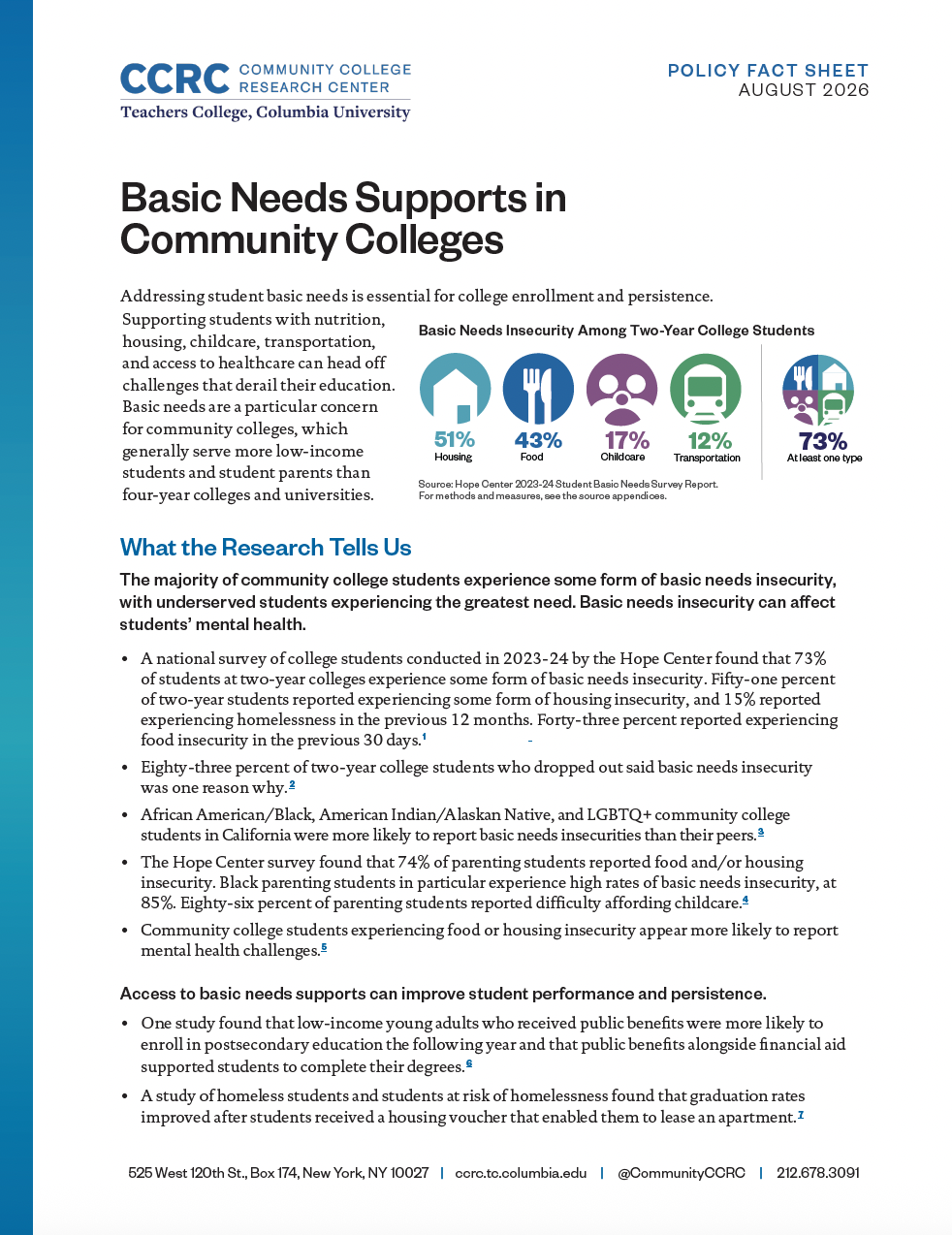
Using information and cost data from several CUNY campuses, this brief describes the FWS program’s core administrative components, estimates the campus costs of its implementation, and shows how program scale, staffing, and technology shape these costs.
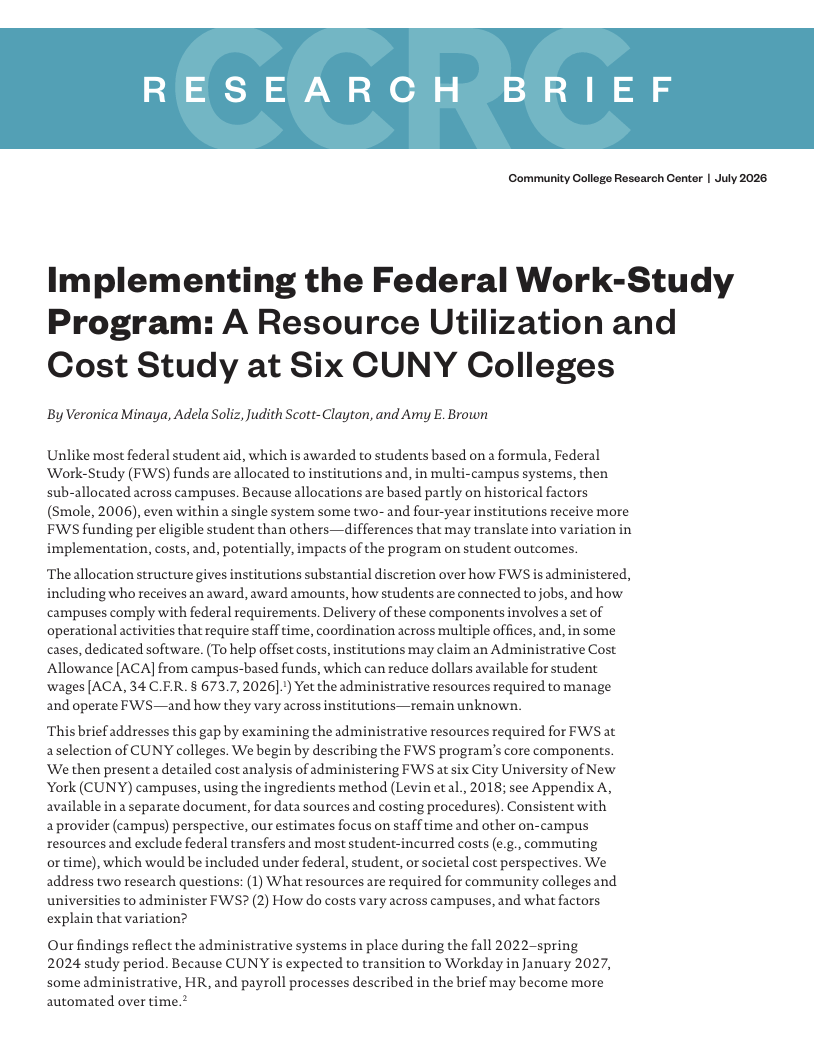
Drawing on student surveys, staff interviews, and administrative data, this brief describes the pandemic-era evolution of the FWS program across multiple undergraduate CUNY colleges, highlighting institutional management challenges, student access issues, and common academic benefits of work-study jobs.
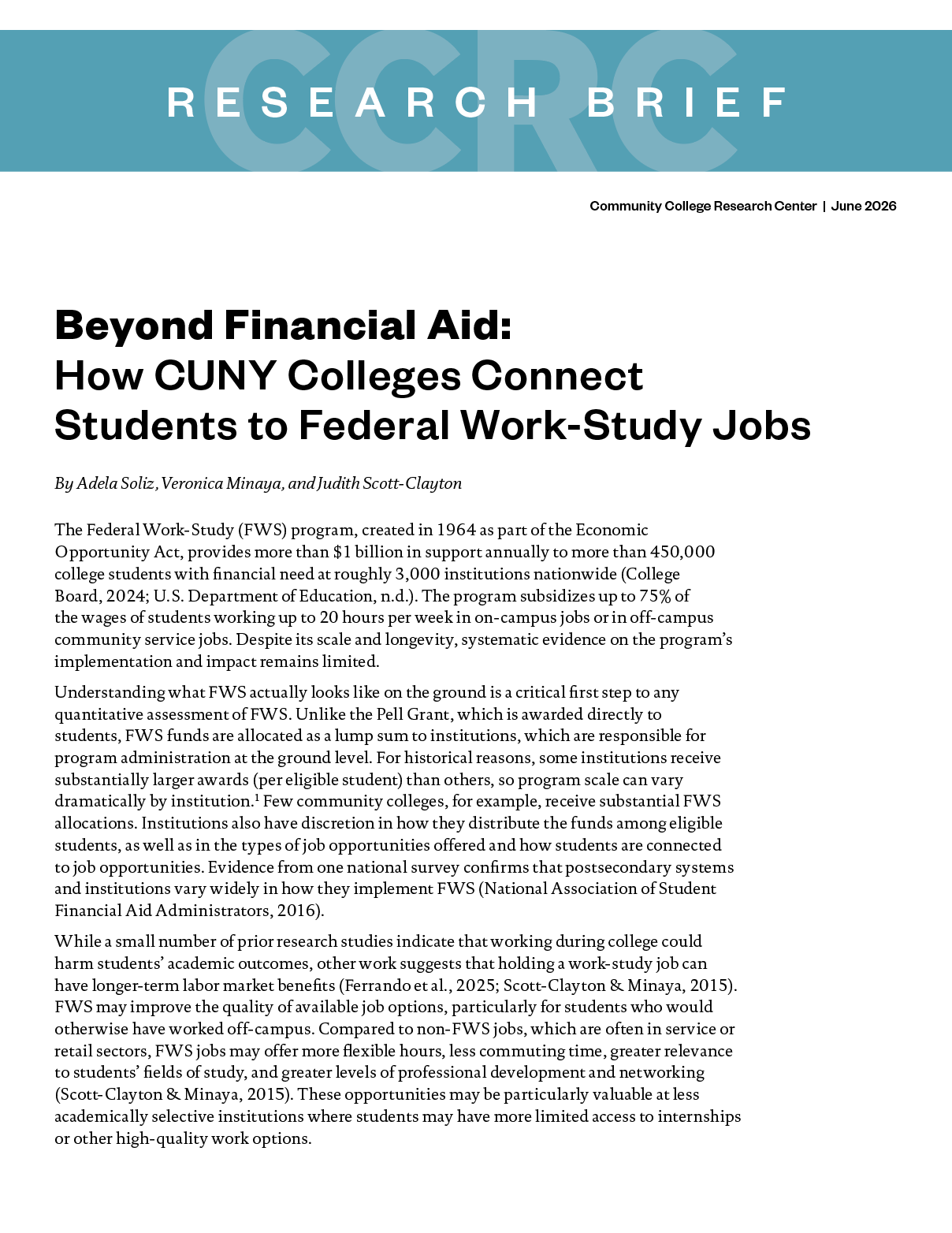
This new fact sheet explores student debt among community college students and provides policy considerations for supporting students in making informed borrowing decisions and successfully repaying their loans.
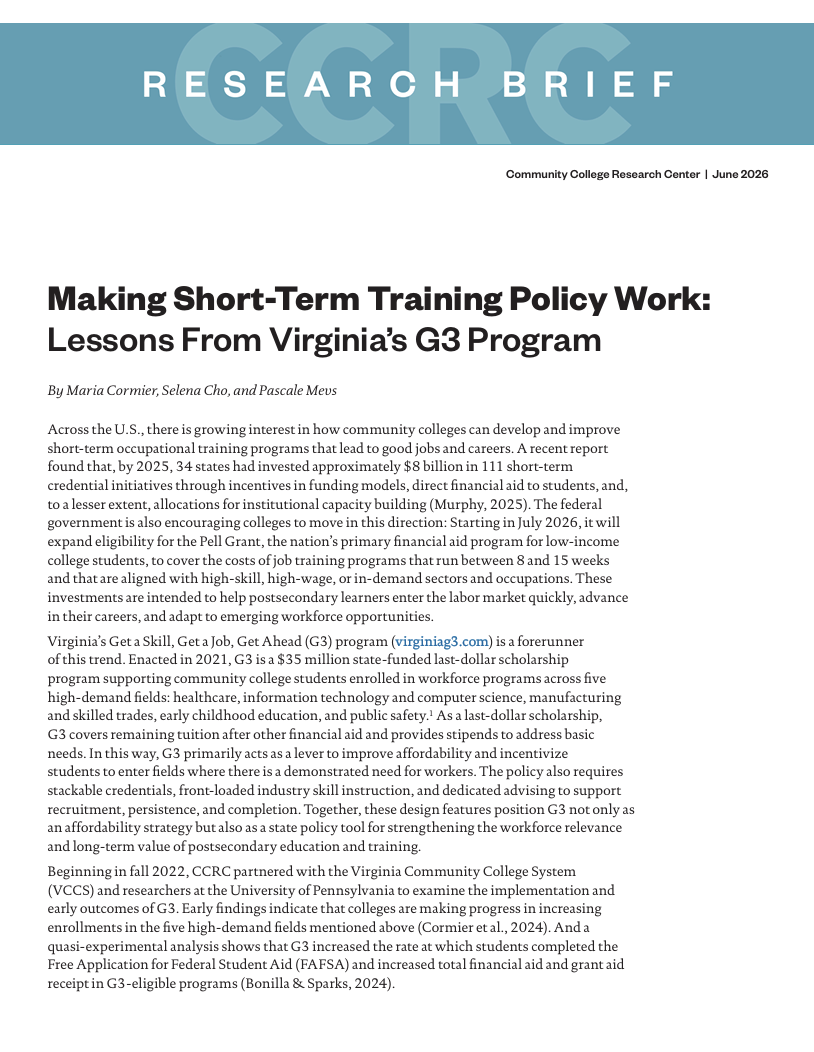
Drawing on three rounds of site visits to eight institutions, this brief examines how Virginia community colleges implemented G3 policy and offers lessons for developing, strengthening, and expanding access to short-term training programs for high-demand jobs.
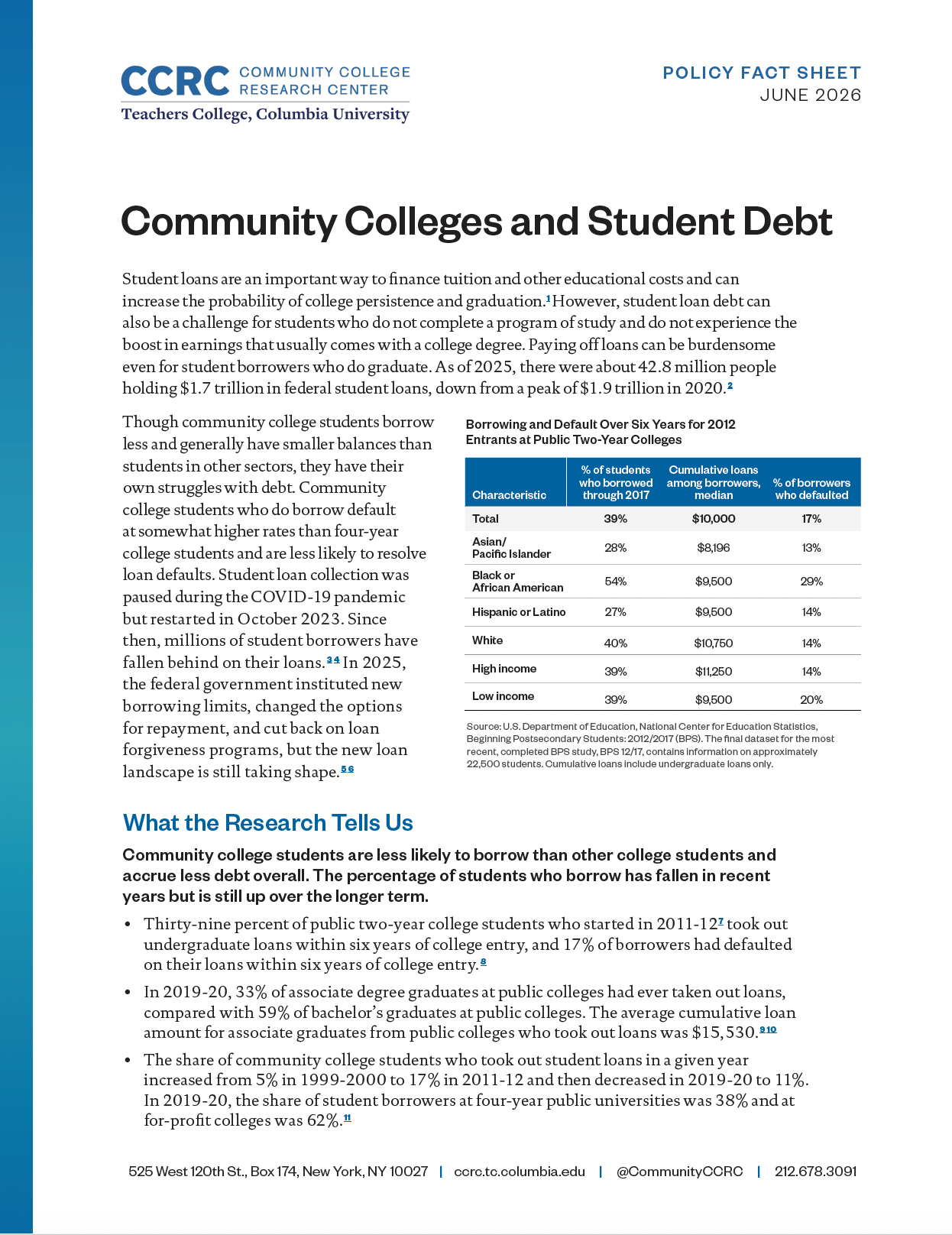
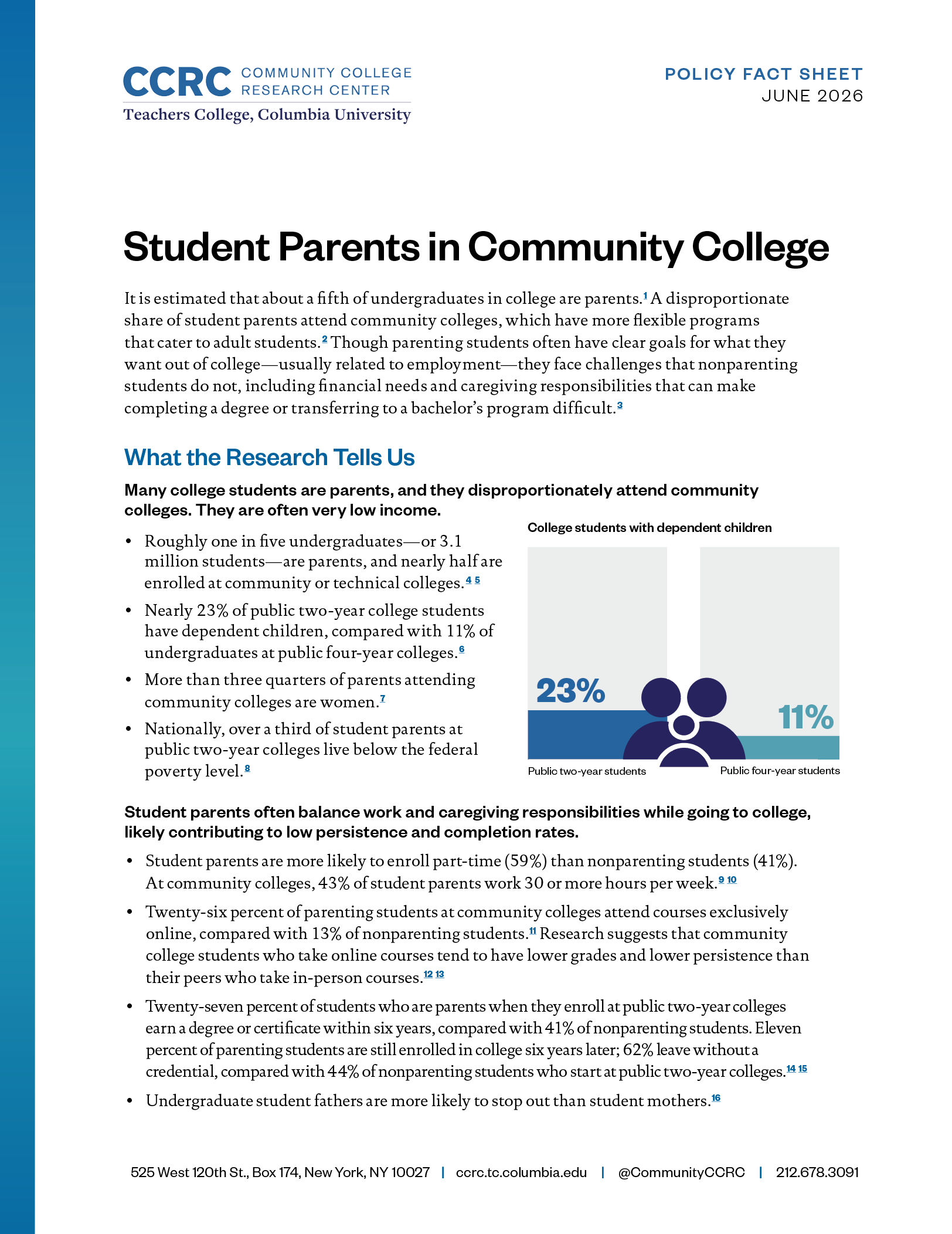
This new fact sheet provides an overview of student parents and the challenges they face, and provides policy considerations for supporting student parents and improving their experiences.
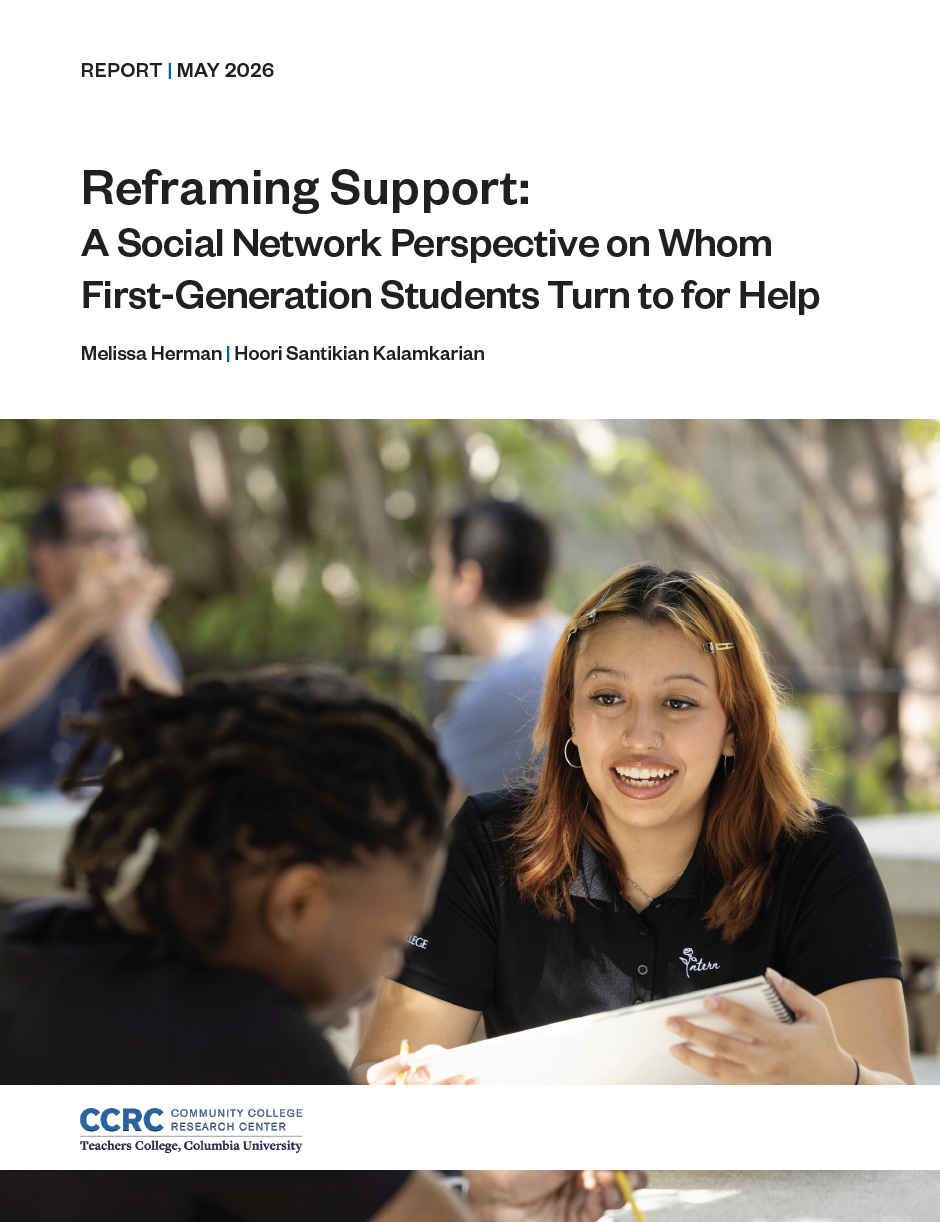
This report uses student survey and interview data from four California colleges to examine how first-generation college students build relationships and use support networks on- and off-campus to address academic and nonacademic challenges in the first year of college.
Based on a review of relevant literature and interviews with experts and administrators, this report discusses how federal policy aims are addressed by AE ESL providers and the distinct role that community colleges play in delivering AE ESL programming.
Using administrative data tracking Federal Work Study (FWS) offers, enrollment, and participation from the date of application, this working paper studies the causal impacts of receiving an FWS offer at a large public college system, including both two- and four-year campuses.
Andrea Lopez SalazarNicole MoraCatherine RivasHoori Santikian Kalamkarian
Based on survey and interview data from first-generation students who stopped out of four colleges in California, this brief examines students’ reasons for leaving, the role their social networks played in informing or supporting their decision, and how they thought about their futures—including the possibility of reenrollment.
Konrad MugglestoneMillicent BenderTess HenthorneTania LaVioletKathryn MastersonKristin O’KeefeKate WilliamsonJoshua WynerDavis JenkinsSerena C. KlempinHana LahrAurely Garcia Tulloch
This practice guide builds on the work of colleges in the Unlocking Opportunity Network by offering practical strategies that can help more students graduate with credentials that lead directly to good jobs or transfer and successful attainment of a bachelor’s degree.
Serena C. KlempinEstefanie Aguilar PadillaAkilah H. ThompsonHana Lahr
This report discusses the program choice process among 42 student interviewees; it describes factors that influenced their choice and how their choice often changed, and it offers recommendations to better support students in selecting a program.
Based on survey findings from 480 former students who stopped out of community college before the start of their second year, this report sheds light on the experiences of this population and their reasons for leaving college.
Judith Scott-ClaytonIrwin GarfinkelElizabeth AnanatSophie CollyerRobert Paul HartleyAnastasia KoutavasBuyi WangChristopher Wimer
This Center on Poverty and Social Policy working paper estimates the incremental long-run benefits and costs of participation in CUNY’s Accelerate, Complete, and Engage program, aimed at increasing bachelor’s completion rates.
Elisabeth A. BarnettSelena ChoKristin M. CorneliusBrad Phillips
This journal article describes the design of the Caring Campus–Faculty program, presents findings from four years of research on important practices and outcomes, and describes implementation experiences at one college that adopted the program.
Using administrative data, this paper analyzes Get a Skill, Get a Job, Get Ahead (G3)—a free community college initiative that Virginia implemented in 2021—and shows that both institutions and students responded to the tuition-free messaging and eligibility criteria.
Maria S. CormierRichard KazisNikki EdgecombeMycaeri Atkinson
This ARCC Network brief uses enrollment and outcome data as well as interview data from eight colleges implementing the Get A Skill, Get A Job, Get Ahead (G3) program to examine college-level G3 outreach, recruitment, and enrollment strategies and the process for awarding G3 aid.
Andrea Lopez SalazarHoori Santikian KalamkarianMelissa Herman
This book chapter explores the personal support networks and help-seeking preferences of immigrant-origin, first-generation-in-college students (FGCS) as part of a three-year longitudinal mixed-methods study with FGCSs at four public Hispanic-serving institutions in California.
Elisabeth A. BarnettSelena ChoAndrea Lopez Salazar
Based on interview data, this report examines a set of seven strategies that presidents of community colleges implementing Caring Campus are using to develop a more positive college culture and to support this culture-focused reform.
This fact sheet discusses how important Pell Grants are for community college students and describes recent and proposed changes in the Pell Grant program.
Using administrative data from the City University of New York (CUNY), this paper examines the impact of the summer Pell program on community college student persistence, completion, and employment outcomes.
Using three case studies, this paper examines the conditions under which dual enrollment programming could be made sustainable through efficiency gains, even for colleges that charge discounted tuition (or none at all)
Hoori Santikian KalamkarianAndrea Lopez SalazarElisabeth A. BarnettArmando LizarragaNoemi GaribayCameron Diwa
This report shares results of research undertaken to understand what five iPASS institutions were doing before and during the iPASS grant period to advise and support Black, Latinx, and low-income students both in and outside the classroom.
Caring Campus/Faculty is a program aimed at increasing students’ connection to college; this report shares findings from a study on how it is being adopted at several colleges, including insights into effective faculty engagement and implementation.
Based on fieldwork at six institutions, this report describes how colleges are implementing Caring Campus/Staff, a program designed to engage nonacademic staff in improving interactions with students and fostering a culture of caring at community colleges.
This fact sheet describes the importance of academic and nonacademic services, particularly for underserved students, and how students that receive targeted, intensive support experience improved outcomes.
This fact sheet outlines how the Federal Work-Study program works, its effects on academic and labor market outcomes, and why so few community college students receive Federal Work-Study aid.
This report examines how Ohio community colleges—which have been engaged in guided pathways reform for several years—are innovating within the model to provide scaled, personalized support to help students gain early academic momentum.
This set of three studies examines what states and community colleges can do to address the needs of racially minoritized adult learners who are pursuing postsecondary education and training as a path to re-employment, better jobs, and higher incomes.
This brief discusses the experiences, achievements, and challenges of 26 broad-access two- and four-year colleges that, in 2015, began steps to adopt or enhance technology-mediated advising practices to improve the way they support students.
Susan BickerstaffElisabeth A. BarnettAndrea Lopez Salazar
This brief describes the importance of nonacademic staff to the student experience and presents initial findings related to the Caring Campus initiative’s capacity to affect college culture and ground further change efforts.
This report summarizes enhancements to technology-based advising at three institutions and their effects on students' academic outcomes for four semesters after study entry.
This brief examines the relationship between BCC’s ASAP expansion and institutional change to illuminate how scaling a discrete reform can impact other areas of the college and change the way an institution serves all students.
Hoori Santikian KalamkarianLauren PellegrinoAndrea Lopez SalazarElisabeth A. Barnett
This report presents findings on the implementation of technology-mediated advising reforms at California State University at Fresno, Montgomery County Community College, and the University of North Carolina at Charlotte.
Based on a forthcoming book chapter, this paper discusses how the development of an overall framing vision for student success, the implementation of evidence-based practices, and the establishment of a culture that is conducive to innovation can help colleges improve student outcomes.
Drawing on interviews with 96 first-year community college students, this journal article compares the roles of students' on- and off-campus relationships in providing information and support.
Davis JenkinsHana LahrLauren PellegrinoElizabeth M. KopkoSarah Griffin
This practitioner packet provides guidance to colleges seeking to redesign their new student onboarding practices to better help students explore, choose, and plan a program of study best suited to their interests and aspirations.
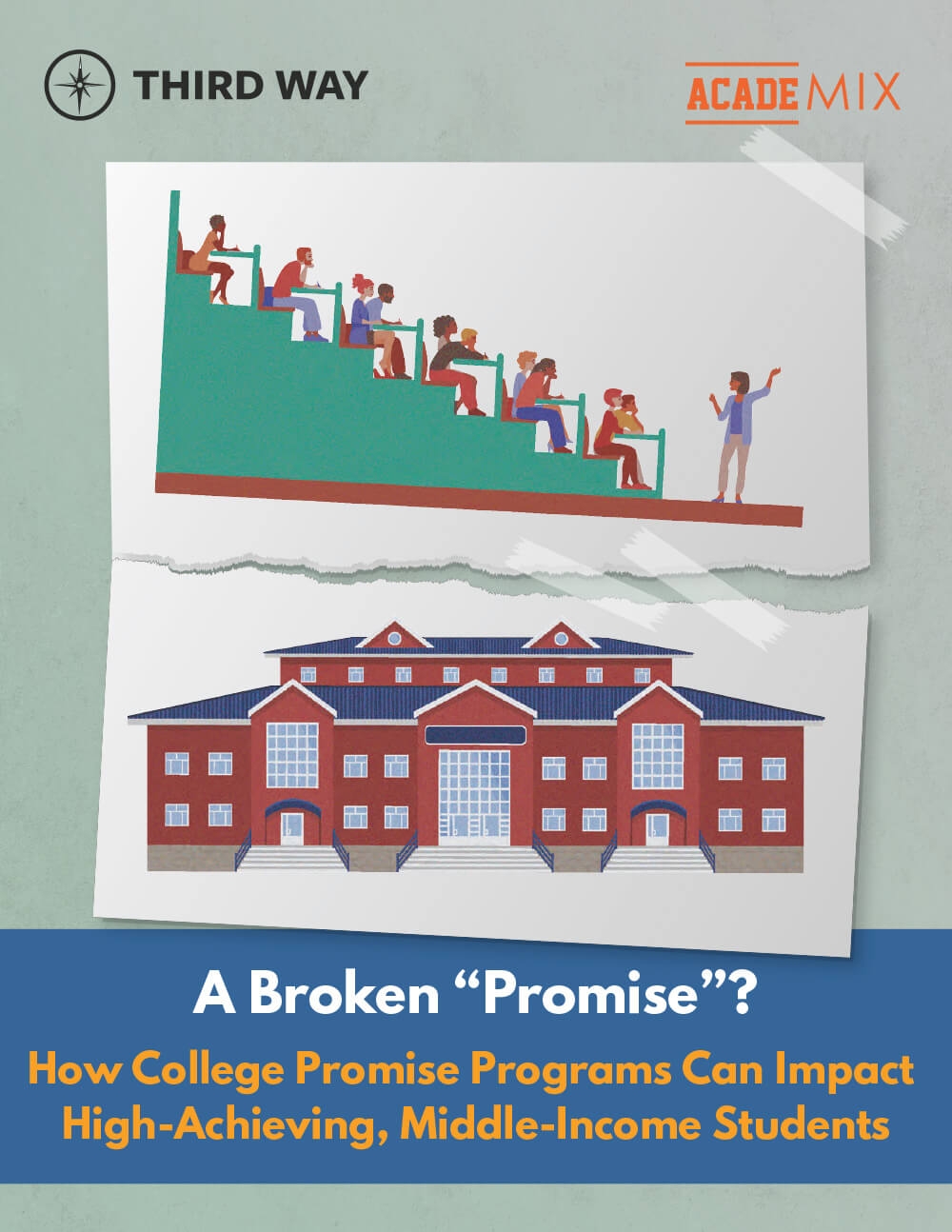
This report builds off previous research on American Honors to look at the unintended consequences of college promise programs for the economic mobility of high-achieving, low-income students.
This paper explores the dynamics in and around an institution that influence how advisors and students experience technology-mediated advising reforms, along with the opportunities and challenges these dynamics create for colleges.
Serena C. KlempinHoori Santikian KalamkarianLauren PellegrinoElisabeth A. Barnett
This book chapter describes key principles of CCRC's evidence-based framework for advising redesign, which emphasizes a sustained, strategic, integrated, proactive, and personalized (SSIPP) approach to advising.
Tatiana VelascoKatherine L. HughesElisabeth A. Barnett
This report describes trends in key performance indicators among the 26 two- and four-year institutions that participated in the Integrated Planning and Advising for Student Success (iPASS) grant initiative from 2011 to 2017.
Serena C. KlempinLauren PellegrinoAndrea Lopez SalazarElisabeth A. BarnettJulia Lawton
This report shares the stories of four community colleges that participated in the Integrated Planning and Advising for Student Success (iPASS) initiative, which provided support for institutions as they redesigned their advising processes and adopted and implemented new technologies.
Alexander K. MayerHoori Santikian KalamkarianBenjamin CohenLauren PellegrinoMelissa BoyntonEdith Yang
This study, conducted in partnership with MDRC, examines the effects of three institutions’ efforts to expand the use of advising technologies and to use administrative and communication strategies to increase student contact with advisors.
Maria S. CormierJasmine SandersJulia RaufmanDiana Strumbos
This brief examines the expansion and adaptation of the City University of New York’s Accelerated Study in Associate Programs (ASAP), using Bronx Community College as an illustrative case study.
This paper illustrates student responses to Satisfactory Academic Progress (SAP) requirements as well as the tradeoffs faced by a social planner weighing whether to set performance standards in the context of need-based aid.
This paper employs a difference-in-difference approach to examine the credit, credential completion, and labor market outcomes resulting from the year-round Pell using a state administrative dataset from a community college system.
This report describes how three institutions—the University of North Carolina, Charlotte; California State University, Fresno; and Montgomery County Community College in Pennsylvania—are approaching comprehensive, technology-based advising reforms.
This Brookings Institution report uses data from the U.S. Department of Education to examine whether disparities in student loan default rates by race/ethnicity and institution sector can be explained by other factors, along with what happens after a default and whether this also varies across student subgroups.
This paper looks at baseline key performance indicators (KPIs) for 26 two- and four-year institutions that received grants to implement technology-mediated advising reforms.
This CCRC working paper examines the perspectives of college personnel engaged in the consideration, launch, and use of predictive analytics tools for targeted advising.