

Skip to content
Teachers College logo
CCRC's 30th Anniversary Logo
  • About Us
    • About CCRC
    • CCRC Staff
    • Advisory Board
    • Biennial Report
    • Employment
    • Contact
    • About CCRC
    • CCRC Staff
    • Advisory Board
    • Biennial Report
    • Employment
    • Contact
  • News
    • CCRC in the News
    • Opinion
    • Press Releases
    • CCRC in the News
    • Opinion
    • Press Releases
  • Community College FAQs
  • Research Areas
    • Dual Enrollment
    • Developmental Education
    • Guided Pathways
    • Advising & Student Supports
    • Teaching & Learning
    • Transfer
    • Workforce Education
    • Dual Enrollment
    • Developmental Education
    • Guided Pathways
    • Advising & Student Supports
    • Teaching & Learning
    • Transfer
    • Workforce Education
  • Publications
  • Blog
  • Resources
    • Data Tools
    • Policy Fact Sheets & Briefs
    • Guided Pathways Workshops
    • Data Tools
    • Policy Fact Sheets & Briefs
    • Guided Pathways Workshops
  • More
    • Events
    • Research Projects
    • Events
    • Research Projects
  • Overview
  • Important Dates
  • FAQs
  • Overview
  • Important Dates
  • FAQs
  • Overview
  • Important Dates
  • FAQs

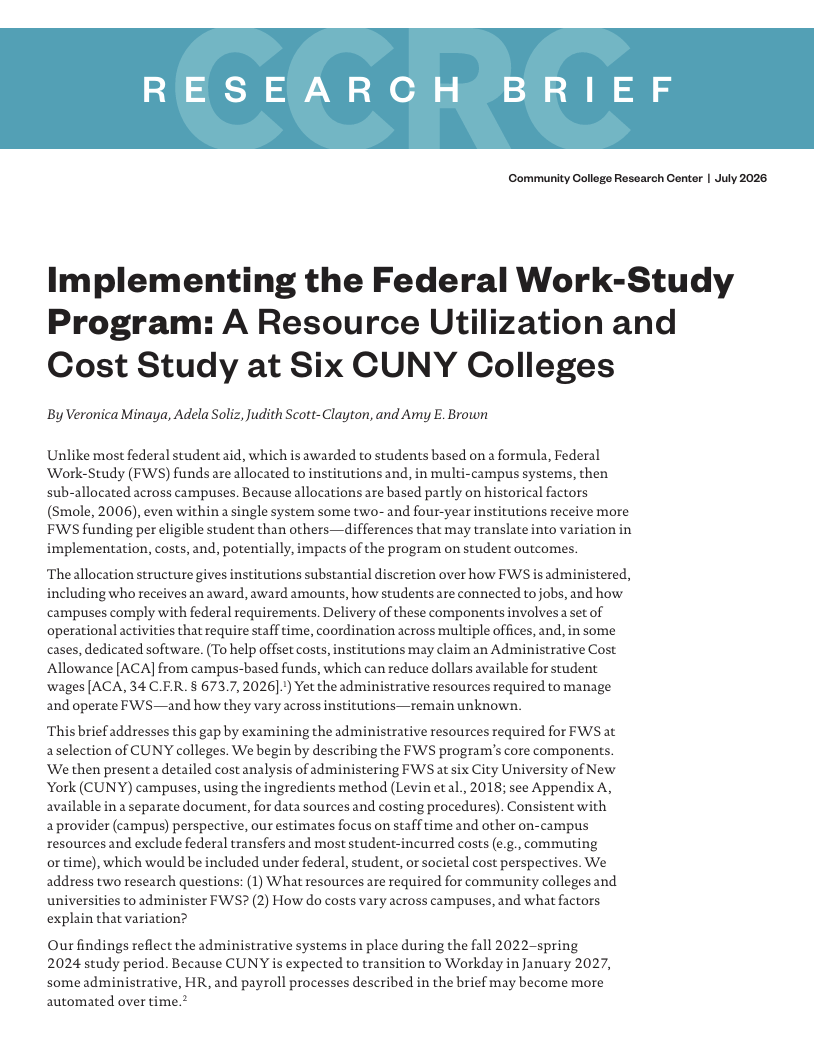
Implementing the Federal Work-Study Program: A Resource Utilization and Cost Study at Six CUNY Colleges

By Veronica Minaya, Adela Soliz, Judith Scott-Clayton & Amy E. Brown

Federal Work-Study (FWS) is not just a form of financial aid—it is also a campus-based employment program. Unlike most federal student aid, which is awarded to students based on a formula, FWS funds are allocated to institutions. The allocation structure gives institutions substantial flexibility regarding who receives an award, award amounts, and how students are connected to jobs. Helping students translate an FWS award into a paid job requires institutions to manage an employment system spanning eligibility verification, job placement, hiring and onboarding, supervision, timekeeping, payroll, and federal compliance. Yet the administrative resources required to manage and operate FWS—and how they vary across institutions—have not previously been documented.

This brief addresses this gap by examining the administrative resources required for FWS at a selection of CUNY colleges. The authors describe the FWS program’s core operational components and, using the ingredients method, present a detailed cost analysis of the staff time, technology, and other campus resources required to administer the program. The authors estimate that the annual administrative cost of FWS was $955 per student worker in 2021-22, a pandemic-era year when participation was substantially below pre-pandemic levels, compared with about $570 when the same estimated total costs are spread across 2017-18 participation levels. Across campuses, annual per-student costs ranged from $529 to $1,703 in 2021-22 and from $156 to $1,152 under the pre-pandemic scale test—variation that reflects campus differences and the sensitivity of per-student costs to program scale due to significant fixed costs.

Personnel accounts for 91% of total costs, driven largely by FWS coordinators, who dedicate much of their time (about 25 hours/week, on average) moving students through the paperwork-to-placement pipeline and whose time allocation also varies with program scale. Technology adoption also serves as a primary source of institutional cost variation, as campuses with lower student enrollment frequently use manual workflows instead of relying on software, effectively shifting their expenses from material costs to staff time for data entry and error checking.

The study provides a useful benchmark for interpreting how program scale, staffing, and technology shape campus costs. Variation in administrative cost is not simply a matter of institutional efficiency. Some of the variation reflects real differences in how campuses staff and operate the program, while some reflects differences in scale and the extent to which fixed costs can be spread across participants. More broadly, the findings suggest that student employment programs require meaningful administrative capacity, but that institutions may be able to operate them more efficiently by coordinating participation targets, staffing, and technology and taking advantage of economies of scale.

  • Does Federal Work-Study Work for Students?

Download Links

Download brief
June 2026

Related Publications

June 2026

Beyond Financial Aid: How CUNY Colleges Connect Students to Federal Work-Study Jobs

February 2026

The Causal Effects of Federal Work-Study Offers on College Enrollment and Program Participation

Additional Resources

For more policy briefs and fact sheets, visit CCRC’s Policy Resources page.

Stay in Touch!

Subscribe to our newsletter for the latest on our research, including publications, blog posts, and upcoming events.
Subscribe

Community College Research Center, Teachers College, Columbia University
Box 174 | 525 West 120th Street, New York, NY 10027

  • 212.678.3091
  • ccrc@columbia.edu
Facebook-f Twitter Linkedin Youtube Instagram

© 2026. All rights reserved.

RESEARCH AREAS

  • Dual Enrollment
  • Developmental Education
  • Guided Pathways
  • Advising & Student Supports
  • Teaching & Learning
  • Transfer
  • Workforce Education
  • Dual Enrollment
  • Developmental Education
  • Guided Pathways
  • Advising & Student Supports
  • Teaching & Learning
  • Transfer
  • Workforce Education
  • CC FAQs
  • About CCRC
  • Biennial Report
  • CCRC Staff
  • Employment
  • CC FAQs
  • About CCRC
  • Biennial Report
  • CCRC Staff
  • Employment
  • Publications
  • Blog
  • Data Tools
  • Policy Fact Sheets & Briefs
  • Events
  • Publications
  • Blog
  • Data Tools
  • Policy Fact Sheets & Briefs
  • Events
Accessibility Adjustments

Powered by OneTap

How long do you want to hide the toolbar?
Hide Toolbar Duration
Select your accessibility profile
Vision Impaired Mode
Enhances website's visuals
Seizure Safe Profile
Clear flashes & reduces color
ADHD Friendly Mode
Focused browsing, distraction-free
Blindness Mode
Reduces distractions, improves focus
Epilepsy Safe Mode
Dims colors and stops blinking
Content Modules
Font Size

Default

Line Height

Default

Color Modules
Orientation Modules
  • About Us
    • About CCRC
    • CCRC Staff
    • Advisory Board
    • Biennial Report
    • Employment
    • Contact
  • Research Areas
    • Dual Enrollment
    • Developmental Education
    • Guided Pathways
    • Advising & Student Supports
    • Teaching & Learning
    • Transfer
    • Workforce Education
  • Publications
  • Blog
  • Community College FAQs
  • News
    • CCRC in the News
    • Opinion
    • Press Releases
  • More
    • Data Tools
    • Events
    • Guided Pathways Workshops
    • Policy Fact Sheets & Briefs
    • Research Projects