Julia RaufmanJessica BrathwaiteHoori Santikian Kalamkarian
This paper examines factors within the community college context that affect the experiences and academic outcomes of the English learner population broadly and students who enroll in ESL courses in particular.
Using interview, focus group, and survey data, this brief explores the experiences of part-time faculty at six Achieving the Dream leader colleges working to engage adjunct faculty in student success initiatives.
Using student transcript records and detailed college instructor employment information from one state, this CAPSEE working paper examines whether adjunct faculty have different impacts on student academic outcomes than tenure-track and tenured faculty.
Using interview, focus group, and case study data, this paper documents the perceptions and experiences of faculty members in the midst of statewide reform efforts in Virginia and North Carolina to integrate developmental reading and writing courses.
This paper introduces an online course quality rubric addressing four quality areas, and it examines the relationship between each quality area and student end-of-semester performance.
This article uses qualitative data from a multi-campus study of instructional reform in developmental education to present a typology of questions raised by community college faculty teaching in reformed contexts.
Susan BickerstaffBarbara LontzMaria S. CormierDi Xu
This chapter describes a promising approach to teaching developmental arithmetic and prealgebra and presents findings on a faculty support network that helped instructors adopt new teaching strategies.
This study examines how well students adapt to the online environment in terms of their ability to persist and earn strong grades in online courses relative to their ability to do so in face-to-face courses.
This issue of Inside Out identifies and explores the implications of three faculty orientations toward reform that consistently manifest when an innovation is introduced: ready to act, ambivalent, and reluctant to change.
Using an instrumental variable technique, the authors estimate the impact of online versus face-to-face course delivery on student course performance, as indicated by course persistence and final course grade.
This journal article reviews the evidence for contextualization, an instructional approach that connects foundational skills and college-level content.
Using data from a qualitative investigation of online courses at two community colleges, this paper examines how expectations about the roles of online student and online instructor differ among these two groups.
Melinda Mechur Karp reviews Higher Education in the Digital Age and argues that the author ignores the potential stratifying effects of online learning in higher education.
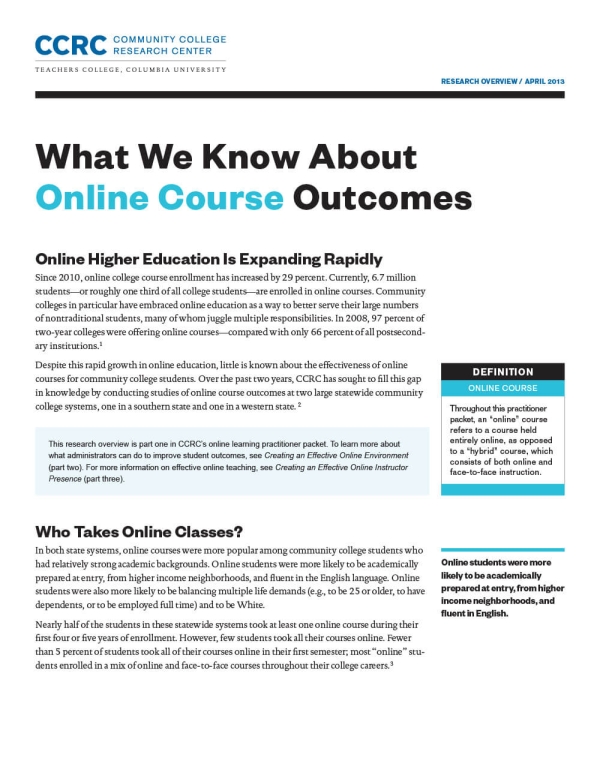
This practitioner packet summarizes CCRC findings on online course outcomes and presents insights and recommendations for administrators and instructors seeking to improve online student performance.
This chapter reviews the literature on online learning in community colleges, focusing online course-taking patterns, performance in online versus face-to-face courses, and factors affecting online course performance.
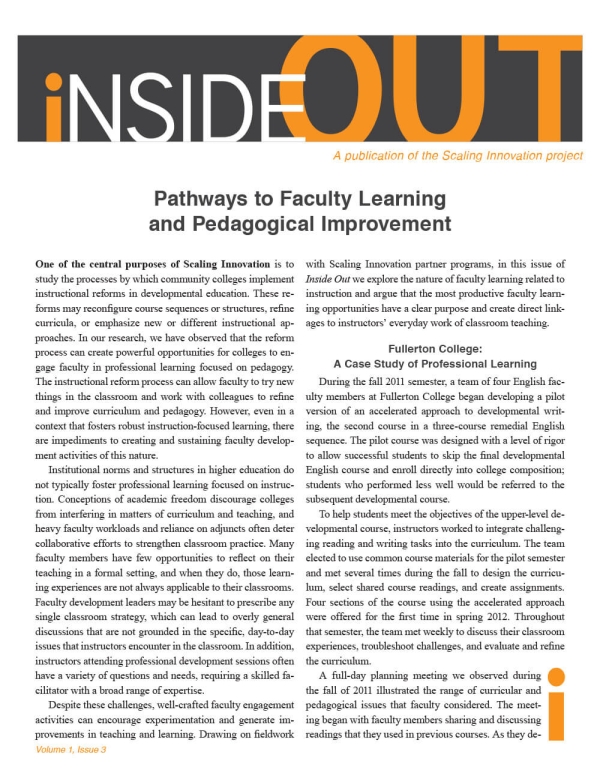
This issue of Inside Out explores how developmental education reforms can create opportunities for faculty to engage in professional learning related to instruction.
Melinda Mechur KarpSusan BickerstaffZawadi Rucks-AhidianaRachel Hare BorkMelissa BarraganNikki Edgecombe
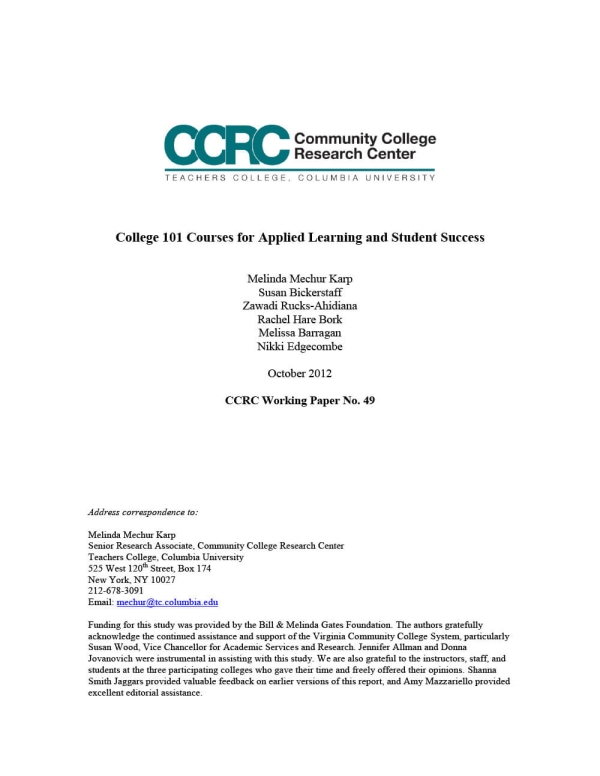
A study of College 101 courses at three community colleges in Virginia suggests that these courses could have long-term impacts if they focused more on the application and practice of learned skills.
This chapter discusses instructional approaches intended to prepare initially low-skilled college entrants for the reading, writing, and mathematics skills they need to learn from the postsecondary curriculum.
Using qualitative data from California's Concurrent Courses Initiative, this article explores how teaching in a dual enrollment program can foster new approaches to classroom pedagogy.