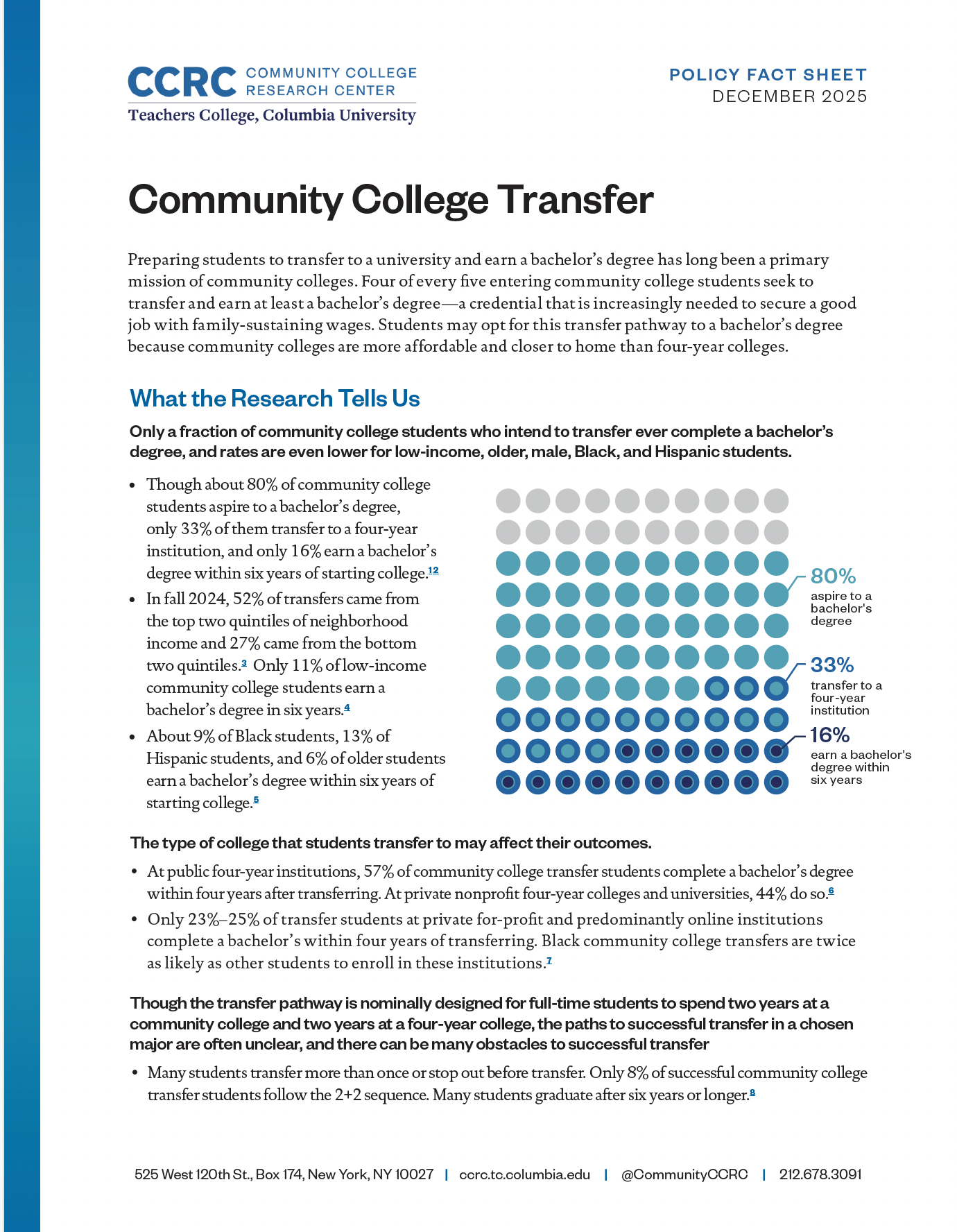
This updated fact sheet outlines challenges in supporting successful student transfer from community colleges to four-year institutions and considerations for improving the transfer process.
The second edition of the Transfer Playbook provides guidance for achieving excellence in transfer and bachelor’s attainment for community college students based on practices observed at exemplary community college and university partnerships.
These two reports use student data disaggregated by race/ethnicity, neighborhood income, and age to measure the performance of two- and four-year institutions in enabling students who start college at a community college to transfer and complete bachelor’s programs. State-by-state breakdowns of transfer metrics designed for use by college and state system leaders are included in the reports and in an online data dashboard.
John FinkAurely Garcia TullochJessica SteigerVikash Reddy
This brief, published by The Campaign for College Opportunity, explores ways transfer reform can close equity gaps in bachelor’s degree attainment by providing vital degree pathways for students from minoritized backgrounds.
This report argues that a more inclusive definition of STEM that accounts for STEM-oriented technical training programs would better represent the contribution community colleges make to STEM education and the STEM workforce.
John FinkTaylor MyersDaniel SparksShanna Smith Jaggars
Drawing on administrative records from transfer-intending community college starters across three states, this paper develops a set of early STEM momentum metrics that are useful indicators of subsequent STEM transfer and bachelor’s degree attainment.
This report describes the rationale, goals, and activities of the Strengthening Michigan Humanities project, and it provides statewide statistics and trends on community college enrollment, transfer, and bachelor’s degree completion in humanities fields.
Using nine years of data from one state, this paper tracks completion and transfer outcomes to examine when gaps between Black, Hispanic, and White community college students occur, and it estimates the benefits of reaching early academic milestones for such students.
This journal article examines how students at six community colleges identified and weighed possible transfer destination colleges, and how dedicated and personalized advisement shaped students’ transfer plans and contributed to their transfer outcomes.
John FinkTaylor MyersDaniel SparksShanna Smith Jaggars
Drawing on findings from a study of postsecondary college transcript and degree records, this brief describes metrics that may be useful in assessing efforts to improve STEM transfer outcomes.
This fact sheet outlines challenges in supporting successful student transfer from community colleges to four-year institutions and considerations for improving the transfer process.
This report builds off previous research on American Honors to look at the unintended consequences of college promise programs for the economic mobility of high-achieving, low-income students.
In this Innovative Higher Education article, the authors examine the development and dissolution of a partnership between a privately held firm and six community colleges, which had established honors programs with the goal of facilitating students' transfer to selective institutions.
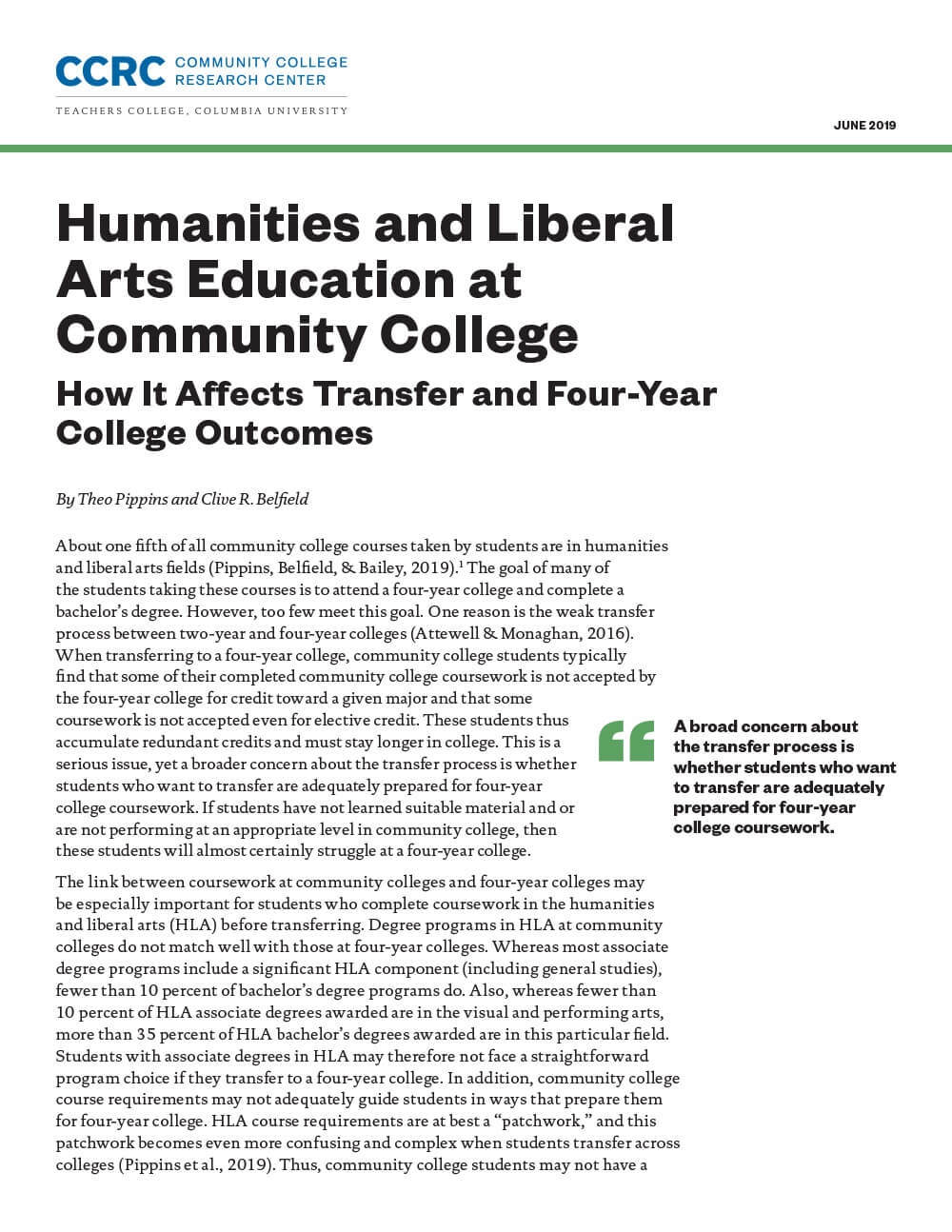
Using transcript-level data from two community college state systems and a nationally representative survey, this short report examines how course-taking in humanities and liberal arts at community colleges affects transfer and outcomes at four-year colleges.
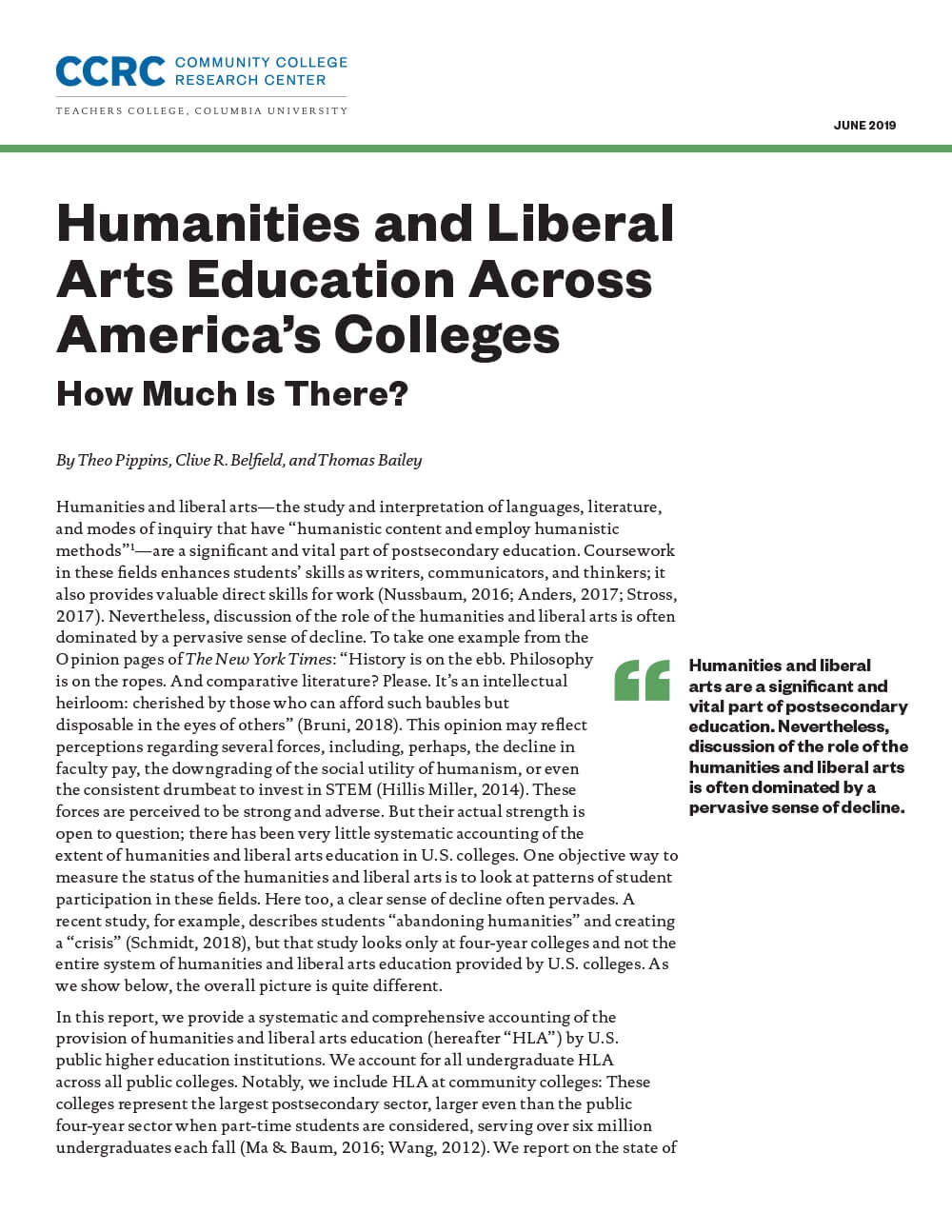
This short report provides a systematic accounting of the provision of humanities and liberal arts education at public colleges in the United States, including community colleges.
In 2012, Quad Learning partnered with two community colleges to pilot American Honors, a program designed to help academically talented community college students overcome the challenges of transferring to more selective four-year destinations. This paper traces the components of the program's socially conscious theory of change, its for-profit business model, and the tensions between the two.
Di XuFlorence Xiaotao RanJohn FinkDavis JenkinsAfet Dundar
Using National Student Clearinghouse data, this paper introduces a two-stage, input-adjusted, value-added analytic framework for identifying partnerships of two- and four-year institutions that are particularly effective in enabling students to transfer and earn bachelor’s degrees.
This paper assesses the degree to which community college websites present challenges for students looking for information on how to transfer to a four-year institution.
Di XuShanna Smith JaggarsJeffrey FletcherJohn Fink
Using detailed administrative data from Virginia, this journal article examines whether community college “vertical transfer” students who resemble “native four-year” students in their accumulated college-level credits and performance at their point of entry into the four-year sector perform equally well in terms of both academic and labor market outcomes.
John FinkDavis JenkinsElizabeth M. KopkoFlorence Xiaotao Ran
This CCRC working paper uses data-mining techniques to analyze student transcripts from two states and identify variables associated with excess credits among bachelor’s degree completers who started at a community college.