Drawing on survey and interview data, this article describes what students want from their dual enrollment experiences and implications for college and K-12 leaders working to strengthen their dual enrollment programming.
John FinkDavis JenkinsSarah GriffinAurely Garcia Tulloch
This report describes strategies for providing purposeful dual enrollment, which better guides underserved students into degree- and career-connected education after high school, without shifting the cost burden onto students and families.
Using data from Texas, this report examines how students combine different types of accelerated coursetaking in high school and how these combinations are associated with students’ subsequent postsecondary attainment and earnings trajectories.
Using a regression discontinuity approach and data from two cohorts of students in one state, this paper examines the effect of taking dual enrollment credits on the number of in-state public colleges students apply and are admitted to and the selectivity of those colleges.
Using interview data from program leaders and statewide student data, this paper examines the implementation and estimates the effects of Ohio’s Innovative Programs, a policy aimed at expanding access to dual enrollment for underserved high school students.
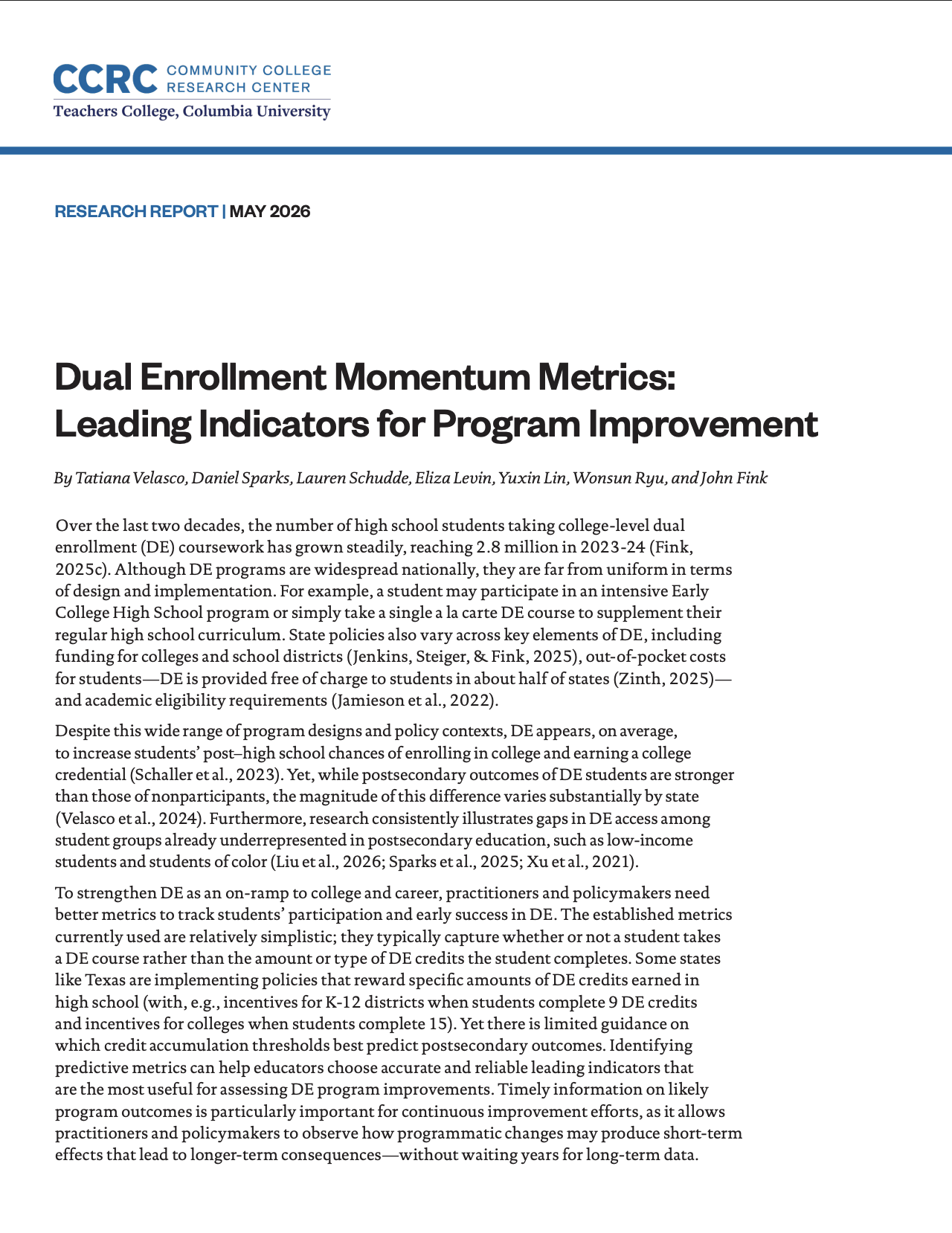
This working paper describes dual enrollment (DE) high school–college partnerships and estimates which DE structures and contexts predict aggregate DE course completion, college enrollment, and degree attainment.
Using NSC data, this report presents national and state-by-state findings on the postsecondary enrollment and completion outcomes of high school students who began taking dual enrollment college courses in fall 2015, tracked for four years after high school.
Based on focus group interviews with predominantly Black, Hispanic, and low-income students, this brief examines the experiences of students historically underserved in dual enrollment to understand what these students want from their programs and the educators who lead them.
Sarah GriffinJessica SteigerAurely Garcia TullochJohn FinkDavis Jenkins
This article introduces “dual enrollment equity pathways” (DEEP)—a research-based framework for rethinking à la carte dual enrollment as a more equitable on-ramp to college programs of study that lead to high-opportunity career paths for students historically underserved in dual enrollment.
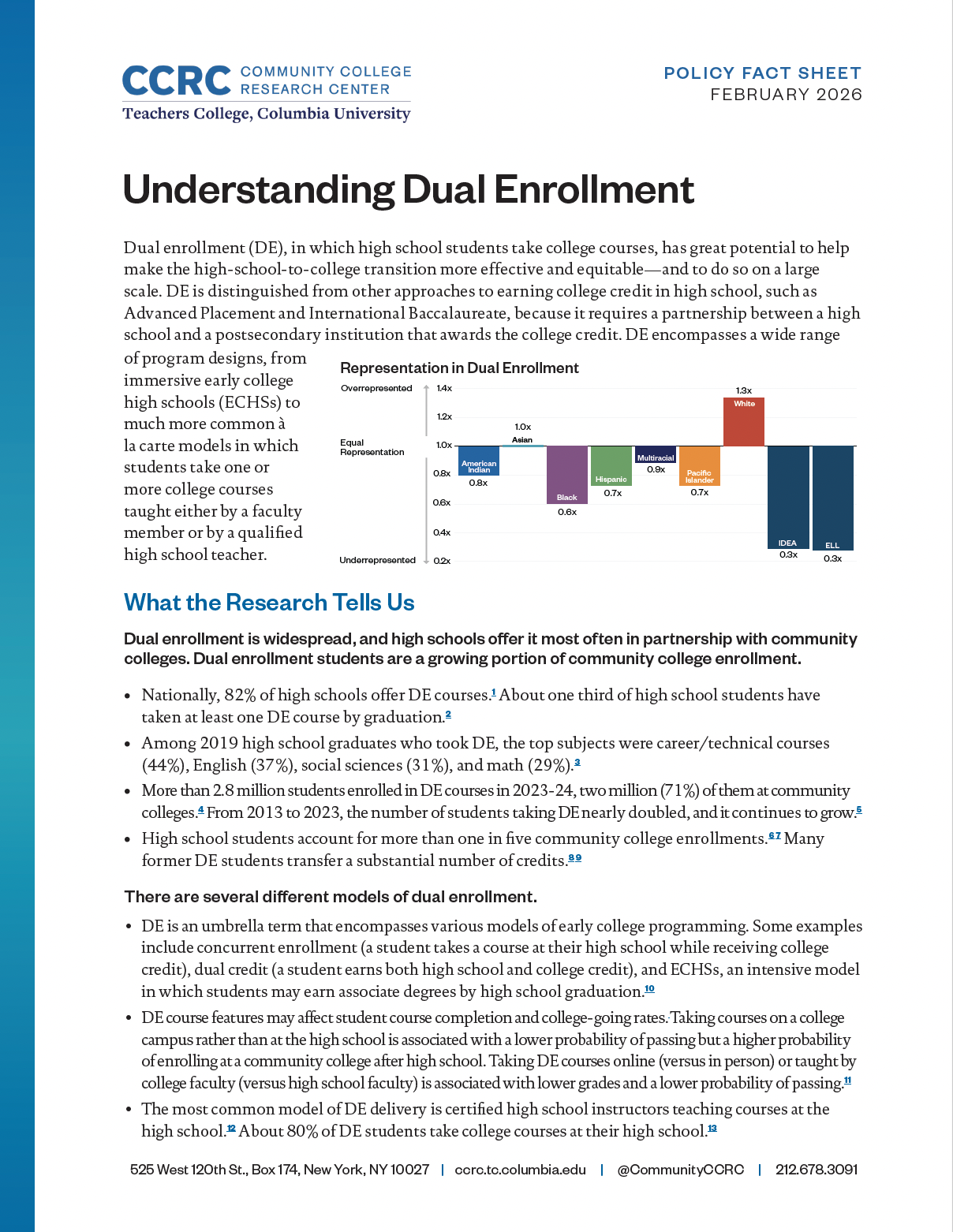
This fact sheet describes the growth of dual enrollment, the various models and funding mechanisms, and steps colleges and high schools can take to make dual enrollment more equitable.
Informed by findings from The Dual Enrollment Playbook and site visits to Title I high schools and their community college partners in Texas and Florida, this report offers guidance for state leaders on how to support practitioner efforts to broaden the benefits of dual enrollment.
The brief, published by The Campaign for College Opportunity, summarizes the research on dual enrollment programs and offers policymakers a strategy to increase college enrollment and attainment via such efforts.
This report presents the dual enrollment equity pathways (DEEP) framework, which aims to expand access to dual enrollment and redesign practices so that underserved students can use it to pursue a high-value postsecondary degree program directly after high school.
John FinkSarah GriffinAurely Garcia TullochDavis JenkinsMaggie P. FayCat RamirezLauren SchuddeJessica Steiger
This report describes dual enrollment equity pathways (DEEP) reforms implemented by six community college–K-12 partnerships in Florida and Texas, and it provides insights and guidance for other colleges and schools interested in undertaking DEEP reforms.
Using data from Texas, this paper describes dual enrollment course characteristics such as instructor affiliation, location, and modality and examines how these characteristics predict students’ course completion, course grades, and subsequent college enrollment.
This brief examines research on five programs—AP, IB, dual enrollment, ECHSs and P-TECHs, and high school CTE with articulated credit—and assesses their potential as large-scale on-ramps to high-quality postsecondary programs for underrepresented students.
Using three case studies, this paper examines the conditions under which dual enrollment programming could be made sustainable through efficiency gains, even for colleges that charge discounted tuition (or none at all)
Elisabeth A. BarnettMaggie P. FayCynthia ListonRyan Reyna
Based on interviews with educators who are rethinking and revising secondary math coursework, this report describes the role of higher education in influencing high school math reform nationally and in three particular states.
Using administrative data from a large state community college system, this paper examines whether being exposed to a higher percentage of dual enrollment peers influences non-dual enrollment enrollees’ performance in college courses.
This paper estimates the patterns and sources of White–Black and White–Hispanic enrollment gaps in Advancement Placement (AP) and dual enrollment programs across several thousand school districts and metropolitan areas in the United States.