



By Tatiana Velasco and John Fink
To strengthen high school dual enrollment as an on-ramp to college and career opportunity, practitioners and policymakers need better metrics to track students’ early success in dual enrollment and predict longer-term outcomes. Research on traditional community college students indicates that early momentum metrics capturing first-year college credit accumulation (such as earning 15 or 30 credits in the first year) and first-year college math and English completion reliably predict subsequent student credential completion and thus function as leading indicators of the effectiveness of institutional reforms. But these types of leading indicator metrics have yet to be adapted and validated in the dual enrollment context, despite high school students making up a fifth of overall community college enrollments and several states incentivizing specific credit thresholds for dual enrollment students.
In a new report, Dual Enrollment Momentum Metrics: Leading Indicators for Program Improvement, we and our coauthors introduce a set of 11 dual enrollment momentum metrics that capture participation and academic progress of high school dual enrollment students, and we assess how reliably these metrics predict postsecondary success. Leveraging longitudinal data on students from four states who expected to graduate high school between 2015-16 and 2022-23, we identify and test three types of metrics: credit momentum (i.e., threshold numbers of dual enrollment credits completed), gateway course completion in math and/or English, and college credential completion while in high school. The graphs below show the percentage of dual enrollment students in each state who achieved each of the momentum metrics.
We focus on how each of these relates to three key postsecondary outcomes: college enrollment after high school, college completion by roughly age 24, and time to degree completion (in years) among bachelor’s completers. To make the results easier to compare across states, we present the findings as percentage differences relative to each state’s average outcome among dual enrollment students (shown in the table below from the report) rather than as point estimates from the regressions. This approach accounts for the fact that variation in state policies and contexts affects dual enrollment students’ outcomes.
To illustrate the interpretation of each metric’s predictive power, consider State B’s college enrollment rate and the momentum metric of completing at least 6 dual enrollment credits. The average enrollment rate among State B’s dual enrollment students is 56% (shown in the top row of the table). Our analysis finds that students who complete at least 6 dual enrollment credits are 6.3 percentage points more likely to enroll in college, compared to students who do not complete 6 credits. This gain represents an 11% increase relative to the average (6.3 ÷ 56 = 0.11). Thus, completion of at least 6 dual enrollment credits predicts enrollment gains equivalent to 11% of the average enrollment rate for dual enrollment students in State B.
Predicted Percent Change in Postsecondary Outcomes by Momentum Metric
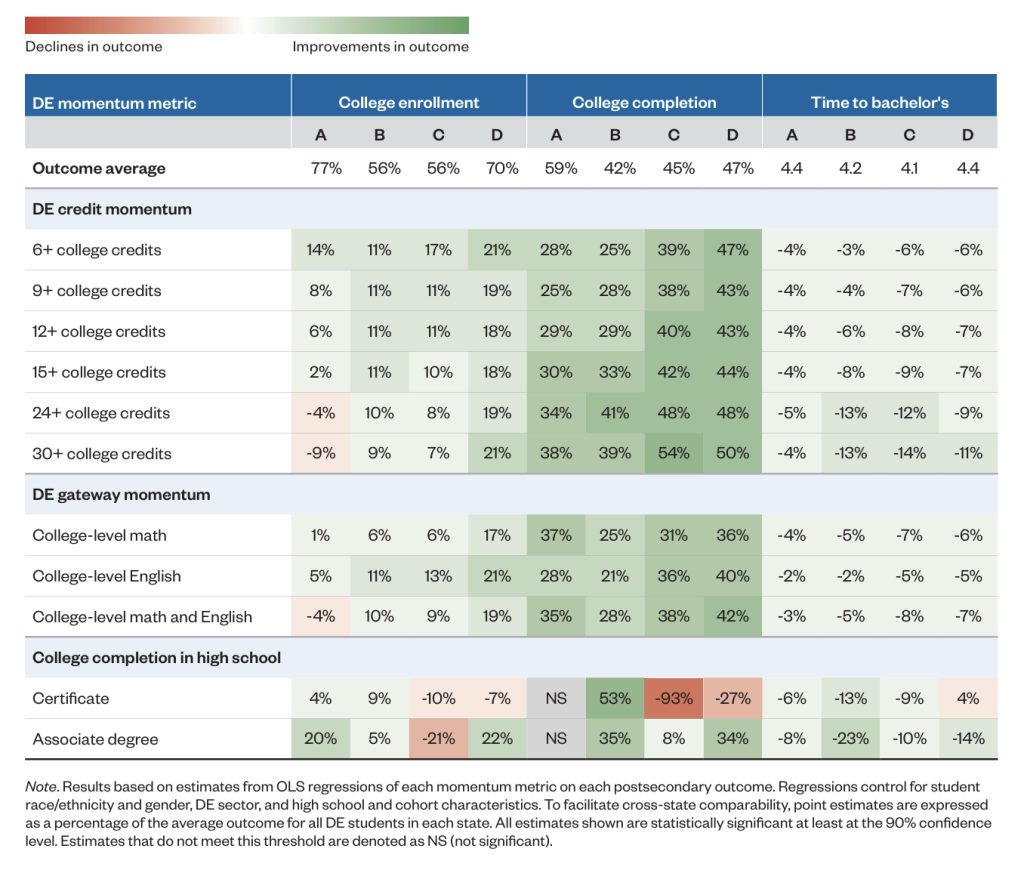
Dual Enrollment Momentum Metrics Predict College Outcomes
We find that the dual enrollment momentum metrics reliably predict college outcomes after high school across the four states. However, the magnitude of the predicted gains varies across metrics, outcomes, and subgroups.
- Credit momentum. Higher dual enrollment credit thresholds (e.g., 15+, 24+, and 30+ credits) predict higher credential completion and a larger reduction in time to bachelor’s degree completion. However, for college enrollment, lower credit thresholds (e.g., 6+ credits) are stronger predictors in three of the four states.
- Gateway course momentum. Dual enrollment gateway course completion metrics predict college success, but college-level English is a stronger predictor of college enrollment, whereas college-level math, or math and English combined, are stronger predictors of college completion and reduced time to a bachelor’s degree.
- Credential completion in high school. The relationship between credential completion in high school and postsecondary outcomes is mixed across states. Certificate completion in high school shows a negative or insignificant relationship with post–high school college completion in three states and a mixed relationship with college enrollment and time to bachelor’s completion (since most certificates are in career-technical fields, earning one in high school may signal a desire to enter the workforce directly rather than pursue a college degree immediately after high school). Associate degree completion in high school tends to be a more consistent predictor of increases in college enrollment, completion, and reduced time to bachelor’s completion.
Across the four states, the dual enrollment momentum metrics predict larger college enrollment gains for men than for women, though the differences by gender narrow for college completion and time to bachelor’s completion. Differences between overall results and those for Black and Hispanic students are less consistent or statistically insignificant; however, results from one state indicate that credit momentum and gateway course completion predict larger college enrollment gains for Hispanic students. And in three states, credit and gateway momentum metrics predict larger gains in enrollment and time to bachelor’s completion among Title I high school students.
Using Dual Enrollment Metrics to Set Goals and Monitor Improvements
Findings from this study provide evidence that the dual enrollment momentum metrics we examined are reliable leading indicators of subsequent postsecondary success. Colleges and their K-12 partners as well as state and system leaders can replicate the momentum metrics defined in the report using their student data. We recommend selecting a subset of the 11 metrics and tracking these metrics for cohorts of high school graduates, disaggregated by student demographics and specific K-12 partnerships.
The specific metrics selected for regular tracking to support program improvement efforts should align with how practitioners and policymakers envision the purpose and goals of their dual enrollment programming.
- College access goals. Lower credit thresholds and college-level English metrics are strong predictors of postsecondary enrollment, making these suitable metrics when the purpose is to assess which students are on track and which are falling behind in terms of accessing college.
- College completion and affordability goals. Higher credit thresholds and college-level math metrics are strong predictors of college completion and reduced time to bachelor’s degree, making these suitable metrics when the purpose is to assess students’ chances of completing a credential and to improve affordability by reducing time to completion.
- Broad goals. When dual enrollment programming has a broad set of goals, a balanced set of metrics—such as 6+ credits earned, 15+ credits earned, gateway English completion, and gateway math completion—can be ideal. Specific metrics may be selected to track major dual enrollment practices implemented in the state or key policy goals, such as having students accumulate a minimum of dual enrollment credits or having students complete a credential while in high school.
Regardless of which metrics practitioners and policymakers use, findings from this analysis show that dual enrollment momentum metrics are reliable predictors of students’ postsecondary outcomes. Educators working to strengthen the impact of dual enrollment programs for their students should consider analyzing similar metrics locally and using them as leading indicators to help assess the effectiveness of program improvement efforts.