



Onondaga Community College in Central New York had a long history of prerequisite, developmental English. By 2017, however, the college moved to a corequisite model. In a coreq dev ed system, every student takes credit-bearing first-year composition (FYC), but, depending on placement metrics, some students simultaneously enroll in a noncredit support course. Coreq dev ed was significantly better than prerequisite in terms of dev ed students enrolling in and completing FYC with a C or better. Graduation rates for dev ed students, however, were only marginally higher than those of students who went through prereq. The noncredit support course, with its potential impact on student confidence (“Do I really belong here?”), combined with very real costs in time and money, seemed to be functioning as a barrier in and of itself.
There had to be a better approach, and a small group of OCC English faculty began exploring what it could be. Eliminating coreq would remove one barrier, but what about supporting the students who really needed it? Our solution was to redesign FYC to have the best chance of supporting all students, those who would have placed in coreq and those who would not.
After several intense department meetings, we had a rough consensus on how to move forward. The new course would draw heavily from coreq pedagogy, with its explicit emphasis on holistic student success, as well as an explicit integration of reading and writing (IRW). The newly redesigned FYC course was introduced at 100% scale in fall 2020, eliminating noncredit classes and the placement process for English and reading while continuing to support those students who needed it most.
Read part 1 on Onondaga Community College’s developmental education transformation to learn more about how the college changed course structures.
Revamping the Curriculum of First-Year Composition
As we met, our conversations kept coming back to reading. OCC’s FYC required students to write in response to complex readings, and campus-wide discussions consistently pointed to reading skills as an area of concern in almost all academic areas. Composition scholars like Alice Horning, Elizabeth Kramer, and Ellen Carillo have documented the connections between reading and writing. Foregrounding reading instruction seemed like the best place to start making our FYC accessible and impactful for all students. We were making an implicit part of the class explicit. Our approach to course design was heavily influenced by work done at Chabot College, the California Acceleration Project’s work on IRW, and work done by CCRC.
Launching IRW at OCC
We planned this change prior to 2020, but the implementation occurred during COVID. The goal was to give everyone who was going to teach this new version of FYC a crash course in the theory and practice of IRW. We created modular, asynchronous trainings on the history and theory of composition, what IRW looks like in a composition class, and student-centered pedagogy. Luckily, we were able to attach paid professional development activities to an existing grant. Though voluntary, the vast majority of adjuncts and full-timers completed the training, and most agreed to teach from a common syllabus for at least one semester. Undoubtedly, compensation was an incentive to participate, but most faculty were excited to try something new.
At OCC, we believe students learn to write essays by writing essays, not isolated sentences or paragraphs, and they learn to read complex texts by reading complex texts. Our approach to designing the common syllabus was to use a textbook that explicitly focused on IRW, creating four units, each culminating in an essay that grew in length and complexity. Each essay topic was intended to be applicable to all students, regardless of background.
The first unit of the course ended with a personal essay on literacy and the individual students’ experiences with reading. The goal was to get them thinking and writing about their current relationship with reading, how it evolved, and whether it was positive, negative, or neutral.
The second unit, focused on happiness, included themed readings with different, complementary, and sometimes opposite points of view on a given topic. It was here that the formal reading instruction became explicit, introducing pre-reading, reading, and post-reading strategies tied to low stakes assignments. Students wrote an essay in which they connected their personal views of happiness to what they read in the unit.
The third unit mirrored the second in its structure and goals but was centered on the connection between college and career. There was also a required element of independent research and evaluation of sources. Students could use “I” in the final essay, but we built in conversations about its pros and cons, building rhetorical awareness. The fourth unit focused on the connections between the individual and larger society, but students were encouraged to avoid “I” in their writing unless they had sound rhetorical reasoning for it.
We wanted both faculty and students to see reading/thinking/writing not as discrete activities happening in sequence but as recursive activities happening simultaneously. Not
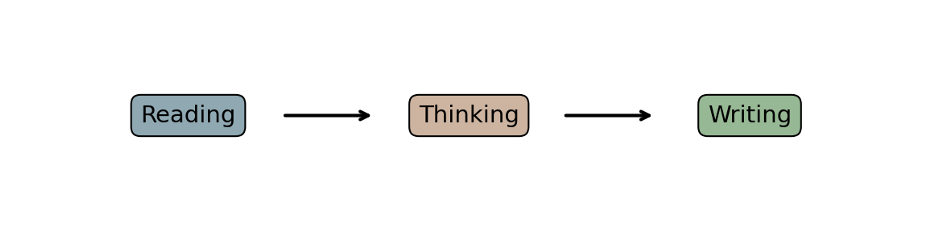
But more like
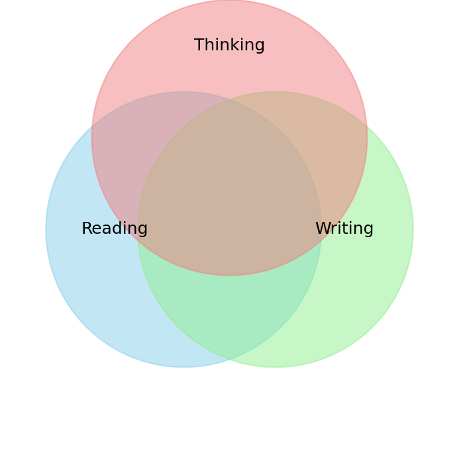
There are real benefits in faculty teaching the same or similar versions of a course. It enables conversations about pedagogy and course design that are particularly difficult otherwise. Hallway conversations about what was going on in our classes took on new meaning. Additionally, the overwhelming majority of us—adjuncts, full-timers, teachers new to OCC and those who had been here for years—were doing something new; it felt like we were in it together.
We believe that the redesign of FYC contributed to substantial improvements in course outcomes for the most vulnerable students while maintaining or even slightly increasing success rates for those students who were considered “prepared” for college-level writing under the old placement system.
The Ideal Versus the Real: Five Years On
Over time, almost imperceptibly, there was a shift in our department. The grant ran out. The shared syllabus went from a strong suggestion to a suggestion, to an option. People moved on and new teachers took their place. Some returned to old content they loved. Hallway conversations about IRW were not as noticeable. A year into our curricular shift, I would have been confident saying almost everyone teaching FYC was using an IRW pedagogy, regardless of texts or assignments. Now, I don’t think we can say that.
Student success in FYC and beyond, as reported in our last blog post, however, continues to either stay steady or grow for many diverse populations.
It is possible the sustained work with IRW pedagogy had a lasting effect on all those who participated, but, given the amount of adjunct faculty turnover alone, it is unlikely this is the only reason for our success. What I can say with confidence, though, is we changed the department culture. There was no more talk about “those” students. Eventually, they all just became “students.” By getting rid of placement, by eliminating the distinction between who was and was not deserving of taking credit-bearing FYC, we changed the conversation, and that change has had a positive impact on students that will be felt for a long time to come.