Skip to content
  • About Us
    • About CCRC
    • CCRC Staff
    • Advisory Board
    • Biennial Report
    • Employment
    • Contact
    • About CCRC
    • CCRC Staff
    • Advisory Board
    • Biennial Report
    • Employment
    • Contact
  • News
    • CCRC in the News
    • Opinion
    • Press Releases
    • CCRC in the News
    • Opinion
    • Press Releases
  • Community College FAQs
  • Research Areas
    • Dual Enrollment
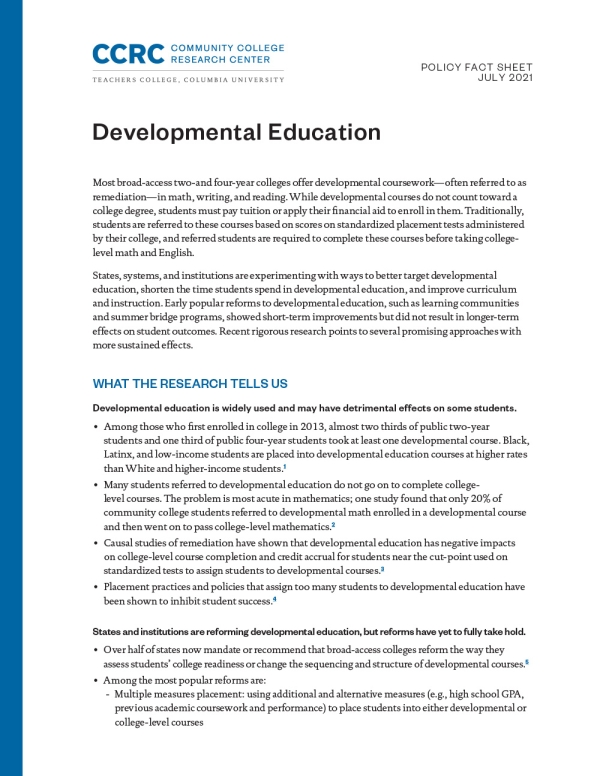
    • Developmental Education
    • Guided Pathways
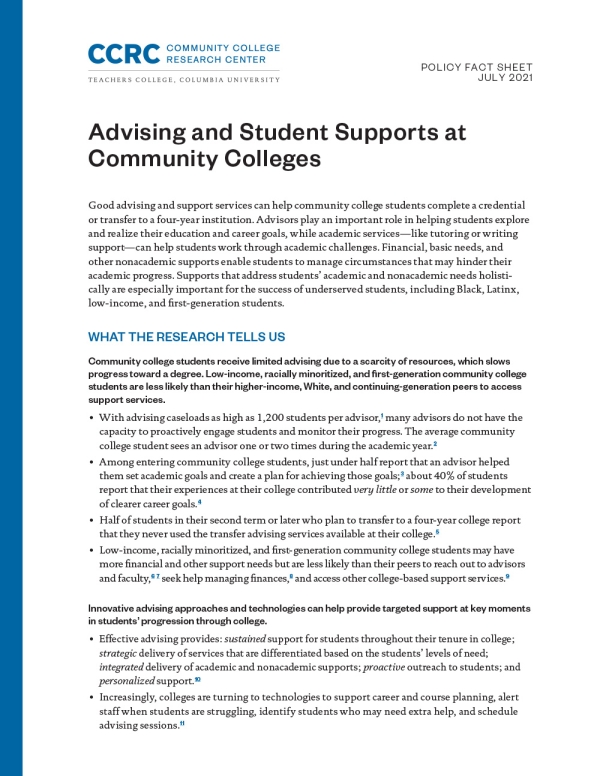
    • Advising & Student Supports
    • Teaching & Learning
    • Transfer
    • Workforce Education
    • Dual Enrollment
    • Developmental Education
    • Guided Pathways
    • Advising & Student Supports
    • Teaching & Learning
    • Transfer
    • Workforce Education
  • Publications
  • Blog
  • Resources
    • Policy Resources
    • Guided Pathways Workshops
    • Policy Resources
    • Guided Pathways Workshops
  • More
    • Events
    • Research Projects
    • Events
    • Research Projects
  • Overview
  • Important Dates
  • FAQs
  • Overview
  • Important Dates
  • FAQs
  • Overview
  • Important Dates
  • FAQs
Filter

Category

  • All publications
  • High school to college
  • Dual enrollment
  • Developmental education
  • Assessment and placement
  • Guided pathways
  • Transfer
  • Advising and student supports
  • Financial aid
  • Teaching and learning
  • Workforce education
  • Returns to degrees
  • Community college policy and finance
  • Peformance funding
  • For-profit colleges

Filter by

Clear all

Author

Publication type

State

Year

Publications

141–160 of 701 results
  • Results per page
  • 10
  • 20
  • 50
  • All
High School Dual Enrollment in Florida: Effects on College Outcomes by Race/Ethnicity and Course Modality
October 2020

High School Dual Enrollment in Florida: Effects on College Outcomes by Race/Ethnicity and Course Modality

Vivian Yuen Ting LiuVeronica MinayaQing ZhangDi Xu
Using data on two cohorts of Florida students who started public high school in 2007 and 2012, this report analyzes dual enrollment course-taking and outcomes by racial/ethnic group (Black, Hispanic, White) and course modality (face-to-face on-college-campus, face-to-face off-campus, and online).
The Dual Enrollment Playbook: A Guide to Equitable Acceleration for Students
September 2020

The Dual Enrollment Playbook: A Guide to Equitable Acceleration for Students

Gelsey MehlJoshua WynerElisabeth A. BarnettJohn FinkDavis Jenkins
Based on research conducted in three states, this report identifies five principles that undergird the strategies and practices of equitable dual enrollment partnerships between high schools and colleges.
Major Decision: The Impact of Major Switching on Academic Outcomes in Community Colleges
September 2020

Major Decision: The Impact of Major Switching on Academic Outcomes in Community Colleges

Vivian Yuen Ting LiuSoumya MishraElizabeth M. Kopko
Using state administrative data and propensity score matching, this study examines the characteristics and academic outcomes of community college students who switch majors.
Do Differential Grading Standards Across Fields Matter for Major Choice? Evidence From a Policy Change in Florida
August 2020

Do Differential Grading Standards Across Fields Matter for Major Choice? Evidence From a Policy Change in Florida

Veronica Minaya
Using administrative data from Florida, this article examines the effect of changing the grading scale from whole-letter grades to plus/minus grades on STEM major choice.
Labor Market Trajectories for Community College Graduates: New Evidence Spanning the Great Recession
August 2020

Labor Market Trajectories for Community College Graduates: New Evidence Spanning the Great Recession

Veronica MinayaJudith Scott-Clayton
This paper examines returns to terminal associate degrees and certificates up to 11 years after students initially entered a community college in Ohio. The authors use an individual fixed-effects approach that controls for students’ pre-enrollment earnings and allows the returns to credential completion to vary over time.
How Did Six Community Colleges Design Supports for Part-Time Faculty? A Report on Achieving the Dream’s Engaging Adjuncts Project
July 2020

How Did Six Community Colleges Design Supports for Part-Time Faculty? A Report on Achieving the Dream’s Engaging Adjuncts Project

Susan BickerstaffFlorence Xiaotao Ran
This report describes findings from a study of a two-year initiative led by Achieving the Dream to develop and implement strategies to support adjunct faculty in improving student outcomes.
Unpacking Program Enrollments and Completions With Equity in Mind
June 2020

Unpacking Program Enrollments and Completions With Equity in Mind

John FinkDavis Jenkins
This guide presents a set of example data analyses colleges can replicate to examine whether underserved groups of students are equitably represented in programs that lead to higher opportunity outcomes for employment and/or baccalaureate transfer.
What Really Works in Student Success?
June 2020

What Really Works in Student Success?

Elisabeth A. BarnettElizabeth M. Kopko
Based on a forthcoming book chapter, this paper discusses how the development of an overall framing vision for student success, the implementation of evidence-based practices, and the establishment of a culture that is conducive to innovation can help colleges improve student outcomes.
How Relationships Support and Inform the Transition to Community College
June 2020

How Relationships Support and Inform the Transition to Community College

Zawadi Rucks-AhidianaRachel Hare Bork
Drawing on interviews with 96 first-year community college students, this journal article compares the roles of students' on- and off-campus relationships in providing information and support.
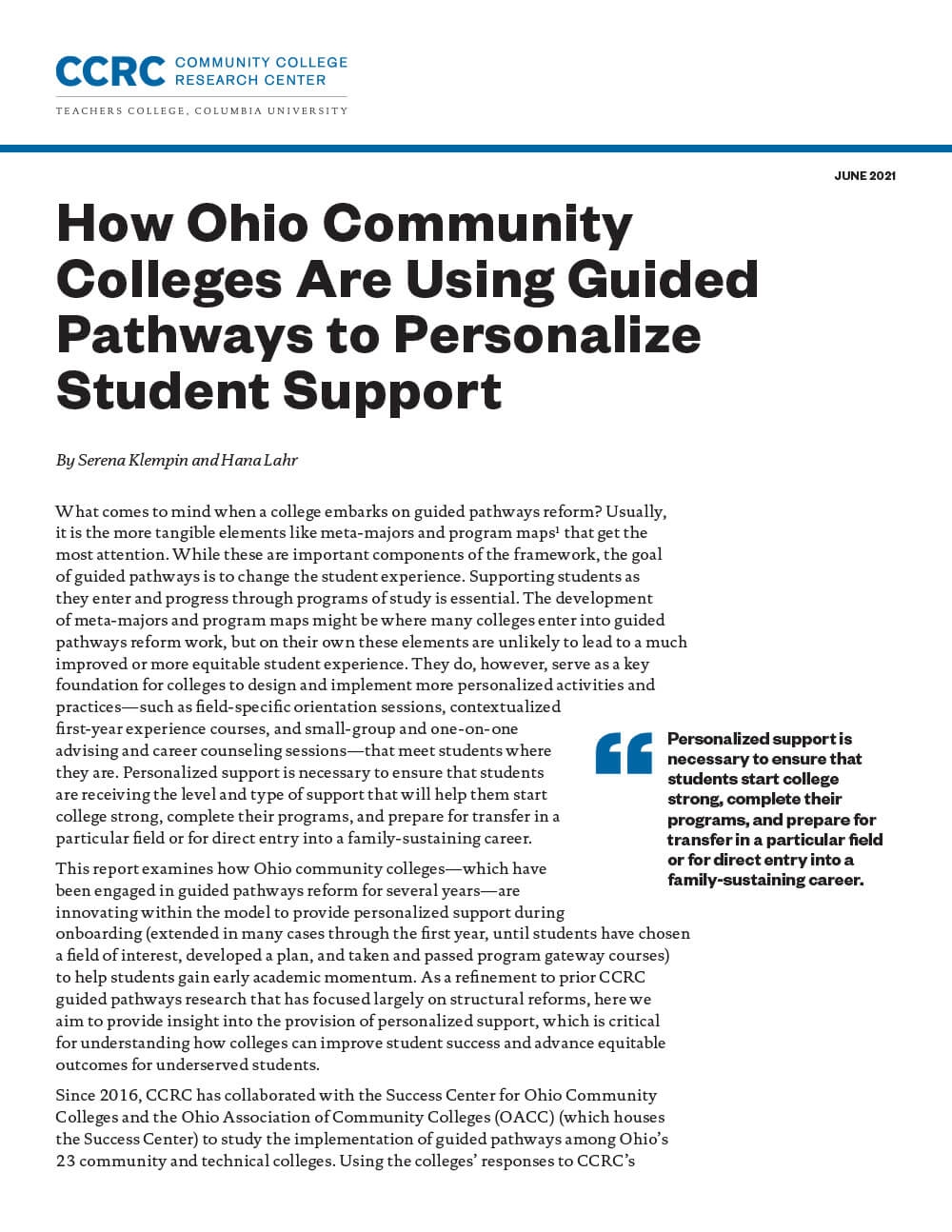
Redesigning Community College Student Onboarding Through Guided Pathways
May 2020

Redesigning Community College Student Onboarding Through Guided Pathways

Davis JenkinsHana LahrLauren PellegrinoElizabeth M. KopkoSarah Griffin
This practitioner packet provides guidance to colleges seeking to redesign their new student onboarding practices to better help students explore, choose, and plan a program of study best suited to their interests and aspirations.
How Can We Improve Teaching in Higher Education? Learning From CUNY Start
May 2020

How Can We Improve Teaching in Higher Education? Learning From CUNY Start

Maria S. CormierSusan Bickerstaff
This paper describes the professional development model used in CUNY Start, a program developed at the City University of New York to support entering students identified as academically underprepared in literacy and mathematics.
Exploring the State of the Humanities in Community Colleges
May 2020

Exploring the State of the Humanities in Community Colleges

Susan BickerstaffThomas BrockAdnan MoussaFlorence Xiaotao Ran
This paper discusses what is known about humanities coursework in community colleges, outlines key challenges facing humanities education in this sector, and considers approaches to addressing these challenges
A Broken “Promise”? How College Promise Programs Can Impact High-Achieving, Middle-Income Students
April 2020

A Broken “Promise”? How College Promise Programs Can Impact High-Achieving, Middle-Income Students

Shanna Smith Jaggars
This report builds off previous research on American Honors to look at the unintended consequences of college promise programs for the economic mobility of high-achieving, low-income students.
Should Colleges Invest in Machine Learning? Comparing the Predictive Powers of Early Momentum Metrics and Machine Learning for Community College Credential Completion
April 2020

Should Colleges Invest in Machine Learning? Comparing the Predictive Powers of Early Momentum Metrics and Machine Learning for Community College Credential Completion

Takeshi Yanagiura
This study compares the out-of-sample predictive power of early momentum metrics—13 near-term success measures suggested by the literature—with that of metrics from machine-learning-based models that employ approximately 500 predictors for community college credential completion.
Comparing and Learning From English and American Higher Education Access and Completion Policies
March 2020

Comparing and Learning From English and American Higher Education Access and Completion Policies

Kevin DoughertyClaire Callender
This journal article explores similarities and dissimilarities of higher education policies in England and the United States with an eye to what each country can learn from the other regarding the reduction of social class and racial/ethnic differences in higher education access and success.
A Top-Down/Bottom-Up Approach to Statewide Change: Mathematics Pathways to Completion
February 2020

A Top-Down/Bottom-Up Approach to Statewide Change: Mathematics Pathways to Completion

Susan BickerstaffAdnan Moussa
This report examines the efforts of six state higher education systems to improve student outcomes and close opportunity gaps in mathematics as part of a three-year project led by the Charles A. Dana Center at The University of Texas at Austin.
Public-Private Partnership: How and Why Six Community Colleges Loved and Left a For-Profit Partner
February 2020

Public-Private Partnership: How and Why Six Community Colleges Loved and Left a For-Profit Partner

Negar FarakishShanna Smith JaggarsMaggie P. Fay
In this Innovative Higher Education article, the authors examine the development and dissolution of a partnership between a privately held firm and six community colleges, which had established honors programs with the goal of facilitating students' transfer to selective institutions.
Early Academic Outcomes for Students of Part-Time Faculty at Community Colleges: How and Why Does Instructors’ Employment Status Influence Student Success?
January 2020

Early Academic Outcomes for Students of Part-Time Faculty at Community Colleges: How and Why Does Instructors’ Employment Status Influence Student Success?

Florence Xiaotao RanJasmine Sanders
Drawing on data from six community colleges, this paper estimates the effects of part-time faculty versus full-time faculty on students’ current and subsequent course outcomes in developmental and gateway courses and explores potential explanations for these effects.
A Complex Ecosystem: A Qualitative Investigation Into Dynamics Affecting the Implementation of College Advising Redesigns
January 2020

A Complex Ecosystem: A Qualitative Investigation Into Dynamics Affecting the Implementation of College Advising Redesigns

Serena C. KlempinLauren Pellegrino
This paper explores the dynamics in and around an institution that influence how advisors and students experience technology-mediated advising reforms, along with the opportunities and challenges these dynamics create for colleges.
A Framework for Advising Reform
January 2020

A Framework for Advising Reform

Serena C. KlempinHoori Santikian KalamkarianLauren PellegrinoElisabeth A. Barnett
This book chapter describes key principles of CCRC's evidence-based framework for advising redesign, which emphasizes a sustained, strategic, integrated, proactive, and personalized (SSIPP) approach to advising.
« Previous Page 1 … Page 6 Page 7 Page 8 Page 9 Page 10 … Page 36 Next »

Stay in Touch!

Subscribe to our newsletter for the latest on our research, including publications, blog posts, and upcoming events.
Subscribe

Community College Research Center, Teachers College, Columbia University
Box 174 | 525 West 120th Street, New York, NY 10027

  • 212.678.3091
  • ccrc@columbia.edu
Facebook-f Twitter Linkedin Youtube Instagram

© 2026. All rights reserved.

RESEARCH AREAS

  • Dual Enrollment
  • Developmental Education
  • Guided Pathways
  • Advising & Student Supports
  • Teaching & Learning
  • Transfer
  • Workforce Education
  • Dual Enrollment
  • Developmental Education
  • Guided Pathways
  • Advising & Student Supports
  • Teaching & Learning
  • Transfer
  • Workforce Education
  • CC FAQs
  • About CCRC
  • Biennial Report
  • CCRC Staff
  • Employment
  • CC FAQs
  • About CCRC
  • Biennial Report
  • CCRC Staff
  • Employment
  • Publications
  • Blog
  • Policy Resources
  • Events
  • Publications
  • Blog
  • Policy Resources
  • Events
Accessibility Adjustments

Powered by OneTap

How long do you want to hide the toolbar?
Hide Toolbar Duration
Select your accessibility profile
Vision Impaired Mode
Enhances website's visuals
Seizure Safe Profile
Clear flashes & reduces color
ADHD Friendly Mode
Focused browsing, distraction-free
Blindness Mode
Reduces distractions, improves focus
Epilepsy Safe Mode
Dims colors and stops blinking
Content Modules
Font Size

Default

Line Height

Default

Color Modules
Orientation Modules
  • About Us
    • About CCRC
    • CCRC Staff
    • Advisory Board
    • Biennial Report
    • Employment
    • Contact
  • Research Areas
    • Dual Enrollment
    • Developmental Education
    • Guided Pathways
    • Advising & Student Supports
    • Teaching & Learning
    • Transfer
    • Workforce Education
  • Publications
  • Blog
  • Community College FAQs
  • News
    • CCRC in the News
    • Opinion
    • Press Releases
  • More
    • Events
    • Guided Pathways Workshops
    • Policy Resources
    • Research Projects