


By Davis Jenkins and John Fink
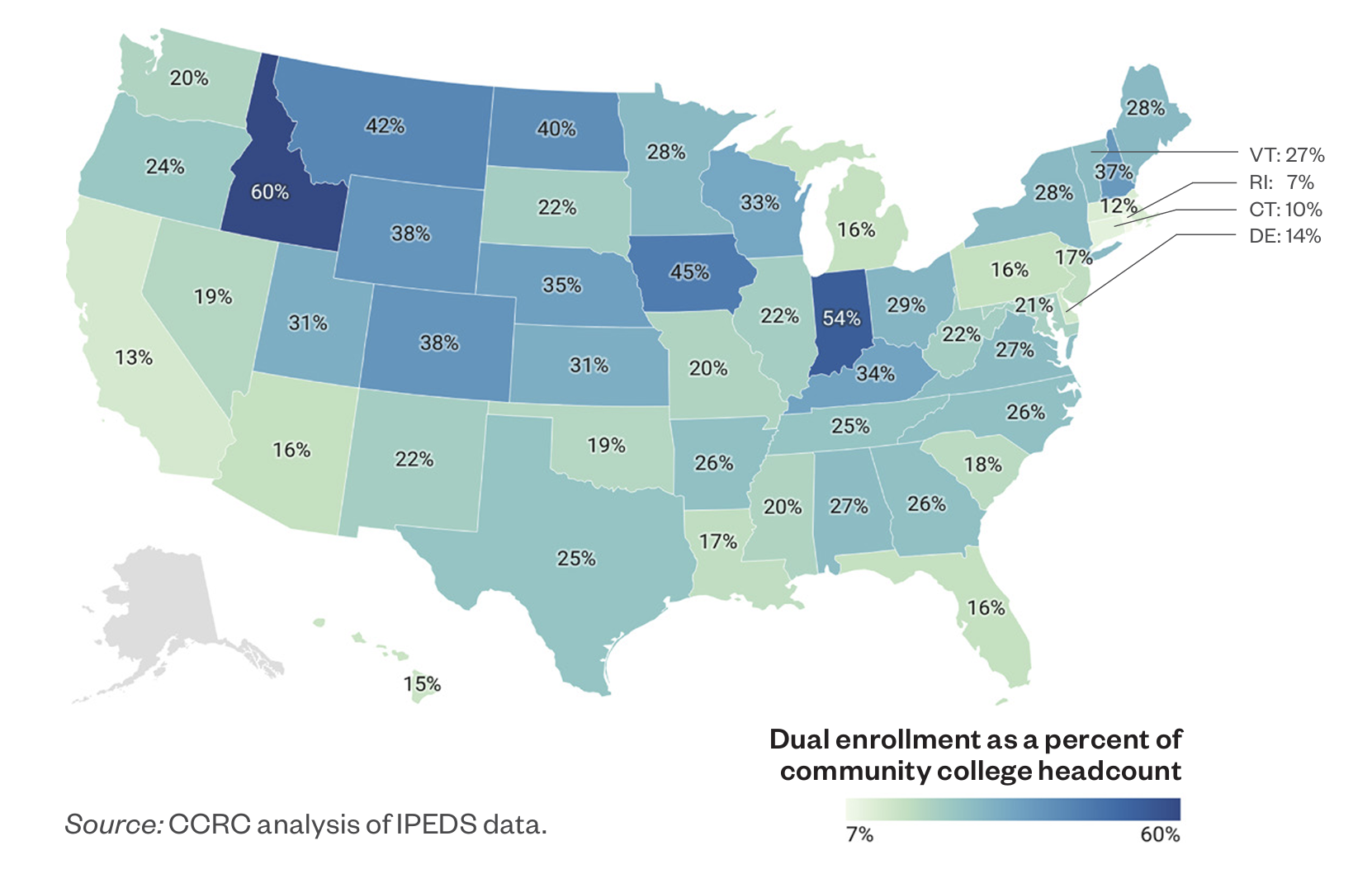
Dual enrollment has become one of the largest—and fastest growing—connections between high school and college in the United States. In 2023-24, approximately 2.8 million high school students took college courses through dual enrollment, including roughly 2 million at community colleges. Nationally, dual enrollment students now account for one in five community college enrollments, and in 11 states and hundreds of colleges they comprise more than one third of all community college students.
Percentage of Community College Students in High School in 2023-24
States have embraced dual enrollment as a strategy to increase educational attainment and improve college affordability. Between 2010 and 2025, states have enacted nearly 1,500 dual enrollment policies, the vast majority aimed at expanding student access and participation.
That expansion is an important success. But participation alone is not the goal. The larger question is whether states are investing in forms of dual enrollment that produce the greatest returns for students, employers, and taxpayers.
Too often, the answer is no.
Many dual enrollment programs still consist of isolated college courses rather than coherent pathways into postsecondary programs that lead to well-paying, career-path jobs. Students accumulate credits they may not be able to apply to a college program in a field of interest to them—a pattern often described as “random acts of dual enrollment.” Meanwhile, students from higher-income and college-educated families continue to participate at substantially higher rates than students from low-income, rural, and first-generation backgrounds. As a result, dual enrollment too often functions as a “program of privilege,” rather than expanding opportunity for students who might not otherwise continue their education after high school.
State policies have clearly propelled the expansion of dual enrollment nationally, but to better realize the potential of dual enrollment, state policies should encourage dual enrollment programs that help many more students enter and succeed in postsecondary pathways leading to educational opportunity, high-demand careers, and economic mobility.
States cannot create such purposeful dual enrollment programs on their own. Colleges and their K-12 partners do that work. But state policy strongly influences which models flourish, what colleges and school districts can afford to offer, and who ultimately benefits.
Over the past several years, our research at CCRC has examined partnerships of community colleges and K-12 schools that have redesigned dual enrollment as an intentional on-ramp to college and career opportunity, particularly for students from groups that have historically had limited access to higher education. Through our Dual Enrollment Equity Pathways (DEEP) research, we have studied how these partnerships have been able not only to broaden access to dual enrollment but align it with high-value postsecondary career pathways, provide career exploration and advising, and support students in making successful transitions to further education and training after high school.
Our new policy brief addresses the question: What can states do to help more colleges and school districts adopt and sustain purposeful dual enrollment practices?
Drawing on examples from states around the country, we identify five policy strategies that can help states answer this question and thus increase the returns on their investment in dual enrollment:
- Define dual enrollment as a pathway strategy that prepares students for postsecondary credentials leading to well-paying, high-demand jobs—not simply early college credit accumulation.
- Align funding and incentives with pathway-building goals, including support for colleges to assist schools in providing career and educational advising and planning assistance to all students.
- Remove barriers to participation—such as rigid eligibility requirements—while providing the academic support students need to succeed.
- Strengthen partnerships among colleges, school districts, employers, and workforce systems to build coherent pathways connected to regional opportunity.
- Use data and accountability systems to focus continuous improvement on long-term student outcomes, including college completion and labor market success.
The past decade has been about making dual enrollment bigger. The next decade should be about making it better.
The stakes for states are growing. As college-going rates decline and good jobs increasingly demand education and training beyond high school, states will depend more heavily on populations historically underrepresented in postsecondary education to meet workforce needs.
If states want stronger returns on their investments—for students, employers, and taxpayers—they will need policies that encourage dual enrollment not simply as a way to earn college credits early, but as a powerful on-ramp to postsecondary success and career opportunity.