

Skip to content
Teachers College logo
CCRC's 30th Anniversary Logo
  • About Us
    • About CCRC
    • CCRC Staff
    • Advisory Board
    • Biennial Report
    • Employment
    • Contact
    • About CCRC
    • CCRC Staff
    • Advisory Board
    • Biennial Report
    • Employment
    • Contact
  • News
    • CCRC in the News
    • Opinion
    • Press Releases
    • CCRC in the News
    • Opinion
    • Press Releases
  • Community College FAQs
  • Research Areas
    • Dual Enrollment
    • Developmental Education
    • Guided Pathways
    • Advising & Student Supports
    • Teaching & Learning
    • Transfer
    • Workforce Education
    • Dual Enrollment
    • Developmental Education
    • Guided Pathways
    • Advising & Student Supports
    • Teaching & Learning
    • Transfer
    • Workforce Education
  • Publications
  • Blog
  • Resources
    • Data Tools
    • Policy Fact Sheets & Briefs
    • Guided Pathways Workshops
    • Data Tools
    • Policy Fact Sheets & Briefs
    • Guided Pathways Workshops
  • More
    • Events
    • Research Projects
    • Events
    • Research Projects
  • Overview
  • Important Dates
  • FAQs
  • Overview
  • Important Dates
  • FAQs
  • Overview
  • Important Dates
  • FAQs

Scaling Dual Enrollment Pathways to College and Career Opportunity: Five State Policy Strategies

By Davis Jenkins & John Fink

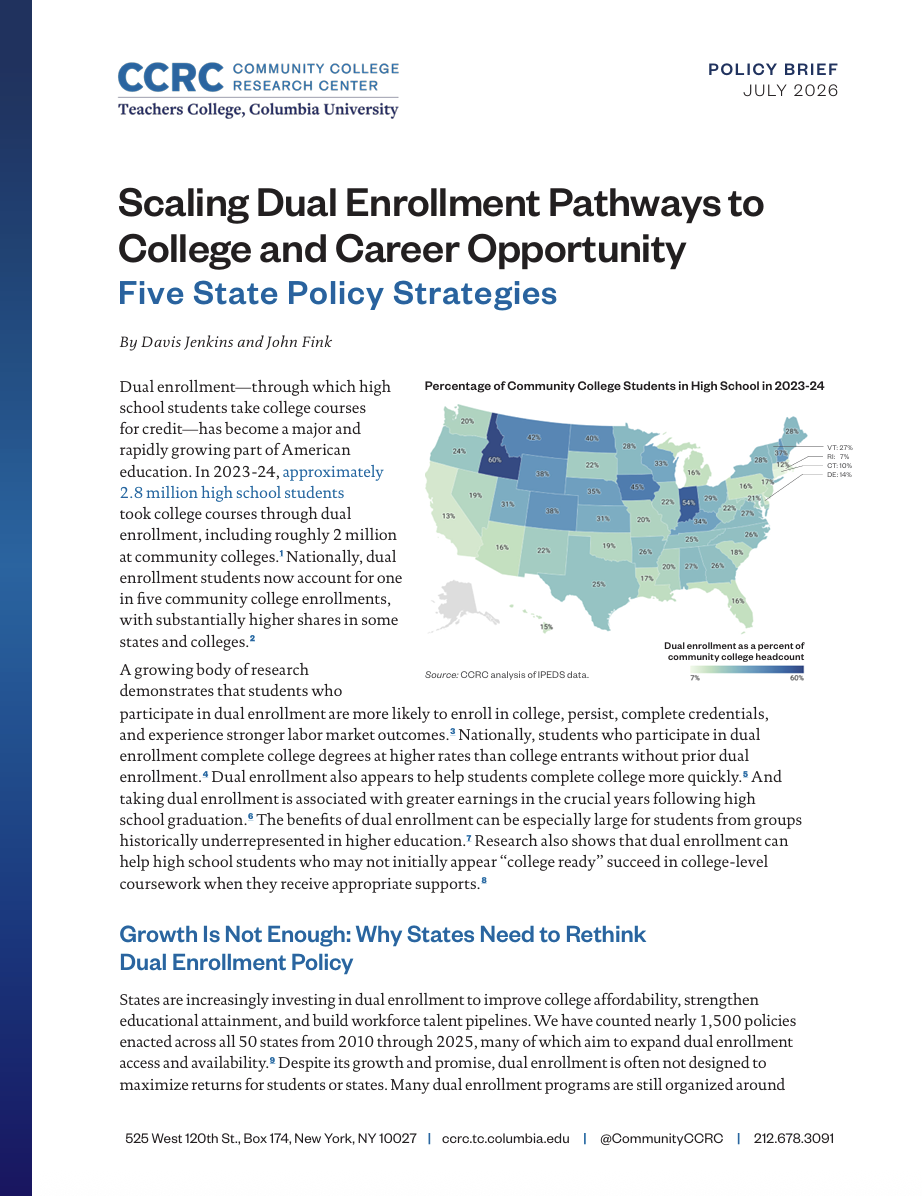
Dual enrollment—through which high school students take college courses for credit—has become a major and rapidly growing part of American education. Nationally, dual enrollment students now account for one in five community college enrollments, with substantially higher shares in some states and colleges. A growing body of research demonstrates that students who participate in dual enrollment are more likely to enroll in college, persist, complete credentials, and experience stronger labor market outcomes. The benefits of dual enrollment can be especially large for students from groups historically underrepresented in higher education. However, access to high-quality dual enrollment opportunities remains uneven.

This brief provides an overview of dual enrollment—including its associated benefits and challenges—and introduces a framework for rethinking dual enrollment as not only a way to earn early college credit, but as a pathway to college and career opportunities. It also provides recommendations to help college leaders and policymakers craft dual enrollment programs that maximize returns for students, employers, and taxpayers.

Download Links

Download policy brief
July 2026

Related Publications

February 2026

Understanding Dual Enrollment

October 2025

College Business Models for Scaling Purposeful Dual Enrollment

October 2023

DEEP Insights: Redesigning Dual Enrollment as a Purposeful Pathway to College and Career Opportunity

Additional Resources

For more policy briefs and fact sheets, visit CCRC’s Policy Resources page.

Stay in Touch!

Subscribe to our newsletter for the latest on our research, including publications, blog posts, and upcoming events.
Subscribe

Community College Research Center, Teachers College, Columbia University
Box 174 | 525 West 120th Street, New York, NY 10027

  • 212.678.3091
  • ccrc@columbia.edu
Facebook-f Twitter Linkedin Youtube Instagram

© 2026. All rights reserved.

RESEARCH AREAS

  • Dual Enrollment
  • Developmental Education
  • Guided Pathways
  • Advising & Student Supports
  • Teaching & Learning
  • Transfer
  • Workforce Education
  • Dual Enrollment
  • Developmental Education
  • Guided Pathways
  • Advising & Student Supports
  • Teaching & Learning
  • Transfer
  • Workforce Education
  • CC FAQs
  • About CCRC
  • Biennial Report
  • CCRC Staff
  • Employment
  • CC FAQs
  • About CCRC
  • Biennial Report
  • CCRC Staff
  • Employment
  • Publications
  • Blog
  • Data Tools
  • Policy Fact Sheets & Briefs
  • Events
  • Publications
  • Blog
  • Data Tools
  • Policy Fact Sheets & Briefs
  • Events
Accessibility Adjustments

Powered by OneTap

How long do you want to hide the toolbar?
Hide Toolbar Duration
Select your accessibility profile
Vision Impaired Mode
Enhances website's visuals
Seizure Safe Profile
Clear flashes & reduces color
ADHD Friendly Mode
Focused browsing, distraction-free
Blindness Mode
Reduces distractions, improves focus
Epilepsy Safe Mode
Dims colors and stops blinking
Content Modules
Font Size

Default

Line Height

Default

Color Modules
Orientation Modules
  • About Us
    • About CCRC
    • CCRC Staff
    • Advisory Board
    • Biennial Report
    • Employment
    • Contact
  • Research Areas
    • Dual Enrollment
    • Developmental Education
    • Guided Pathways
    • Advising & Student Supports
    • Teaching & Learning
    • Transfer
    • Workforce Education
  • Publications
  • Blog
  • Community College FAQs
  • News
    • CCRC in the News
    • Opinion
    • Press Releases
  • More
    • Data Tools
    • Events
    • Guided Pathways Workshops
    • Policy Fact Sheets & Briefs
    • Research Projects