This chapter reports on a major college-wide effort to smooth students’ paths as they enter the college, choose a program, and progress to a credential.
This paper introduces a model that uses transcript data matched to credit-level cost data and funding formulae to calculate the implications for efficiency of reforms intended to improve completion rates.
Olga RodríguezBrooks BowdenClive BelfieldJudith Scott-Clayton
Using detailed data from three community colleges, the authors of this study employ the ingredients method to estimate the costs to colleges and students of remedial placement systems at community college.
Using the Education Longitudinal Study of 2002, this CAPSEE working paper evaluates the postsecondary and labor market outcomes of students who attended for-profit colleges.
This report reviews research evidence on college policies designed to facilitate on-time degree completion among students by encouraging them to enroll in at least 15 credits per semester.
This paper uses administrative data and a rich predictive model to examine the accuracy of remedial screening tests, used either with or instead of high school transcript data to determine remedial assignment.
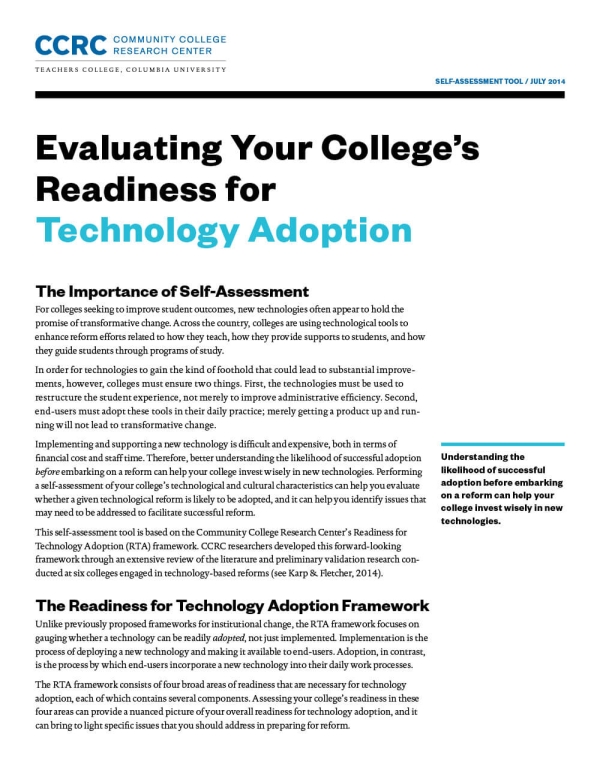
Based on CCRC’s Readiness for Technology Adoption framework, this self-assessment tool provides rubrics to help colleges identify issues that may need to be addressed to facilitate successful reform.
This study uses a difference-in-differences approach to identify the impact of ESL compared with developmental writing at an urban community college system.
Valerie Lundy-WagnerCindy P. VeenstraMarisa K. OrrNichole M. RamirezMatthew W. OhlandRussell A. Long
This article uses economic, human, and cultural capital theories to frame and then describe access to undergraduate engineering degree programs and bachelor's degrees.
Shanna Smith JaggarsJeffrey FletcherGeorgia West StaceyJill Little
This practitioner packet aims to help colleges identify areas where students struggle due to complexity in the academic decision-making process and devise low-cost solutions.
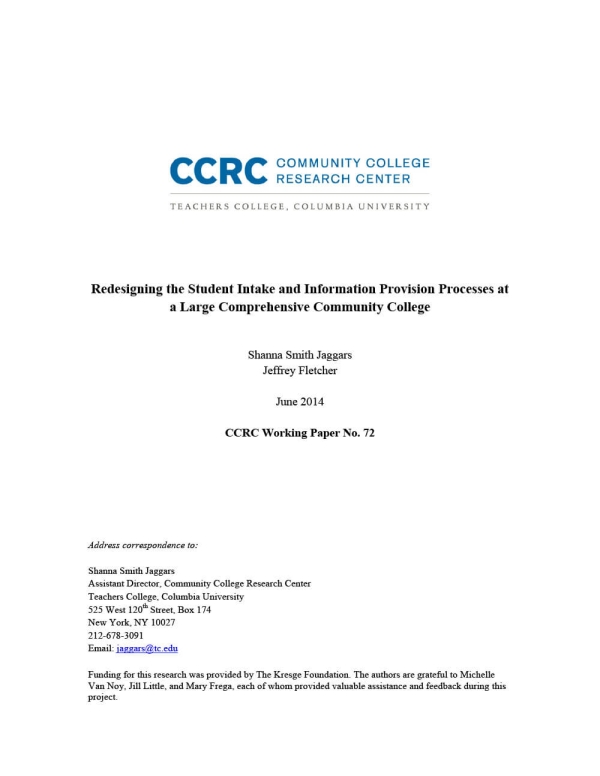
This working paper presents a case study of how one large, suburban community college planned and implemented a relatively low-cost redesign of its student intake and information provision processes.
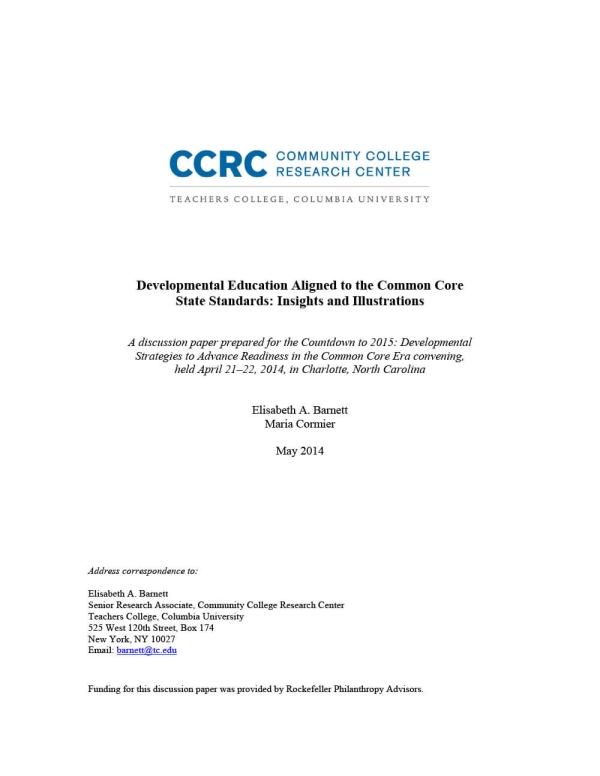
Based on interview data, this discussion paper explores whether faculty and college leaders are considering or undertaking reforms of developmental education informed by the Common Core State Standards.
This report presents a framework that identifies characteristics associated with colleges’ readiness to adopt technology-based reforms, emphasizing the need for both technological and cultural readiness.
In light of cost-cutting practices used by community colleges today, this article argues that the emphasis of policy and practice should be on improving efficiency: the cost per completion of a high-quality credential.
Nikki EdgecombeShanna Smith JaggarsDi XuMelissa Barragan
This paper compares the academic outcomes of students at Chabot College who participated in an accelerated, one-semester developmental English course and those who enrolled in a two-semester sequence.
This brief examines changes in entry-level college math enrollment and completion rates in Virginia's community colleges after the introduction of a new math placement test and placement policy.
Drawing on interviews with students, faculty, and staff at three community colleges, this paper aims to clarify the role of community college student and the behaviors that must be enacted for students to succeed.