

By Lauren Schudde, Kimberly Pack-Cosme & John Fink
Evidence links dual enrollment (DE), in which students take college courses during high school, to college enrollment, persistence, and completion. Yet haphazard selection of dual enrollment coursework may lead to wasted credits. DE students often select courses based on availability, reflecting “random acts of dual credit,” rather than intentionally choosing courses to meet educational goals. These courses may not transfer or apply toward a student’s desired bachelor’s degree program.
The challenges related to credit transfer for community college students are well documented, but there is less information on how dual enrollment credits fare in the transfer process. Students may face a similar uphill battle getting universities to accept DE credits toward a degree in their major field of interest.
In Texas, 21% of high school students take at least one DE course, and 95% of DE students enroll in DE courses through community colleges. In this blog post, we offer insights from newly available data from the Texas Higher Education Coordinating Board on which DE courses apply to degree programs when former dual enrollment coursetakers transfer from community colleges to public universities.
In 2019, the Texas legislature began requiring public universities to report academic credits earned by community-college transfer students that were not granted credit at the university. This novel dataset, referred to as the Transfer Report, allows us to examine which courses first-time community college transfer students lost upon transfer and the reasons the university reported for the denials.
One key caveat with this dataset is that it reports only on credit transfer for a subset of transfer students who meet these two conditions:
- Students must have kept the same major between transfer application and enrollment (i.e., the major they declared on their application is the same); and
- Students must have had at least one course denied for transfer.
Students in the Transfer Report—comprised of students who enrolled in the same major from their university application and lost at least some credit—represent approximately one third of the total community college transfer population in Texas. Nevertheless, students in our sample appear similar to the overall population of transfer students in terms of distribution across majors. And, to the extent that students who are admitted with the same major they applied to are better prepared for that major than other transfer students who do not meet that major-alignment condition, the results shown here may represent a lower bound of the credit loss experienced by DE students who transfer to universities.
Our preliminary analyses offer several main takeaways: Among transfer students who lost at least some credits, there does not appear to be an additional dual credit transfer penalty. During vertical transfer, a nearly identical share of DE courses and courses taken after high school are denied.
1. Among transfer students who lost at least some credits, there does not appear to be an additional dual credit transfer penalty. During vertical transfer, a similar share of DE courses and courses taken after high school are denied.
Rate of Transfer Credit Denial
Note. Data include courses from a restricted sample of students reported in the CBM00t Transfer Report between 2020 and 2024. Full course n =749,742; denied course n = 114,663.
About 15% of DE courses and post-high-school courses were denied for either transfer or applicability to a major at the time of university transfer. (Note that we plan to publish results from a more in-depth analysis, which will include estimates of the number of credits students in the sample were and were not able to transfer.)
2. The reasons for credit loss differed slightly between DE and non-DE students. DE students were slightly more likely to have their credits denied because they didn’t apply to the major or because the course is a repeat of an earlier course than non-DE students.
Reasons for Transfer Credit Denial
Note. Data include courses from a restricted sample of students reported in the CBM00t Transfer Report between 2020 and 2024. Full course n =749,742; denied course n = 114,663.
As shown above, public universities attribute DE course denial slightly more often to a lack of program applicability (46% for DE vs. 43% for post-high-school courses) and course repetition (18% vs. 14%, respectively) and less often to minimum grade or excess credits beyond the transfer threshold. It’s useful to note that we found considerable similarities between the community college courses students took through DE and after high school.
3. The reasons for denials differed for different common subjects. The most popular DE courses attempted were in English, government, and history, but the reasons these courses were denied differed.
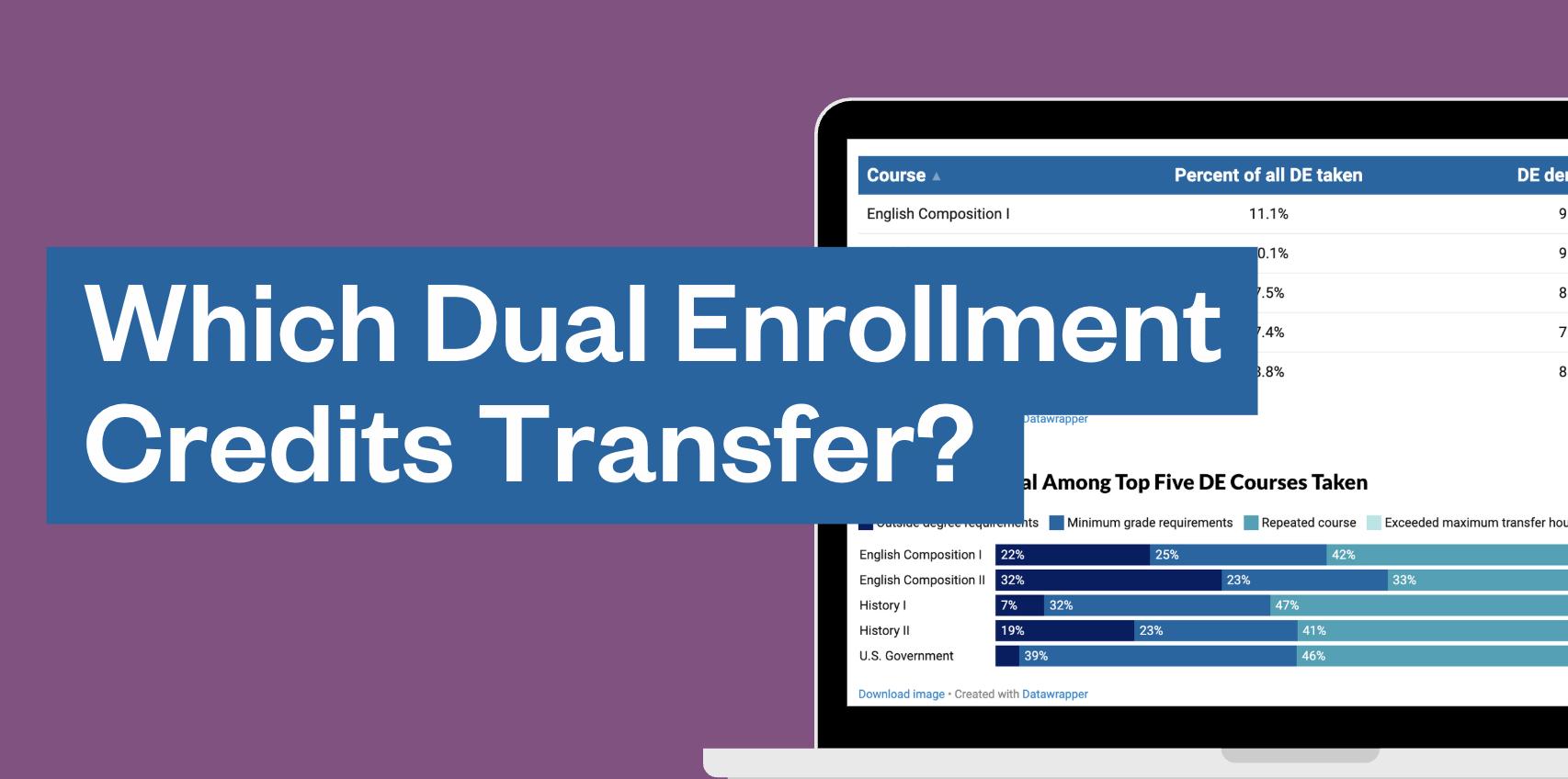
We show the frequency with which these courses were taken by DE students and the rate of denial for each course in the table below, followed by a figure with the reasons for denial. The denial rates for these top five most common DE courses were all below the overall sample average of 15%.
Top Five DE Courses Taken
Reasons for Denial Among Top Five DE Courses Taken
Looking at the reasons for credit transfer denial among the most common DE courses, English Composition I and II had higher proportions denied for being outside of degree requirements (22% and 32%, respectively), whereas U.S. Government and U.S. History 1 were less likely to be denied for being outside degree requirements (3% and 7%, respectively) but more likely to be denied because students did not meet the minimum grade requirement in that course (39% and 32%, respectively). These findings suggest that U.S. Government and U.S. History 1 courses may be “safer” in terms of credit applicability to major requirements but require more student success supports. The English composition courses—the two most common DE courses—are more likely to be denied because of university program requirements (falling outside degree requirements), which are commonly set by individual academic departments. Another important observation is that a third or more of all DE course denials (starting at 33% for English Composition II and going up to 47% for U.S. History I) in each of these popular courses were due to repeating the same course—only one iteration of the same course can count.
4. Looking at the most frequently denied courses highlights further challenges. Principles of Macroeconomics and College Algebra, while not in the top five most common DE courses, are in the top five most commonly denied courses.
The table below shows the top five DE courses lost upon transfer. For each, we include the proportion they represent out of all denied courses in the sample, followed by their respective denial rate (the count of DE course denials for this course divided by the count of all DE course attempts for this course).
Top Five DE Courses Denied
In the figure below, we show the reported reasons for denial for each of these courses. For Principals of Macroeconomics and College Algebra, the most common reason for denial was that the course falls outside of the degree requirements.
Reasons for Denial Among Top Five Courses Denied
The reported reason universities denied the credits varies considerably across courses, with the high-denial-rate courses differing dramatically from the most frequently taken courses. For example, only 3% of U.S. Government courses were denied due to falling outside students’ major requirements (a phenomenon referred to as major credit loss, which means credits will not apply to the university’s degree program though will count as electives), while 57% of College Algebra and 54% of Macroeconomics courses were reported as denied for that reason. We suspect that College Algebra may not apply toward degree requirements because STEM majors generally require pre-calculus and calculus and social sciences often require statistics, and yet some community colleges still encourage students to take algebra despite the “math pathways” movement. Students need to be informed up front whether College Algebra, Principles of Macroeconomics, and other courses such as these will apply toward their intended major. Given the role of College Algebra as a gatekeeping course, it is striking that it is so often denied for credit transfer due to misalignment with students’ university degree programs.
Our findings from this newly available data bolster prior evidence from research on purposeful DE practices and effective transfer partnerships, which argue for better transfer advising based on institution and major-specific transfer maps for DE students and transfer-intending students at community colleges.
Moreover, the variation we observe in the reasons for credit denial across core courses, combined with prior evidence that some universities appear more likely to deny transfer credits than others, also points to the need for a closer examination of credit-transfer policies within university programs. Our team will continue to dive DEEPer into this analysis and will share more later in 2026.