
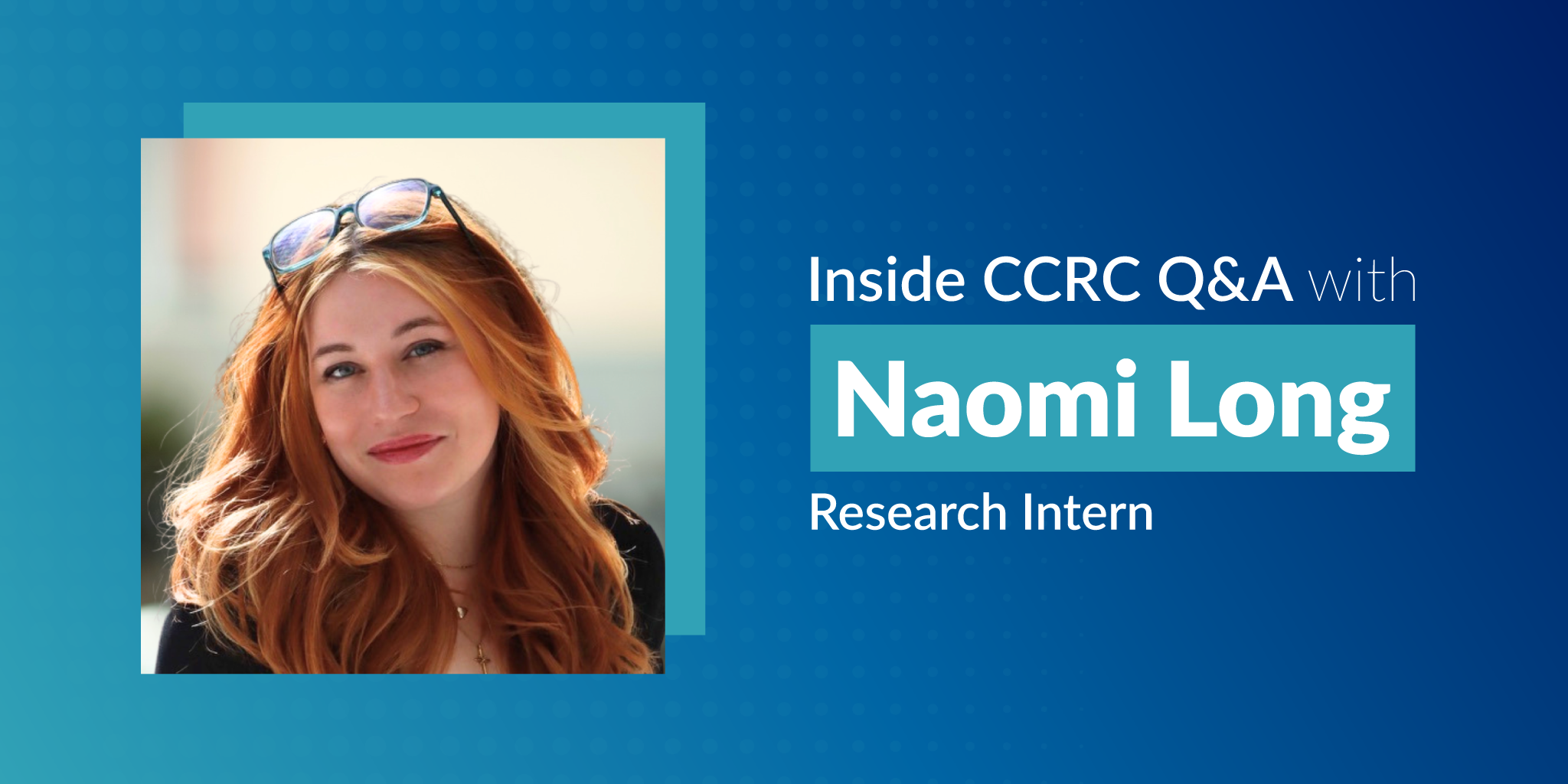
As a community college transfer student, Naomi Long, a rising senior at George Washington University, is deeply passionate about making higher education more equitable and accessible for transfer students through policy research. This summer, she is a research intern at CCRC working on a project to improve advising and another evaluating federal Strengthening Community College Training Grants. In this Q&A, Long, who earned an associate degree from Brookdale Community College in New Jersey, talks about the challenges students face during the community college transfer process, reflects on her experiences with policy research, and discusses her goals for expanding access to higher education.
This Q&A has been condensed and edited for clarity.
Narju Nawar: What inspired your interest in higher education policy and research?
Naomi Long: My experience as a transfer student, as well as being a first-generation college student, has influenced my interest in higher education. I had the opportunity to work on building the first Transfer Student Association at GWU, which I now lead! Working with fellow transfer students as well as my own institution in D.C. has been an incredible experience. It really helped me find my passion for doing this work, and for ensuring that on both sides—the policy level and the institutional level—that we are creating a safe space for students.
Nawar: Are there any issues specific to community college students that you have noticed and are really passionate about addressing?
Long: I think a lot of the problems that community college students face when they transfer come from a lack of attention from their incoming institution, which tends to prioritize first-year students or even students transferring from other four-year institutions. There often isn’t a lot of supportive infrastructure for community college students, which is why I think, in the long run, they may end up either not finishing their degree or taking longer to do so, simply because the attention to their issues isn’t there.
Nawar: It is so exciting to hear that you were able to create that transfer space at your own college! Now that you are a senior, what is it like having to leave behind this community you built up from the ground?
Long: It’s scary to have worked so hard to make this project work and then have to let it go once you graduate, especially since this is something that I’ve not just put a lot of time and effort into, but I am really passionate about. I’m really confident in the community we’ve formed. We have a fantastic group of people and a really large transfer student population, so I know I am leaving it in really good hands.
Nawar: What drew you to an internship at CCRC, in particular?
Long: I was first introduced to the work and the research that CCRC does through my prior internships. I’ve worked in higher education and workforce policy, and of course, being a community college student drew me to this place a little bit more. I have really appreciated the research that CCRC has done in the past, especially its work on completion rates and the specific challenges that community college students face, because a lot of the higher education institutions don’t look at community colleges specifically. For me, CCRC offered an opportunity to help fill that gap, and that’s what made me so excited to be here.
Nawar: What projects are you working on as a research intern at CCRC this summer?
Long: I am working on the ECMC Foundation Holistic Advising Framework, which is a really interesting study observing different colleges and the way they conduct advising and administer it to students, especially students of different backgrounds. Hopefully we’ll create a model for other colleges to follow. I am also working on the Department of Labor study on the Strengthening Community Colleges Training Grants Program, and we are working with Mathematica for that project.
Nawar: What are you most excited to learn more about or work on this summer?
Long: I’m definitely most interested in developing my research skills. More specifically, I feel like I’ve worked more with policy and legislative work in the past, which is the interpretation of research, whereas now I’m getting more in depth and by working with people face-to-face on gathering and translating that information.
Nawar: How has it been juggling two different projects?
Long: It has definitely been challenging. Both of the projects have similarities, but one is a lot more broad, so it can be a little confusing sometimes to keep up. However, my team has been fantastic and always supports me in trying to get things done in a timely manner to keep up with a very fast-paced schedule while ensuring that I am turning out high-quality work.
Nawar: What has been the most interesting thing you have learned so far during your time at CCRC?
Long: My most unique experience has been working on the holistic advice framework since the project is in the early stages of planning surveys and implementation, and for the first time I am getting insight to what the back end of building these surveys looks like. In all of my other internship experiences, it has always been on the front end where I take research done by organizations like CCRC and use that in policy reports and memos. Seeing higher education from the other perspective is really fascinating and one of my greatest learning experiences.
Nawar: Looking ahead, where do you hope your studies and experiences will take you after graduation? Are there any organizations you’d like to work for or particular topics you’d like to continue researching?
Long: I would love to continue working with transfer student research and policy work, but I am interested in higher education access more broadly as well. I think my dream job would be to work at the Aspen Institute’s College Excellence Program. They do some of the coolest programs and projects nationwide that I would love to be a part of. Ultimately, I’d like to do work that is dedicated to helping non-traditional students achieve their educational and career goals by creating practical pathways to make that happen.
Nawar: That is really admirable, and I wish you the best of luck! If you could improve one aspect of higher education for future students, what would that be, and why?
Long: Yeah, I think the most important thing that I see—especially since I lead the Transfer Student Association here and work with students navigating a variety of challenges—is finances. It is so expensive to go to an academically competitive college. GWU is a great example of this. We’re almost at $100,000 a year for tuition alone, which is an absurd number. It’s crazy. So, with the rising cost of education, combined with a lack of attention given to transfer and community college students, many community college students end up paying a lot more than they should to attend institutions like this, which, of course, can limit their ability to pursue new opportunities and complete their academic journey.