
By Katelyn Perruc and Ellen Wasserman
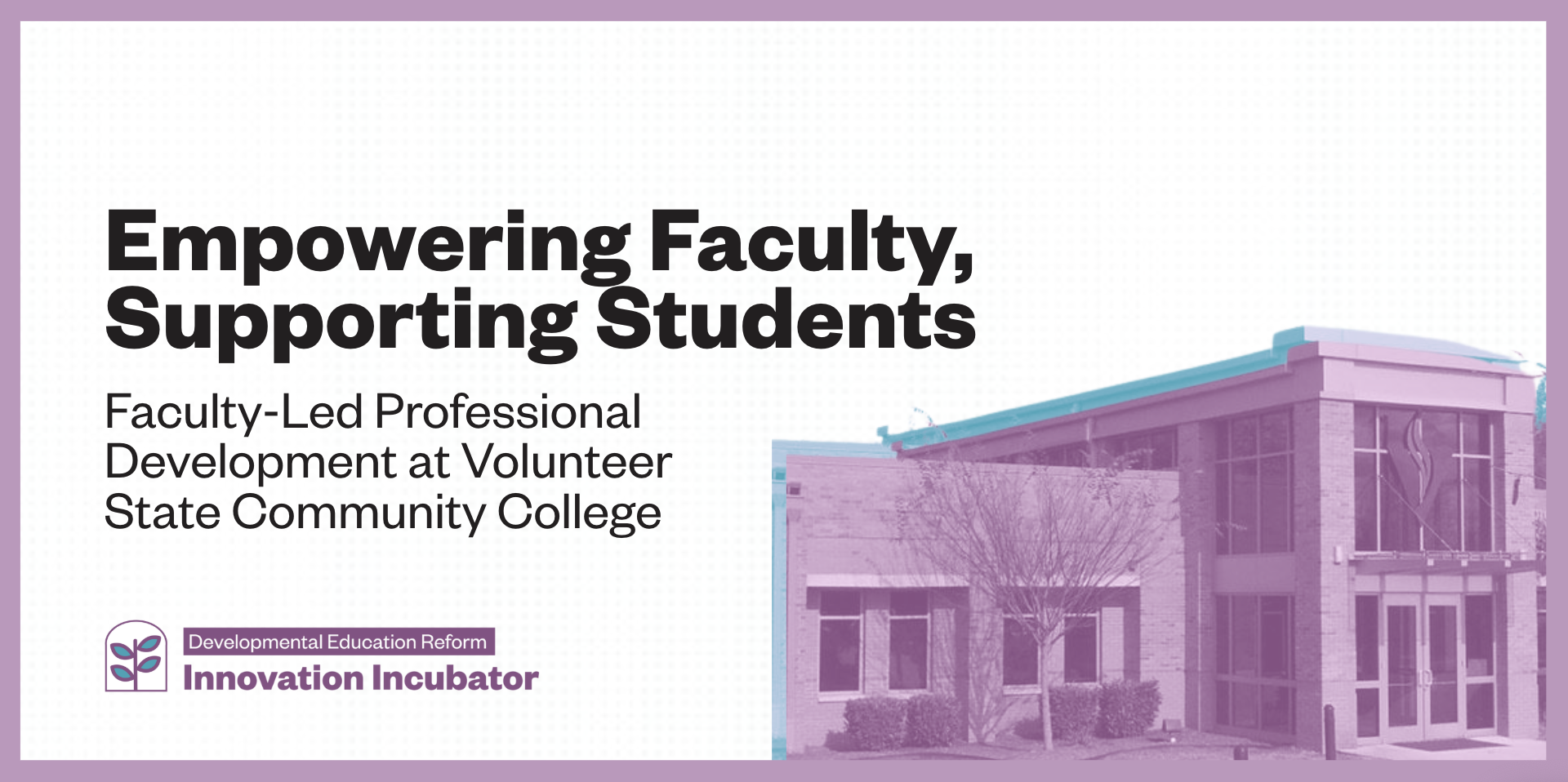
Ten years after Tennessee began reforming developmental education, it became apparent at Volunteer State Community College in Gallatin that the evolving reforms were not the only thing needed to improve student outcomes. This past year, as a team of math, English, and reading faculty explored why attendance and success in corequisite courses was lagging, they saw that despite recent changes to course curriculum, faculty were discouraged and losing heart for teaching corequisite courses.
The Volunteer State team decided to put faculty at the center of the solution by developing faculty-led professional development on classroom practices that build community and motivation, and empower faculty to engage students in active and collaborative learning.
CCRC’s Developmental Education Reform Innovation Incubator community of practice (CoP) has offered the Volunteer State team a sounding board as they build a professional development program for faculty who teach corequisite math, English, and reading courses. The Volunteer State team is one of four teams that came together over a year in the CoP to develop new approaches to improve teaching and learning in developmental courses.
The Volunteer State team’s goal is to help faculty understand the needs and strengths of students in Learning Support (as corequisites are known in Tennessee) and to create a consistent, supportive, and inspiring faculty community. A professional development program specifically for Learning Support faculty is a new approach for Volunteer State, and it fills a gap after other professional development opportunities waned during the pandemic. One Volunteer State CoP team member said the CoP has improved the program and the experiences of both Learning Support students and faculty.
“Carving out time every other week with the [CoP team] on this campus has given me inspiration, energy, fun, laughter, and respect for what I do and for what these other people are doing … ,” the member said. “I think having people talk cross-discipline more than just once, to be able to see what they’re doing and how they’re doing it, to be able to hear what their struggles are and their successes are—I think it makes for a better Learning Support program, a better college experience for anybody who’s coming here and taking these classes.”
In spring 2026, researchers from CCRC visited Volunteer State to learn more about the faculty team’s efforts.
Established in 2024, the Developmental Education Reform Innovation Incubator is a CCRC-led project aimed at elevating innovative practices happening in colleges that have reformed their developmental education courses. Read a report on the project and blog posts sharing innovative practices at other Incubator colleges, and view the recording of a webinar featuring members of each college team.
The Evolving Landscape of Learning Support in Tennessee
Learning Support was established statewide in Tennessee in 2015. Around the same time, the Tennessee Promise financial aid and mentoring program began, making last-dollar scholarships (which are applied after all other grants and scholarships) available for high school graduates to attend community college and other eligible institutions tuition-free for up to five semesters.
At Volunteer State, Tennessee Promise brought in an influx of students who otherwise might not have gone to college, and it increased the number of students in Learning Support courses considerably. This population has continued to grow over the last ten years, and now close to 70% of incoming students at Volunteer State place into at least one Learning Support course. The Learning Support curriculum and structures have evolved over time to keep up with course demand and improve learning, but this evolution has also created challenges for faculty as they adapt to changes. To address some of these challenges, the Humanities and Fine Arts Division at the college recently created a dedicated Learning Support Department, spanning English, reading, English for speakers of other languages (ESOL), and first-year experience courses to provide structure and cohesion and reduce siloing between disciplines.
Faculty Leading the Way on Professional Development
The Volunteer State CoP team, including a humanities administrator and English, reading, and math faculty, recognized that Learning Support faculty in different disciplines faced similar issues with student engagement and course completion despite the differences between subjects. From there, the idea of creating faculty-led professional development about teaching students in Learning Support courses was born.
At Convocation in fall 2025, CoP members presented data to faculty, administrators, and staff about low retention rates in Learning Support courses; they also related students’ stories about the challenges they face, emphasizing the importance of collective effort in helping this group of students succeed.
That same semester, new course models developed by Volunteer State faculty, many of whom were participants in the CoP team, were introduced in Learning Support math and English, providing faculty with a standardized curriculum for their Learning Support sections. Some aspects of the new course models called for active learning lessons and student collaboration, and the CoP team realized that more explicit training on those teaching techniques would help faculty feel more prepared and confident about adopting the new curriculum.
In mid-fall, the CoP team hosted a lunch-and-learn event for all Learning Support faculty, facilitating candid discussions about understanding who students in Learning Support classes are and ways to help them learn. To ensure that their efforts would respond to the faculty’s needs, the team surveyed participants about the challenges of teaching Learning Support courses and what resources and supports would be helpful.
Using responses from the fall survey, many of which highlighted a desire for more opportunities to exchange ideas with their peers, the CoP team developed a two-day Summer Institute for Learning Support faculty interested in exploring teaching strategies that prioritize collaboration and active learning, and developing their own related classroom interventions. This summer, nine faculty members participated in the Summer Institute and will be piloting their interventions in their fall courses. Similar to an action research project, Summer Institute participants will assess the success of their interventions and continue to meet with their Volunteer State colleagues on the CoP team during the fall to receive consistent peer support. The team intends to establish the Summer Institute as an annual opportunity to expand their growing Volunteer State community of practice.
While the team is currently focusing its efforts on Learning Support faculty, they hope to expand to other faculty at the college.
“Most faculty on campus teach Learning Support students,” one instructor said. “Eventually you will have Learning Support students in your other classes, and so I think the conversations that take place in professional development would benefit everyone.”