


As artificial intelligence (AI) raises questions about the future of work, community college students are considering how it might affect their career prospects. In spring 2026, nearly 4 in 10 respondents to a CCRC survey at four community colleges expected AI to substantially change the day-to-day tasks of the jobs they hope to get. They also saw a possibility of reductions in entry-level hiring and the elimination or downgrading of those jobs. Their responses offer insight into how community college students anticipate AI shaping their future jobs and how these expectations may inform their educational and career decisions.
A Longitudinal Look at Expectations About Work
The findings come from a multi-wave survey of first-time-in-college students who enrolled in four community colleges in California, Maryland, Ohio, and Texas in fall 2023. The participating colleges include two Hispanic-Serving Institutions (HSIs) and one Predominantly Black Institution (PBI). An initial survey, completed by 4,515 students in fall 2023 (a 36% response rate), examined students’ program choices, career interests, and beliefs about different educational and career pathways, including their views about how AI may shape their careers. In spring 2026, approximately two and a half years after they first enrolled, 2,595 of the original respondents completed the fourth survey wave (a 58% follow-up response rate), regardless of whether they were still enrolled in any higher education institution.
The study draws on students attending institutions that serve large, historically underrepresented populations: 58% were Hispanic, 20% were Black, and 14% were White. Nearly three quarters of students who provided information on their parents’ education were first generation—neither parent had a bachelor’s degree—and the median age at initial enrollment was 18. The survey provides an opportunity to examine how students from historically underserved backgrounds anticipate AI-related changes to their employment and career opportunities, an important perspective as emerging research examines AI’s implications for younger workers and their transition from education to employment. The findings are descriptive and are not nationally representative.
Students Anticipate Changes to Their Future Jobs and Employment Opportunities
By 2026, expectations of AI-related changes were widespread among students who entered community college in fall 2023. When asked how much AI would change the day-to-day tasks of their first-choice job over the next three years, 39% anticipated substantial changes, while 69% expected at least some change.
Students’ Expectations About AI-Related Changes to Job Tasks
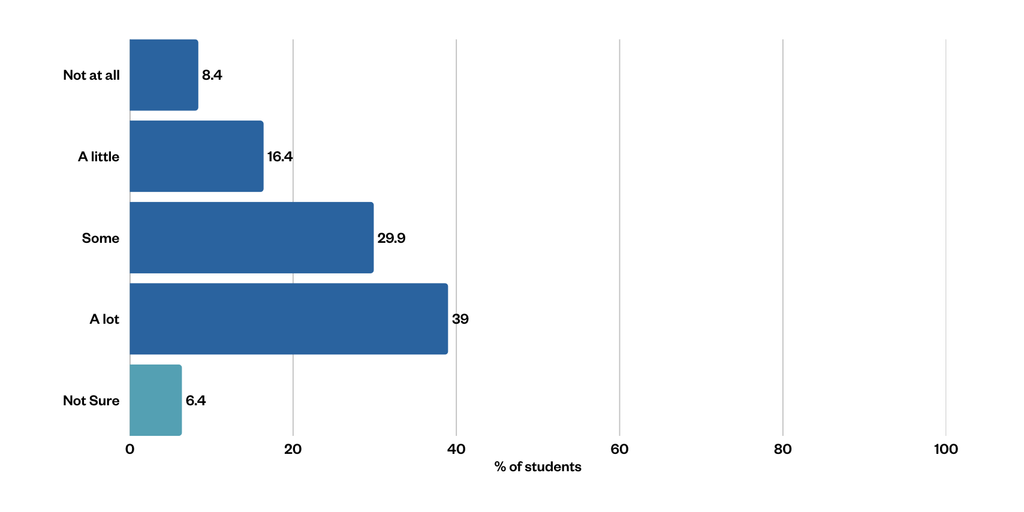
Note: Respondents were asked how much they expected AI to change the day-to-day tasks of their first-choice job over the next three years. N = 2,434.
Students also anticipated potential disruptions to employment opportunities in their preferred careers. When asked to estimate the likelihood of different AI-related outcomes on a scale from 0 to 100, respondents reported, on average, a 36% chance that AI or automation would reduce entry-level hiring in their first-choice job over the next three years, and a 28% chance that AI would eliminate or “substantially downgrade” their current job or the job they hoped to hold over the next five years.
These findings suggest that students expect AI to change not only the nature of their future work but also their employment prospects. Emerging research documents weaker employment growth among young workers in some AI-exposed occupations, while other work highlights AI’s potential to complement workers’ skills and create new opportunities. Other research suggests that lower-to-middle-wage jobs requiring less education face greater risk of automation, but that Black and Hispanic workers are underrepresented in fields likely to expand because of AI. Although the longer-term labor-market effects of AI remain uncertain, these descriptive findings offer an early glimpse into how community college students anticipate changes to their future jobs and career opportunities. Future analyses from our research project will examine how these expectations relate to students’ educational decisions and their transitions from college to work.
Expectations About AI-Related Employment Risks Differ Across Groups
Although expectations about AI changing day-to-day job tasks were broadly similar across demographic groups, students differed in their assessments of potential employment risks. Black respondents perceived, on average, a 38% chance that AI would reduce entry-level hiring in their preferred jobs within three years, compared with 36% among Hispanic respondents and 29% among White respondents. Similar differences emerged in expectations about job elimination or substantial downgrading within five years, with average perceived probabilities of 31%, 28%, and 23%, respectively. First-generation students also saw a higher likelihood that AI would reduce entry-level hiring than students with at least one parent holding a bachelor’s degree (37% versus 33%). These differences raise questions about whether students’ expectations reflect differences in their preferred occupations, access to labor-market information, or other factors that future analyses can explore.
Are AI Concerns Influencing Students’ Program Choices?
The survey also explored whether concerns about AI had influenced students’ educational decisions. Among 1,556 respondents who were still enrolled at any higher education institution in spring 2026 and who answered questions about changes in their programs of study, 36% reported having changed majors since entering college in fall 2023. Of those who switched, approximately 12% cited concerns about AI reducing employment opportunities in their original fields as one reason for their decision.
Although relatively few students reported changing majors partly because of AI concerns, these responses raise questions about how expectations of technological change may factor into students’ educational decisions—and how community colleges can help students navigate uncertainty about the future of work.
Looking Ahead: From College to Work
As the students in our study leave college, we will examine their transitions from college to work, including their employment outcomes and job quality, how internships, college resources, and personal networks help them find jobs, and how well their skills and career readiness align with what they believe employers value. Future analyses will also examine whether students’ expectations about AI line up with measures of AI exposure in their preferred occupations. These comparisons could help educators and policymakers identify where students may benefit from additional labor-market information and career guidance.