
More than five years of research on how to empower students to manage their own learning in online courses has expanded CCRC’s knowledge about how teaching and learning online works in practice.
CCRC worked with SRI Education, Achieving the Dream, and nine broad access colleges on the research as part of the Postsecondary Teaching with Technology Collaborative, observing online classrooms and talking to faculty members, administrators, students, and online education experts. The research culminated in a new Self-Directed Learning Instructional Model that provides instructors and administrators strategies to bolster student learning skills, including planning, reflection, help-seeking, and growth mindset.
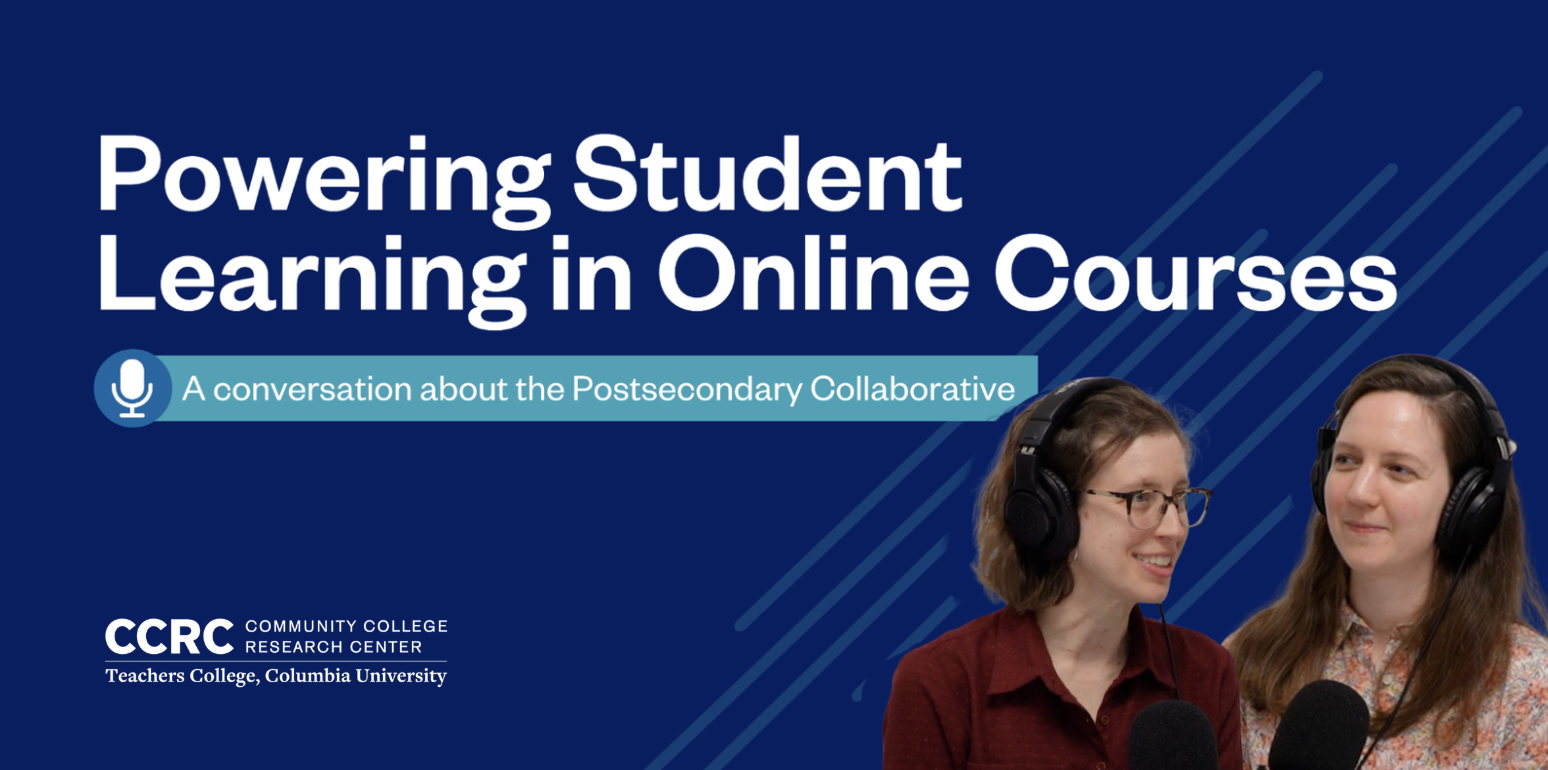
In a new video podcast, CCRC’s Susan Bickerstaff and Amy E. Brown discuss the growing need for improvements to online learning as colleges emerged from the COVID pandemic, the development of the instructional strategies, and unanswered questions about how colleges can improve online learning.
Transcript
Susan Bickerstaff: All right. Hi, Amy.
Amy E. Brown: Hi, Sue.
Bickerstaff: I’m Sue Bickerstaff. I’m here with Amy Brown. We’re researchers at CCRC, and we’re here today to talk about the Postsecondary Teaching with Technology Collaborative. We call it the Collab. And it’s been a partnership between CCRC, SRI Education, and Achieving the Dream, and we’ve been exploring how to support students to learn in online classes. And this work comes out of previous work at CCRC and other places that showed that students in online courses felt disengaged, were struggling, and their outcomes were lower, often in online courses as compared to courses with face-to-face formats. And we were conducting this research beginning back in 2021, which was sort of right as the COVID-19 pandemic was starting to trail off, but there was a lot of demand for online courses, and a lot of students and faculty were learning and teaching online, sort of for the first time. So, what are some of the things that we were hearing from faculty and students when we began this research with them?
Brown: Yeah, so as you alluded to, we knew from a broad body of work that outcomes are generally lower in online courses and programs and achievement gaps persist across those courses. And we know that those courses really place greater demands on students to manage their own learning, and it’s more challenging for students to feel a sense of belonging and make connections with their faculty or with their peers in those courses, and just have a general sense of community in the classroom. So, we started out the work by looking at different policies and practices that institutions had either implemented newly during the pandemic or had started to strengthen at that time because of the increased number of online courses. And we spoke to folks working and learning at seven community colleges and two broad access universities. The faculty, some of whom had to take on a lot more online courses at this time, really found that they were getting less feedback from their students about what they were learning and understanding. They had less information to be able to make adjustments to their teaching. It was hard to reach students who were struggling or behind, and it was hard to just spark students’ interest in the subject.
On the student side, students really saw challenges in their time and task management. Many in 2021 may not have learned online previously, didn’t have a lot of experience, and some of those students were taking asynchronous courses, where they weren’t having live class sessions where they were interacting with their faculty member or their peers. And it just meant that they had to themselves put a lot more structures in place for them to complete their coursework and be successful. And the early years of the pandemic really called for a lot more strategies and support for both students and faculty to help students be able to identify when they needed help and know who to reach out to and feel comfortable about reaching out and just more thinking about how to motivate students and give them the skills to be able to manage their learning in these courses. So, Sue, you alluded to some earlier work that CCRC has done in online education, and I’m just wondering if you could speak about how some of that earlier work really laid a foundation for where we took this project and this work in the Collab.
Bickerstaff: Sure. We had done earlier work at CCRC showing that outcomes in online courses were not as strong as in face-to-face formats, and so that was part of our motivation for getting involved in the Collab. And we also have a long history of working really well and collaboratively with institutions and with faculty, and so I think we built on that. But this work was different than a lot of other CCRC work, in that we actually worked with our partners to design some interventions that we tested in the classroom. So that was exciting to be able to have these nine partner colleges and our colleagues at SRI and Achieving the Dream, who had some experience in designing interventions, and to be able to work with them, and to be able to then test those interventions in classroom settings to see what impact they would have on all of those features that you just talked about, the challenges that students are experiencing in online courses. So that work was guided by what we call a self-directed learning framework. Amy, do you want to talk a little bit about that framework?
Brown: Sure. So, in the early years of this project, we worked on developing a self-directed learning framework that really drew upon three sets of processes that students use to manage their learning. The first is motivation, the second is metacognitive processes, and the third is applied learning approaches. And so the framework really started with students’ initial motivational mindsets, and so that can include just different commitments that they have to their learning. And then that commitment can drive their metacognitive processes, which help them make plans for how they’re going to monitor their learning, make adjustments, and reflect. And then the applied learning processes put those plans into action, and so students adaptively manage their learning as they’re experiencing different activities and assignments and exams in their courses. And so we developed and tested strategies that became what we call a Self-Directed Learning Instructional Model. Could you speak about that process?
Bickerstaff: Sure, so we, as you said, drew on this framework and this body of literature, and we identified these potential strategies that had been shown in that literature review to be evidence-based and effective, and then we worked with faculty partners at some of our partner institutions to adapt those strategies for use in community college classrooms or broad-access university classrooms, and particularly those introductory online STEM courses. So, we worked with small faculty teams to first tailor the practice in ways that they felt would be feasible to implement in their classroom, and then to test them. And we did a set of what we called rapid-cycle experiments, where we would test one or sometimes more than one strategy in a set of sections, and then we would convene with the faculty after the end of the term to make some changes and adjustments, and then tested them again. And we did that over a few different semesters.
And what we learned from the faculty through that process is sort of in what ways could these strategies be layered onto a typical STEM online course. We didn’t want faculty to feel that they had to redesign their whole course, but we wanted light touch approaches that would touch on those processes: motivation, metacognition, and applied learning that you talked about earlier. Once we had a set of provisional strategies, we convened what we called our co-design team, which was a set of faculty and administrators from our partner colleges, and we worked with them over almost a year to think about how could we package these strategies together into a single integrated model that would support students with these processes during the beginning, middle, and end of the course. So, instead of a one-shot intervention that happens in the first week of the term, this is really changing the learning experience for the student throughout the course.
So, I’ll talk about the three strategies that comprise our Instructional Model. The first is a set of videos. These are short videos, under 10 minutes, that focus on time management, sense of belonging, and growth mindset. The students watch the video, and then they have some reflective questions. The second strategy is a set of prompts, and these encourage student reflection. Some of them focus broadly, for example, asking students: What do you have to master, what content do you have to master this week? How are you going to plan your learning for this week? What questions do you have? And some of the prompts are more focused at particular times in the course, for example, leading up to a major assessment or assignment, asking students to think about and make a plan for how they’ll prepare for that assessment, and then to reflect on their performance on the assessment after it’s over. And then the third strategy, we call it SPIN, which is student-peer interaction and networking, and that is a set of activities that encourage students to get to know one another in their online course and to work collaboratively together.
So we conducted two pilot studies of the integrated Instructional Model, and as part of that work, we learned about faculty and student perceptions of the model, we found that students and faculty really largely found these strategies valuable. We found that the model has been feasible to implement, and we found that it appears to have promise for improving student outcomes. So, it’s been really exciting to see the model being implemented in classrooms at multiple colleges over the course of the center. So, Amy, part of our pilot study was to talk to administrators at these colleges to get their perceptions on the model and to learn about how it might be implemented at community colleges and other institutions, along with all of the other things that community colleges are doing. Can you talk a little bit about what you learned from administrators about how this might fit in with the various other student success initiatives?
Brown: Thanks, Sue. Yeah, so we spoke with administrators really throughout the project, but we spoke to them again during the pilot study when the model was more fully formed and nearing finalization. And we really heard three main points from them. They really recommended integrating the model into existing professional development structures and opportunities, and more broadly integrating the model within institutional priorities, so this kind of institutionalization. They also spoke about the need to offer faculty incentives and financial incentives, in particular. They also, as a third point, emphasized that faculty and administrators really want to see data about the effectiveness of these strategies before deciding to implement. And these three points really tie into some other CCRC research that we’ve done about structural reforms. So, when we think about this effort, it really blends good teaching strategies, meaningful support, and different learning structures for students to build their skills over time, and so those can really be a part of many types of structural reforms. As a final question, Sue, how do you see this work and this five-year project informing future work at CCRC?
Bickerstaff: Yeah, we had the opportunity to interview a lot of faculty and students in online courses, and I think we just learned so much about the challenges of learning online, and the opportunities. We know that online learning is a really important part of the broad-access context. It expands access to higher education for students living in rural areas, for students who are parents, for students who are working, and it’s not going away. And we also learned from those interviews and from the other work that we did as part of the Collaborative that there are opportunities to improve online education, so that students feel more connected with their peers, they can have those applied learning experiences that are a little easier to implement in a hands on, face-to-face context, and that students need support to feel like they can seek help and feel connected to their peers in online classes. The other thing that we learned that you mentioned earlier is that institutions have made a lot of investments in online education since 2020 but much of the work on online ed, particularly the outcomes work and work that focused on longer-term outcomes, was conducted with pre-pandemic cohorts. So, we actually know less about online learning outcomes today, and we suspect that they’re changing because of all of the changes in the students and the institutions and the faculty, with all of those parties getting more experienced with teaching online.
So, one question that I have, looking ahead, is sort of might we need to investigate more the current context for outcomes in online and how they’re changing? The other thing that we saw is that online is touching every corner of the institution, and so many of the topics that CCRC has done quite a bit of research on, like, for example corequisites, we have a new project on shortened academic terms, we do a lot of work on dual enrollment, and I’m curious about the intersection between those topics and online. And then a third thing that we saw quite a bit of is that colleges are using hybrid formats, so partially online and partially in person, and some of our study sections were hybrid. And so we saw the ways that these strategies could be implemented, maybe really effectively, in a hybrid format, where you have some online and some face-to-face interactions, and there’s just been less research on that. We know less about the outcomes in hybrid courses and how to implement them, and I think that seems really promising. So, the Collab has been a really great learning context for, I think, for CCRC and for us as researchers, and it’s been a real pleasure to be a part of it over the past five years. Thank you, Amy, for this conversation about the Collab.
Brown: Thanks, Sue. Really excited to see where the work goes next.