


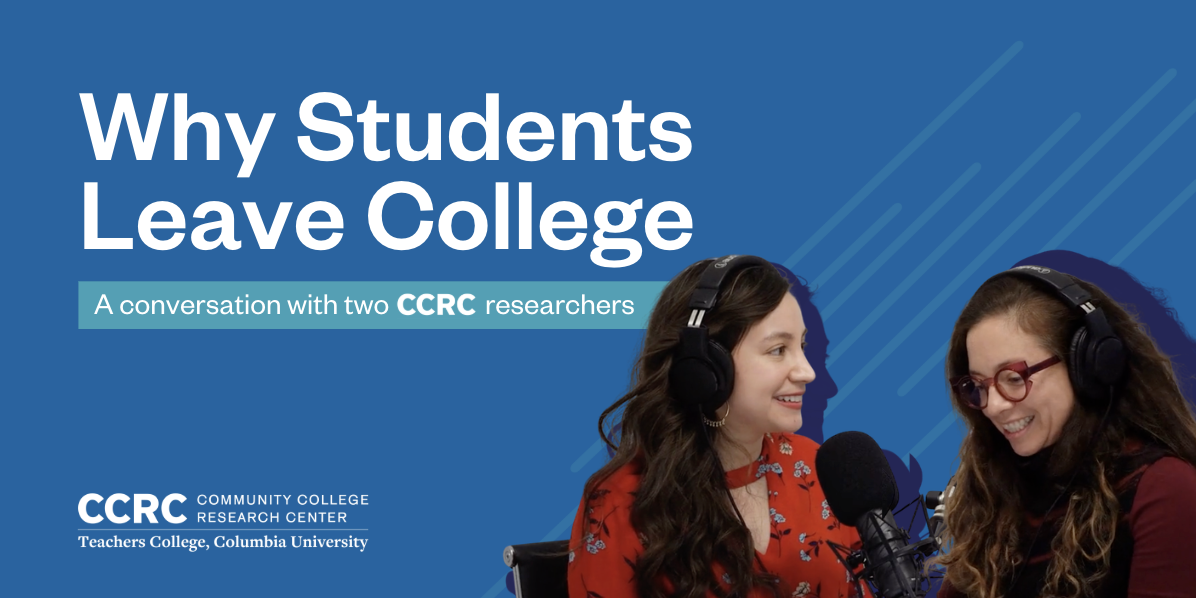
Two CCRC projects exploring why students leave college found striking parallels in students’ reasons for leaving. Though the projects came at the question from different directions, used different research methods, and included different populations, they found that students had similar stories to tell.
CCRC researchers Veronica Minaya and Andrea Lopez Salazar recently sat down to compare notes on what they found about the reasons students leave college and what community colleges can do to keep them enrolled or to help them reenroll. Minaya’s study used a longitudinal survey to explore the reasons students in California, Ohio, Maryland, and Texas left before the start of their second year and to compare their first-year experiences with similar students who didn’t leave. The report grew out of a larger study on how students choose programs of study.
The opportunities colleges provide to help students explore programs and majors in their first year are very important to students’ decisions, along with students’ feelings of connection to the college, Minaya said.
“Improving the day-to-day experience and the quality of the course, of the teaching, is also important,” she said. “What happens in the classroom is determinant to their decision to leave. And how can we engage them while we are still with them?”
Lopez Salazar’s study examined the support networks of first-generation college students in California. Interview and survey data with students who stopped out of college during the study allowed her team to explore first-generation students’ reasons for stopping out and who they turned to for support as they made the decision.
Lopez Salazar recommended that colleges make sure that first-generation students have a point person they can talk to about how to navigate college.
“When students do stop out, how do you have a system in place that helps them with reentry? Students also share that they do want to come back,” Lopez Salazar said. “How do you make sure that students know that door is open whenever they’re ready?”
Transcript
Andrea Lopez Salazar: Well, hi Vero.
Veronica Minaya: Hi Andrea. How are you?
Lopez Salazar: So excited to be here with you. I’m Andrea Lopez Salazar and I’m a research associate at the Community College Research Center. I’m joined here by Vero, Veronica Minaya, who is a senior research associate at CCRC. So the goal of our conversation today is to share a little bit more about two studies. So Vero looked at students overall who stop out of college whereas I looked at first-generation college students. So before we really focus on efforts to re-engage and prevent student stopout, we really want to learn more and share with you all about why students stop out in the first place.
So Vero, I have a question here for you. How did you approach studying this group of students?
Minaya: We originally intended to study how students, first-time-in-college students at community colleges, make major and career choices over time and what are the factors that determine their choices. And, as part of that big project, we became very interested in also understanding why they leave. So, we asked questions about their first experiences, their first-year experiences with their peers, with faculty, with the staff, how they experienced courses and programs, how the programs fit their career goals. And then we also used control groups, or like a comparison group of students, to then compare how the experiences of those who left compare to those who don’t leave, who stay in college, and those who are not yet leaving but are considering leaving.
Andrea, tell me about your project and how the new brief on stop-out students fits in.
Lopez Salazar: Okay. So, our project on stop-out students grew out of a larger study on first-generation college students’ networks at California public institutions. That larger project was mixed methods, combining a social network survey and follow-up one-on-one interviews. So, we really approached this project with a strong focus on learning directly from students. And what became very clear is that their decisions to stop out were very complex.
And Vero, what did you learn about the reasons students gave for leaving college?
Minaya: So, in our study we merged student survey responses with administrative records, with their transcript records. So, we were able to not only analyze their survey responses but also to see how they are performing in college and what were their original intentions that they declared to the colleges. With that rich data merged, we learned that the reason for leaving is not just a single reason and that leaving college is not a one-time decision for students. Instead, pressures—financial pressures, academic challenges or their self-perception of ability to succeed in college, as well as their first experiences in their program and courses and other external factors—they can all stack up and pile up. So, there’s no one single reason, they accumulate. And that’s one of the biggest learnings from the survey and from this project.
A second thing that we learned is that the finances and perceived academic struggle are also central when explaining their decisions to leave. And the stress related to their coursework, which is something that also in a different project, we learned about mental health. That is also important for students to persist in college. And we also learned that even for those who leave, it’s not that they are not thinking of coming back. So, we don’t have to just consider them as gone. Students who leave, most of them their intention is to come back.
So, Andrea, what did you learn about why first-generation students stop out and how they made this decision and who they turn to?
Lopez Salazar: So, one thing that we learned from our study is that students make the decision to stop out on their own, often without talking with anyone at the college. In our sample, students left for several reasons, for financial pressures, for family responsibilities, for work, or other competing demands. And these challenges felt even harder when students were unsure about their academic pathways or felt like they did not belong on campus. And after deciding to leave, they typically went to a partner, a sibling, or a parent for support. College-based supports were rarely part of the decision-making process. In many cases, students left college without informing anyone of their decision to leave. And I think that was definitely something very surprising for us is knowing that students are leaving and they’re just not informing anyone at the college about their decision to leave.
Vero, was there a finding that struck you as especially important?
Minaya: One of the findings was what I mentioned before, that even when they left, they still believe in college. And I think that’s important to emphasize, the perception of the value of college even among those who left college. A second finding that is highly actionable is how predictive their first-year experiences are to their decision to leave. And it’s very interesting to find that those who left, they reported that it’s mostly because of reasons related also to their majors and programs, and I think you referred to that or alluded to that. They reported that they didn’t see the program that they chose as a good fit, for instance. Or they also reported, as a first-year experience, that they were not very clear about the requirements or the courses that they were supposed to take. Or they also reported some scheduling barriers, for instance, course scheduling. And some of those experiences are highly correlated with their decision to leave later on.
Okay, Andrea are there any student stories that have stuck with you?
Lopez Salazar: One story that particularly stands out to me is a story of a student who decided to leave college because, one, the major that he was really interested in was not available at his college and, two, because he wanted to start a business just like his dad had started. And it made me wonder, you know, to what extent did his advisors or other college staff talk to him about different resources, majors, or programs at the college that are helpful for students who want to start a business or who seek a career as an entrepreneur. And it really showed me that it’s important to help students see these resources, these options, when they feel like there’s only one major, one program available to them. So, it’s this or nothing.
What are the lessons for colleges in what you heard from students?
Minaya: When we think about that, we have to think about all the navigation constraints that the students during their first time in college have to face when there’s no clarity in terms of the pathways that they are following, or the courses that they are supposed to take to fulfill their coursework, or if the program that they are interested in is really good for them and fits their career goal. So, some of the career and program exploration early on is also very important when we think about actions that can potentially inform their decision to leave during their first year of enrollment. I also think one of our findings is also the importance of how they feel as students and how they feel connected to the colleges, and to their programs, and to the courses that they are taking, and how they perceive themselves as confident to succeed in these programs and courses.
So, improving the day-to-day experience and the quality of the course, of the teaching, is also important. What happens in the classroom is determinant of their decision to leave and how can we engage them while we are still with them, when we still have them? Also building belonging through structured connections—connections among themselves, connections with the faculty, connections with the staff, connections with the industry, with future employers—so they can see that their academic pathways are leading to actual careers where they’re going to find jobs. How we can integrate also mental health and basic needs supports is also important. Many students have reported financial constraints or just shocks that they cannot control that, if we provide these supports, maybe that’s going to help them cope with these shocks. And lastly, I think plan for re-entry. Many of the students that we surveyed, they have plans and they intend to come back, and that’s very important. It’s not a one-time decision. The fact that they are reporting that they want to come back, that means a lot.
What can colleges do to address the issues that make first-generation students stop out?
Lopez Salazar: I think, first, colleges can make a big difference by ensuring that first-generation college students do have a point person, someone that they can go to for any questions on how to do college. A lot of the students in our study did not have that. And, also, similar to what you said, when students do stop out, how do you have a system in place that helps them with re-entry? Students also shared that they do want to come back, right? But when you think about it, they left and no one noticed. No one at the college noticed, according to them. So if you have someone that is knocking on the door and saying, “Hey, we’re here whenever you’re ready. Come back,” that really matters. So how do you make sure that students know that door’s open whenever they’re ready?
Vero, it was so great to talk to you and learn more about your research and just seeing the ways that our projects really complement each other.
Minaya: Same, Andrea. Like so happy we had some time to really discuss our projects and our findings.