

Skip to content
Teachers College logo
CCRC's 30th Anniversary Logo
  • About Us
    • About CCRC
    • CCRC Staff
    • Advisory Board
    • Biennial Report
    • Employment
    • Contact
    • About CCRC
    • CCRC Staff
    • Advisory Board
    • Biennial Report
    • Employment
    • Contact
  • News
    • CCRC in the News
    • Opinion
    • Press Releases
    • CCRC in the News
    • Opinion
    • Press Releases
  • Community College FAQs
  • Research Areas
    • Dual Enrollment
    • Developmental Education
    • Guided Pathways
    • Advising & Student Supports
    • Teaching & Learning
    • Transfer
    • Workforce Education
    • Dual Enrollment
    • Developmental Education
    • Guided Pathways
    • Advising & Student Supports
    • Teaching & Learning
    • Transfer
    • Workforce Education
  • Publications
  • Blog
  • Resources
    • Data Tools
    • Policy Fact Sheets & Briefs
    • Guided Pathways Workshops
    • Data Tools
    • Policy Fact Sheets & Briefs
    • Guided Pathways Workshops
  • More
    • Events
    • Research Projects
    • Events
    • Research Projects
  • Overview
  • Important Dates
  • FAQs
  • Overview
  • Important Dates
  • FAQs
  • Overview
  • Important Dates
  • FAQs

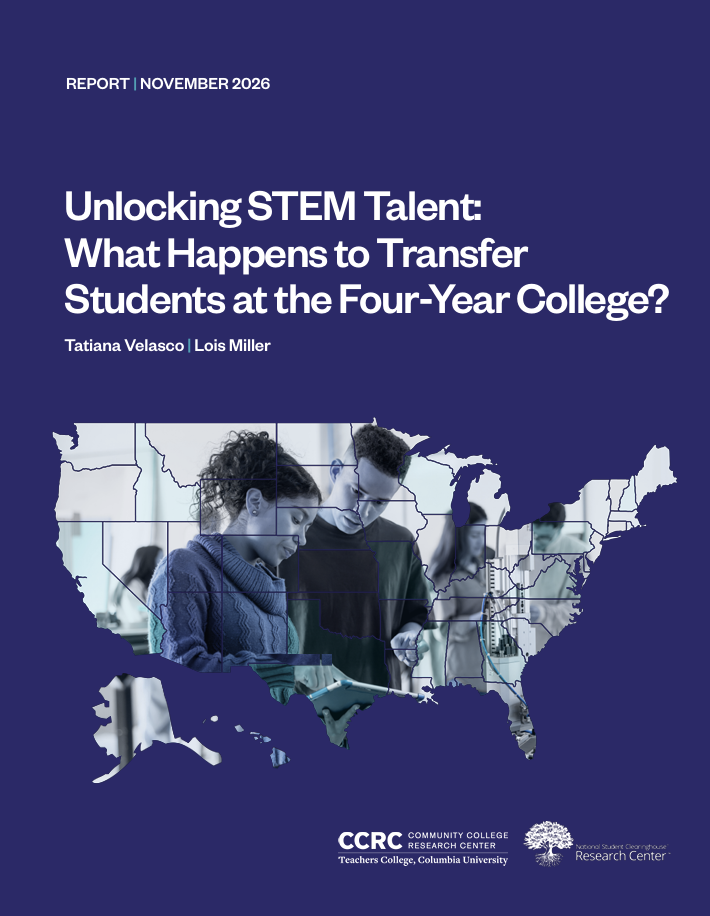
Unlocking STEM Talent: What Happens to Transfer Students at the Four-Year College?

By Tatiana Velasco & Lois Miller

Community colleges represent a vital source of talent for four-year institutions seeking to expand the STEM pipeline and meet regional workforce needs. Analyzing National Student Clearinghouse data for the 2015-16 national cohort of four-year college entrants who completed a bachelor’s degree within six years—a total of 1,723,349 students, 19% of whom were community college transfers—this report shows that transfers accounted for nearly 56,000 STEM bachelor’s graduates. However, substantial untapped potential remains: Among bachelor’s completers, transfers were less likely than non-transfers to earn a STEM degree (17% versus 23%). Equalizing this representation would yield an estimated 18,400 additional STEM transfer graduates.

STEM transfer students face a longer path to bachelor’s degree completion, spending an average of 0.4 additional years at four-year institutions compared to non-STEM transfers—a pattern particularly acute in fields that require strict multi-course sequences, such as engineering. Black, Hispanic, and low-income students face the greatest barriers along transfer pathways. Women are the least likely to complete in STEM, but female transfer graduates demonstrate higher on-time bachelor’s completion due to spending fewer years enrolled pre-transfer. The report also considers enrollment in graduate study: Only 12% of STEM transfers enrolled in a graduate program in the year following bachelor’s completion, compared to 17% of STEM non-transfers.

Wide variation across state contexts and student backgrounds shows that better outcomes are achievable. Transfer graduates with prior dual enrollment were more likely to complete in STEM than transfer graduates in general (20% versus 17%), and they were substantially more likely to earn their bachelor’s degree within four years (24% versus 16%). States such as Washington and California—which feature strong transfer infrastructure and institutional alignment—had high outcomes on several measures. The report is accompanied by an interactive data dashboard [link] in which users can compare outcomes by state. It concludes with key recommendations for four-year institutions, community colleges, and state higher education systems.

  • Broadening STEM Bachelor’s and Graduate Attainment Through Transfer

Download Links

Download report
November 2026
Download executive summary
November 2026
View data dashboard
November 2026
View press release
November 2026

Related Publications

October 2024

The Postsecondary Outcomes of High School Dual Enrollment Students: A National and State-by-State Analysis

February 2024

Tracking Transfer: Community College and Four-Year Institutional Effectiveness in Broadening Bachelor’s Degree Attainment

Related Presentations

October 2026

Unlocking STEM Talent: National and State Insights on Community College Transfer Pathways 

Additional Resources

For more policy briefs and fact sheets, visit CCRC’s Policy Resources page.

Stay in Touch!

Subscribe to our newsletter for the latest on our research, including publications, blog posts, and upcoming events.
Subscribe

Community College Research Center, Teachers College, Columbia University
Box 174 | 525 West 120th Street, New York, NY 10027

  • 212.678.3091
  • ccrc@columbia.edu
Facebook-f Twitter Linkedin Youtube Instagram

© 2026. All rights reserved.

RESEARCH AREAS

  • Dual Enrollment
  • Developmental Education
  • Guided Pathways
  • Advising & Student Supports
  • Teaching & Learning
  • Transfer
  • Workforce Education
  • Dual Enrollment
  • Developmental Education
  • Guided Pathways
  • Advising & Student Supports
  • Teaching & Learning
  • Transfer
  • Workforce Education
  • CC FAQs
  • About CCRC
  • Biennial Report
  • CCRC Staff
  • Employment
  • CC FAQs
  • About CCRC
  • Biennial Report
  • CCRC Staff
  • Employment
  • Publications
  • Blog
  • Data Tools
  • Policy Fact Sheets & Briefs
  • Events
  • Publications
  • Blog
  • Data Tools
  • Policy Fact Sheets & Briefs
  • Events
  • About Us
    • About CCRC
    • CCRC Staff
    • Advisory Board
    • Biennial Report
    • Employment
    • Contact
  • Research Areas
    • Dual Enrollment
    • Developmental Education
    • Guided Pathways
    • Advising & Student Supports
    • Teaching & Learning
    • Transfer
    • Workforce Education
  • Publications
  • Blog
  • Community College FAQs
  • News
    • CCRC in the News
    • Opinion
    • Press Releases
  • More
    • Data Tools
    • Events
    • Guided Pathways Workshops
    • Policy Fact Sheets & Briefs
    • Research Projects