


Preparing students to transfer to a university and earn a bachelor’s degree has long been a primary mission of community colleges. Four of every five entering community college students seek to transfer and earn at least a bachelor’s degree—a credential that is increasingly needed to secure a good job with family-sustaining wages. Students may opt for this transfer pathway to a bachelor’s degree because community colleges are more affordable and closer to home than four-year colleges.
What the Research Tells Us
Only a fraction of community college students who intend to transfer ever complete a bachelor’s degree, and rates are even lower for low-income, older, male, Black, and Hispanic students.
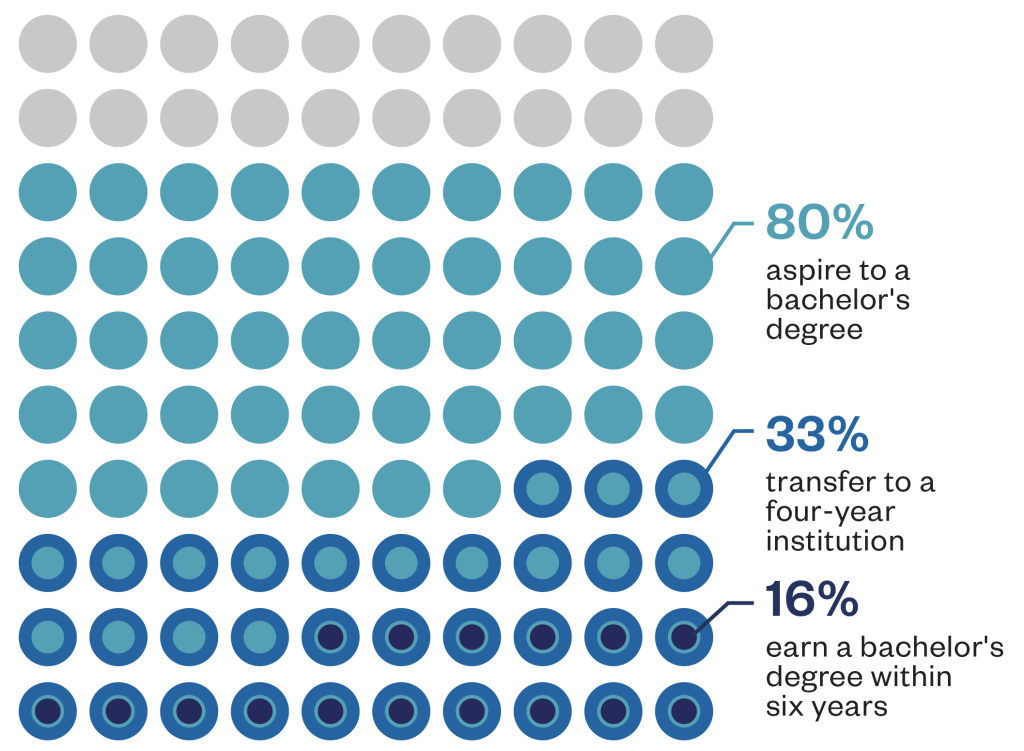
- Though about 80% of community college students aspire to a bachelor’s degree, only 33% of them transfer to a four-year institution, and only 16% earn a bachelor’s degree within six years of starting college.[1][2]
- In fall 2024, 52% of transfers came from the top two quintiles of neighborhood income and 27% came from the bottom two quintiles.[3] Only 11% of low-income community college students earn a bachelor’s degree in six years.[4]
- About 9% of Black students, 13% of Hispanic students, and 6% of older students earn a bachelor’s degree within six years of starting college.[5]
The type of college that students transfer to may affect their outcomes.
- At public four-year institutions, 57% of community college transfer students complete a bachelor’s degree within four years after transferring. At private nonprofit four-year colleges and universities, 44% do so.[6]
- Only 23%–25% of transfer students at private for-profit and predominantly online institutions complete a bachelor’s within four years of transferring. Black community college transfers are twice as likely as other students to enroll in these institutions.[7]
Though the transfer pathway is nominally designed for full-time students to spend two years at a community college and two years at a four-year college, the paths to successful transfer in a chosen major are often unclear, and there can be many obstacles to successful transfer
- Many students transfer more than once or stop out before transfer. Only 8% of successful community college transfer students follow the 2+2 sequence. Many students graduate after six years or longer.[8]
- A growing number of students attempt to transfer dual enrollment credits.[9] Former dual enrollment students transfer and complete bachelor’s degrees at much higher rates than students without dual enrollment.[10]
- Many community college students who transfer lose credits and risk running out of financial aid benefits before earning a degree.[11]
- Transfer credit loss decreases students’ chances of completing a bachelor’s degree and adds extra time and cost for students who do complete a bachelor’s degree.[12][13]
- Though early advising is important for successful transfer, many community college students don’t have firm transfer plans and are not aware of advising resources.[14] Half of students who intend to transfer do not use transfer advising services.[15]
- Sixty-seven percent of transfer students who complete a pre-transfer community college award, such as an associate degree, graduate within four years of transferring, compared with 42% of students without a pre-transfer award.[16]
- Four-year college policies may not account for the needs of transfer students, creating obstacles to course registration, financial aid, housing, and more.[17] Transfer students can be excluded from institutional aid, scholarships, and co-curricular opportunities, such as undergraduate research and leadership development.[18]
Community colleges are working with states and four-year colleges to create more efficient transfer pathways to improve graduation rates and economic mobility and support transfer enrollments at four-year colleges.
- Community college transfer pathways are a major source of enrollments and diversity at four-year institutions.[19]
- Many community colleges and their four-year partners have created structured transfer pathways by major to smooth transfer and minimize lost credits.[20]
- More than 30 states require four-year institutions to accept a core of general education courses or courses fulfilling an associate degree to transfer as a block. Other states have developed common course numbering.[21]
Policy Considerations
- State policymakers should use data on transfer and bachelor’s completion rates, broken down by student group and college, to identify critical areas for improvement.[22]
- States and systems should support colleges’ work on the creation of structured transfer pathways to promote timely bachelor’s completion within a major and the tailoring of transfer advising supports to foster student trust, engagement, and effective planning.[23]
- Four-year institutions should assume a more proactive role in creating transfer partnerships with community colleges that provide students with credit transferability, advising, and other supports.[24] Four-year institutions receiving community college transfer students should be held accountable when not delivering for their students.[25]
- Community colleges and states should further explore and expand the potential of dual enrollment to improve transfer outcomes of underserved students.[26]
Endnotes
- Center for Community College Student Engagement. (2023). Helping students climb the transfer ladder. https://cccse.org/NR2023
- Velasco, T., Fink, J., Bedoya-Guevara, M., Jenkins, D., & LaViolet, T. (2024a). Tracking transfer:
Community college effectiveness in broadening bachelor’s degree attainment. Community College Research Center, Teachers College, Columbia University. https://ccrc.tc.columbia.edu/publications/Tracking-Transfer-Community-College-and-Four-Year-Institutional-Effectiveness-in-Broadening-Bachelors-Degree-Attainment.html - Shapiro, D., Velasco, T., & Wyner, J. (2025). Transfer turnaround: Rebounding enrollments and
recommendations from the updated Transfer Playbook. [Webinar slides]. Community College Research Center, Teachers College, Columbia University. https://ccrc.tc.columbia.edu/presentation/transfer-turnaround-rebounding-enrollments.html - Velasco et. al (2024a).
- Velasco et. al (2024a).
- Velasco, T., Fink, J., Bedoya-Guevara, M., Jenkins, D., & LaViolet, T. (2024b). Tracking transfer:
Four-year institutional effectiveness in broadening bachelor’s degree attainment. Community
College Research Center, Teachers College, Columbia University. https://ccrc.tc.columbia. edu/publications/Tracking-Transfer-Community-College-and-Four-Year-Institutional-Effectiveness-in-Broadening-Bachelors-Degree-Attainment.html - Velasco et. al (2024b).
- Fink, J. (2017). Visualizing the many routes community college students take to complete a bachelor’s degree. The CCRC Blog. https://ccrc.tc.columbia.edu/easyblog/visualizing-many-routes-bachelors-degree.html
- Fink, J. (2025). High school dual enrollment grows to 2.8 million. The CCRC Blog. https://ccrc.
tc.columbia.edu/easyblog/high-school-dual-enrollment-grows.html - Velasco et. al (2024b).
- U.S. Government Accountability Office. (2017). Higher education: Students need more information
to help reduce challenges in transferring college credits (GAO-17-574). https://www.gao.gov/
products/gao-17-574 - Monaghan, D. B., & Attewell, P. (2015). The community college route to the bachelor’s
degree. Educational Evaluation and Policy Analysis, 37(1), 70–91. https://doi.
org/10.3102/0162373714521865 - Xu, D., Jaggars, S. S., Fletcher, J., & Fink, J. (2018). Are community college transfer students “a good bet” for 4-year admissions? Comparing academic and labor-market outcomes between transfer and native 4-Year college students. The Journal of Higher Education, 89(4), 478–502. https://doi.org/10.1080/00221546.2018.1434280
- Center for Community College Student Engagement. (2023).
- Center for Community College Student Engagement. (2018). Show me the way: The power
of advising in community colleges. The University of Texas at Austin, College of Education,
Department of Educational Leadership and Policy, Program in Higher Education Leadership. https://cccse.org/NR2018 - Velasco et. al (2024b).
- LaViolet, T., Masterson, K., Anacki, A., Wyner, J., Fink, J., Garcia Tulloch, A., Steiger, J., & Jenkins,
D. (2025). The transfer playbook (second edition): A practical guide for achieving excellence in
transfer and bachelor’s attainment for community college students. The Aspen Institute College
Excellence Program and Community College Research Center, Teachers College, Columbia
University. https://ccrc.tc.columbia.edu/publications/transfer-playbook-second-edition.html - Ishitani, T. T., McKitrick, S. A. (2010). After transfer: The engagement of community college
students at a four-year collegiate institution. Community College Journal of Research and Practice,
34(7), 576–594. https://eric.ed.gov/?id=EJ884031 - Velasco et. al (2024b).
- LaViolet et al. (2025).
- Whinnery E., & Peisach, L. (2022). 50-state comparison: Transfer and articulation policies. Education Commission of the States. https://www.ecs.org/50-state-comparison-transfer-and-articulation/
- Velasco, T. (2024, March 22). How to boost community-college transfers.
The Chronicle of Higher Education. https://www.chronicle.com/article/how-to-boost-community-college-transfers?sra=true - LaViolet et al. (2025).
- Jabbar, H., & Schudde, L. (2024, October 3). The community-college transfer system is broken.
Who’s to blame? The Chronicle of Higher Education. https://www.chronicle.com/article/the-community-college-transfer-system-is-broken-whos-to-blame - Velasco, T. (2024, March 22).
- Velasco, T. (2024, March 22).
