


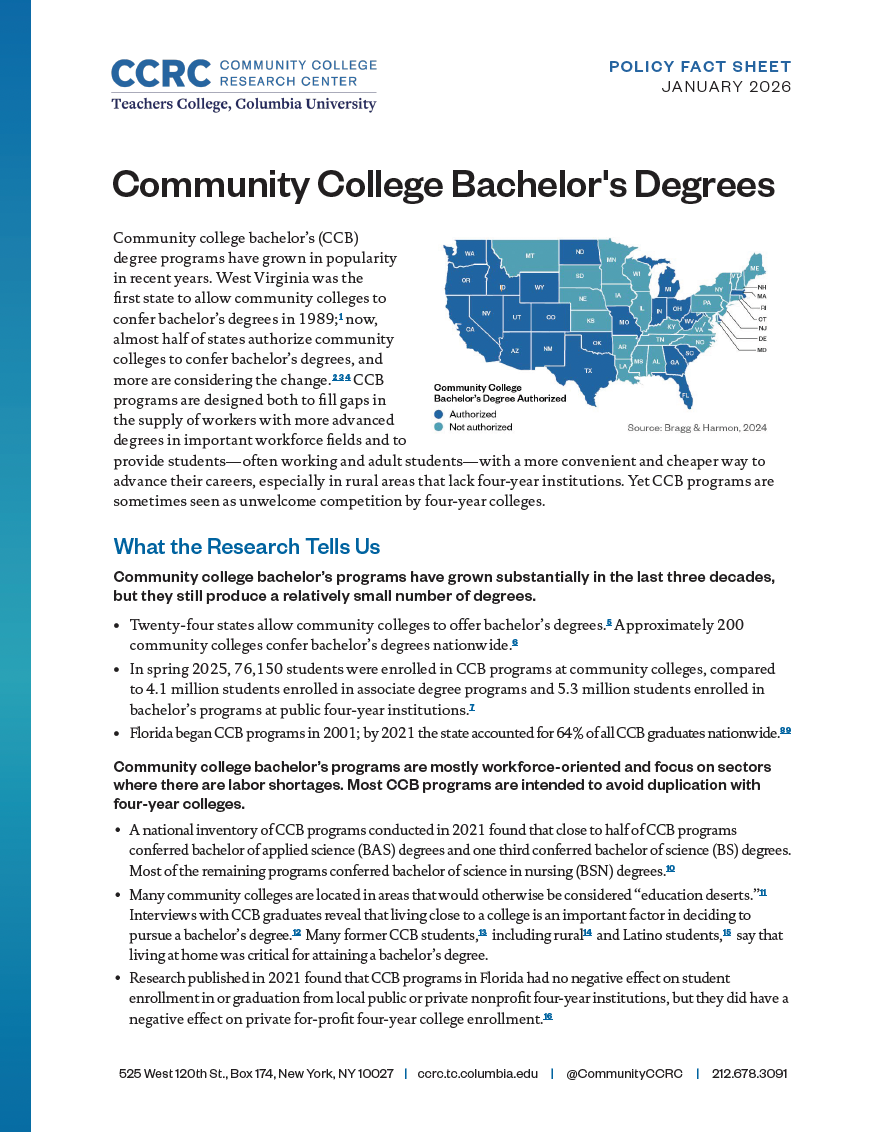
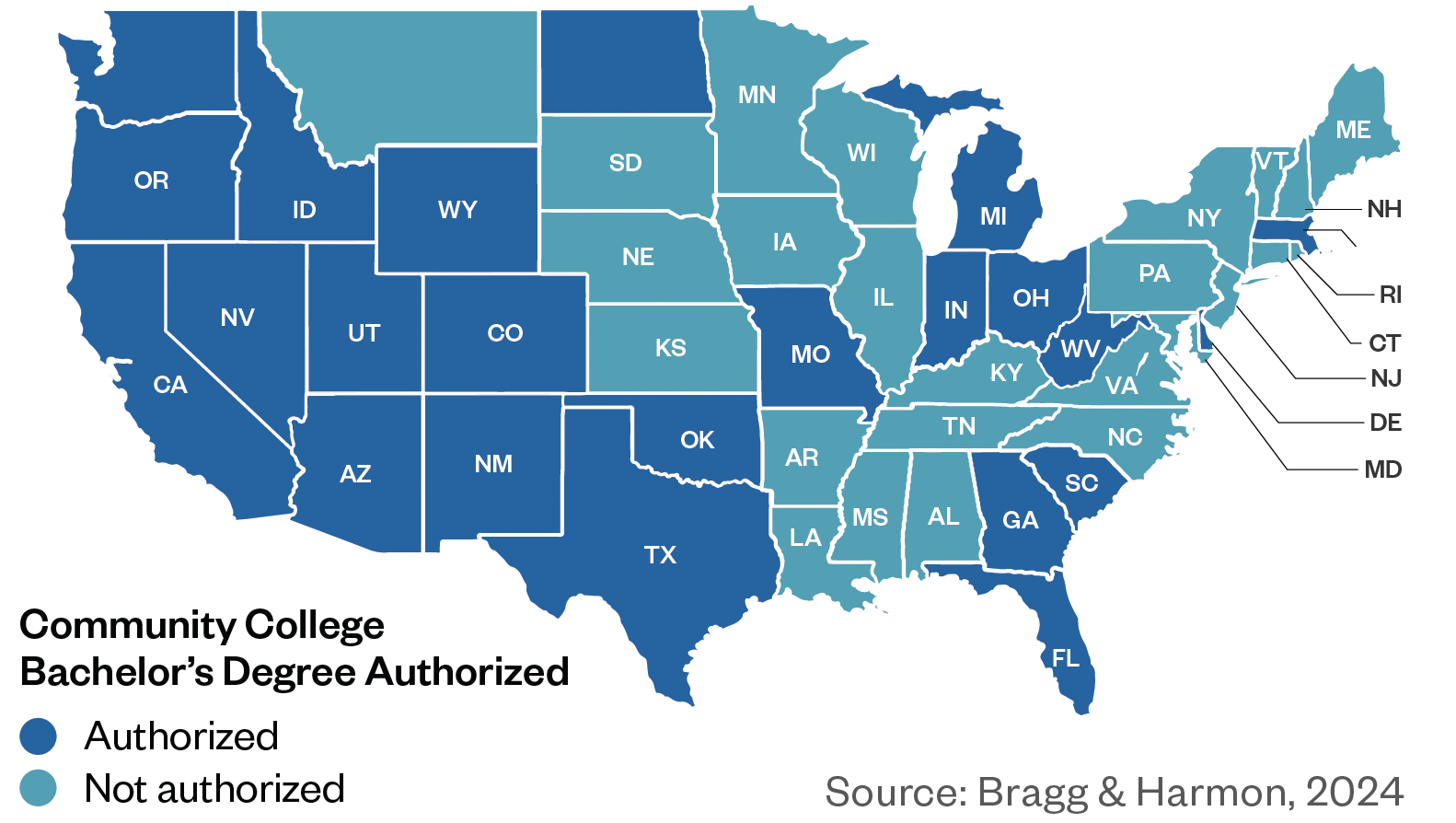
Community college bachelor’s (CCB) degree programs have grown in popularity in recent years. West Virginia was the first state to allow community colleges to confer bachelor’s degrees in 1989;[1] now, almost half of states authorize community colleges to confer bachelor’s degrees, and more are considering the change. [2] [3] [4] CCB programs are designed both to fill gaps in the supply of workers with more advanced degrees in important workforce fields and to provide students—often working and adult students—with a more convenient and cheaper way to advance their careers, especially in rural areas that lack four-year institutions. Yet CCB programs are sometimes seen as unwelcome competition by four-year colleges.
What the Research Tells Us
Community college bachelor’s programs have grown substantially in the last three decades, but they still produce a relatively small number of degrees
- Twenty-four states allow community colleges to offer bachelor’s degrees.[5] Approximately 200 community colleges confer bachelor’s degrees nationwide.[6]
- In spring 2025, 76,150 students were enrolled in CCB programs at community colleges, compared to 4.1 million students enrolled in associate degree programs and 5.3 million students enrolled in bachelor’s programs at public four-year institutions.[7]
- Florida began CCB programs in 2001; by 2021 the state accounted for 64% of all CCB graduates nationwide.[8] [9]
Community college bachelor’s programs are mostly workforce-oriented and focus on sectors where there are labor shortages. Most CCB programs are intended to avoid duplication with four-year colleges.
- A national inventory of CCB programs conducted in 2021 found that close to half of CCB programs conferred bachelor of applied science (BAS) degrees and one third conferred bachelor of science (BS) degrees. Most of the remaining programs conferred bachelor of science in nursing (BSN) degrees.[10]
- Many community colleges are located in areas that would otherwise be considered “education deserts.”[11] Interviews with CCB graduates reveal that living close to a college is an important factor in deciding to pursue a bachelor’s degree.[12] Many former CCB students,[13] including rural[14] and Latino students,[15] say that living at home was critical for attaining a bachelor’s degree.
- Research published in 2021 found that CCB programs in Florida had no negative effect on student enrollment in or graduation from local public or private nonprofit four-year institutions, but they did have a negative effect on private for-profit four-year college enrollment.[16]
Community college bachelor’s programs provide access to students who might not otherwise earn a bachelor’s degree, but equity gaps persist in college and after graduation.
- Research in Florida and Washington suggests that, compared to public university graduates in similar programs, CCB graduates are more likely to be Black and Latino.[17]
- Research in Washington State suggests that compared to other community college students, CCB students are older, more likely to receive need-based financial aid, more likely to have some prior college credits, and more likely to be veterans.[18]
- There is mixed evidence that CCB programs help address college equity gaps. In Texas, Latino students are overrepresented in CCB programs, but Latino graduates of CCB programs earned lower wages compared to White graduates of CCB programs. In Washington, Latino students are underrepresented in CCB programs, but the annualized earnings of Latino CCB program graduates in the state were similar to those of other racial/ethnic groups.[19]
- Research in Washington finds that overall CCB graduation rates are similar to those of transfer students and that American Indian, Black, Latino, and Native Hawaiian students in CCB programs graduate at higher rates than transfer students in those groups. But completion gaps remain between groups.[20] [21] [22]
Community college bachelor’s program graduates earn more than graduates with associate degrees. However, returns are higher for graduates of four-year colleges.
- An evaluation of 13 of the 24 states offering CCB programs found an average annual wage premium of $4,000–$9,000 for CCB graduates over associate degree graduates. CCB graduates earned $2,000 less per year than university graduates, though variation was reported by field of study.[23]
- In Florida, CCB graduates earn $10,000 more on average than associate degree graduates one year after graduation—though these earnings vary widely by field of study and population group. Male CCB graduates experience particularly strong wage increases.[24]
- Research in Washington State shows that average earnings for CCB graduates a year after graduation exceed those of university graduates in similar fields. However, three years post-graduation, university graduates’ earnings outstrip those of CCB graduates.[25]
Policy Considerations
- CCB programs can be used to fill gaps in regional labor markets, and they may provide important avenues to bachelor’s degrees for underserved students, particularly those who do not live close to four-year institutions.
- Some states have enacted legislation to minimize competition with four-year colleges and to ensure program value by considering whether similar programs are offered at nearby four-year campuses or by requiring demonstrated employer or student interest in proposed bachelor’s programs.[26]
- Research suggests that strong employer partnerships, intentional support for adult students, and clear career pathways for graduates enhance program quality.[27] [28] [29]
- CCB programs help students financially because of their low tuition compared to four-year institutions.[30] However, maintaining a CCB program can present additional costs to community colleges as they must acquire regional accreditation and hire doctoral-level faculty.[31] Some states allow community colleges to charge additional tuition or fees for upper-division coursework in bachelor’s degree programs.[32]
- It is important that colleges clearly communicate pathways and their potential earnings outcomes to students.[33] More research is needed to understand how colleges can address earnings gaps between bachelor’s graduates of four-year institutions and community colleges.
Endnotes
- Fulton, M. (2020). Community college bachelor’s degrees: An update on state activity and policy considerations. Education Commission of the States. https://www.ecs.org/wp-content/ uploads/Community-College-Bachelors-Degrees.pdf
- Bragg, D., & Harmon, T. (2024). Twenty frequently asked questions about community college baccalaureate degrees. Community College Baccalaureate Association. https://www.accbd.org/ wp-content/uploads/2024/01/24.1.18-v.2-FAQ-Designed-w_-Cover-Page-Logos-1.pdf
- Draisey, B. (2025, October 2). Iowa community college association report plots path to bachelor’s degrees. Iowa Capital Dispatch. https://iowacapitaldispatch.com/2025/10/02/ iowa-community-college-association-report-plots-path-to-bachelors-degrees/
- Hancock, P. (2025, February 19). Pritzker to call for expansion of 4-year degree offerings at some community colleges. Capitol News Illinois. https://capitolnewsillinois.com/news/ pritzker-to-call-for-expansion-of-4-year-degree-offerings-at-some-community-colleges/
- Bragg & Harmon (2024).
- Bragg, D. (2024). Tracking the growth of CCB degrees in the U.S.: New results and important perspectives [Webinar]. Community College Baccalaureate Association. https://www.accbd. org/2024/01/03/the-latest-ccb-data-tracking-the-growth-of-ccb-degrees-in-the-u-s-new-results-and-important-perspectives/
- Kim, H., Berg, B., Karamarkovich, S., Holsapple, M., & Shapiro, D. (2025). Current term enrollment estimates: Spring 2025. National Student Clearinghouse Research Center. https://nscresearchcenter.org/current-term-enrollment-estimates/
- Thai, T., & Love, I. (2024). Community college bachelor’s degrees in Florida. New America. https://www.newamerica.org/education-policy/briefs/ community-college-bachelors-degrees-in-florida/
- Bragg (2024).
- Love, I., Bragg, D., & Harmon, T. (2021). Mapping the community college baccalau-reate: An inventory of the institutions and programs comprising the current landscape. New America. https://www.newamerica.org/education-policy/briefs/ mapping-the-community-college-baccalaureate/
- Hillman, N. (2019). Place matters: A closer look at education deserts. Third Way. https://www. thirdway.org/report/place-matters-a-closer-look-at-education-deserts
- Wetzstein, L., Meza, E., & Bragg, D. (2022). Evaluating the student experience at community college baccalaureate programs. New America. https://www.newamerica.org/education-policy/ briefs/evaluating-the-student-experience-at-community-college-baccalaureate-programs/
- Wetzstein et al. (2022).
- Meza, E. (2025). Rural residents turn to community colleges for bachelor’s degrees. New America. https://www.newamerica.org/education-policy/edcentral/ rural-residents-turn-to-community-colleges-for-bachelors-degrees/
- Rios-Aguilar, C., Vo, D., Meza, E., & Bragg, D. (2025). A multi-state analysis of Latinos in community college bachelor’s degree programs. UCLA Latino Policy & Politics Institute. https:// latino.ucla.edu/wp-content/uploads/2025/10/A-Multi-State-Analysis-of-Latinos-in-Community-College-Bachelors-Degree-Programs.pdf
- Kramer, D. A., II, Ortagus, J. C., & Donovan, J. (2021). Competing for bachelor’s degrees: Are community colleges cutting into the market share of 4-year institutions? American Educational Research Journal, 58(2), 343–385. https://doi.org/10.3102/0002831220946309
- Meza, E., & Love, I. (2022). Community college baccalaureate programs as an equity strategy: Student access and outcomes data. New America. https://www.newamerica.org/education-policy/briefs/community-college-baccalaureate-programs-as-an-equity-strategy-student-access-and-outcomes-data/
- Meza & Love (2022).
- Rios-Aguilar et al. (2025).
- Bragg & Harmon (2024).
- Meza, E., & Bragg, D. (2020). Community college baccalaureate degree completion in Washington. Community College Research Initiatives, University of Washington. https://www.washington. edu/ccri/newba_dn4/
- Rios-Aguilar, C., Cuéllar, M. G., Bañuelos, N., Lyke, A., & Vo, D. (2023). The potential of California’s community college baccalaureate for closing racial equity gaps. The Civil Rights Project/Proyecto Derechos Civiles, UCLA. https://civilrightsproject.ucla.edu/reports/ the-potential-of-californias-community-college-baccalaureate-for-closing-racial-equity-gaps/
- Acton, R., Cortes, K., Miller, L., Morales, C., & Turner, J. (2025). Community college bachelor’s degrees: How CCB graduates’ earnings compare to AAs and BAs. Postsecondary Employment Outcomes Coalition. https://pseocoalition.org/wp-content/uploads/2025/07/PSEO-Coalition_ Community-College-Bachelor-Degrees-How-CCB-Graduates-Earnings-Compare.pdf
- Love, I. (2020). The baccalaureate and beyond: An analysis of demographics and labor market outcomes of Florida community college baccalaureate graduates. New America. https://files.eric. ed.gov/fulltext/ED609160.pdf
- Meza & Love (2022).
- Fulton (2020).
- Bragg, D., Harmon, T., Napiontek, T., Wasserman, E., & Kersenbrock, A. (2022). 20 promising practices to advance quality, equity, and success in community college baccalaureate (CCB) degree programs. Community College Baccalaureate Association. https://www.accbd.org/wp-content/ uploads/2022/07/CCBA-Ebook.pdf
- Pawlicki, C., Kersenbrock, A., & Garcia-Beaulieu, C. (2023). Measures of quality for community college bachelor’s degree programs: A literature review. Community College Baccalaureate Association. https://www.accbd.org/wp-content/uploads/2023/10/CCBA-Measures-of-Quality-Literature-Review.pdf
- Bragg, D., Endel, B., Anderson, N., Soricone, L., & Acevedo, E. (2019). What works for adult learners: Lessons from career pathway evaluations. JFF. https://files.eric.ed.gov/fulltext/ ED598339.pdf
- Bragg & Harmon (2024).
- Fulton (2020).
- Meza, E., & Pawlicki, C. (2025). How much less?: Examining the tuition and fees of bachelor’s degrees offered by community colleges. Evans School of Public Policy & Governance, University of Washington. https://evans.uw.edu/wp-content/uploads/2025/02/How-Much-Less.pdf
- Potter, M. (2020). The concurrence of colleges and universities conferring baccalaureate degrees: A case study of Washington state [Doctoral Dissertation, Northeastern University]. Northeastern University Library. http://hdl.handle.net/2047/D20351622
