


Despite reforms to developmental and gateway courses at colleges across the country, students continue to struggle in introductory math. Some students do not see math as relevant to their field of study or life, or they avoid taking math or asking for help due to math anxiety. For others, their prior math preparation did not align with college admission standards, and they are therefore deemed “unprepared” and in need of developmental education. These and other factors contribute to low success and persistence in college math.
As colleges have explored potential solutions, some have found that student collaboration with peers is an effective way to address disengagement and math anxiety. Though it can be challenging to implement collaborative and relationship-building approaches in math, one community college in California, Hartnell College, has succeeded in creating a department-wide environment where collaboration and support is the norm. Hartnell is one of four colleges that are participating in the Developmental Education Reform Innovation Incubator, a community of practice led by CCRC that supports the colleges in developing innovative classroom-level practices to positively impact student learning and success in reformed developmental education contexts.
Math Academy Prepares Students for Introductory Math
Hartnell College began reforming its developmental education courses before the California legislature mandated a shift from prerequisite to corequisite courses starting in 2017. Now, like at every California community college, all Hartnell students have access to college-level courses. Since 2009, even before developmental education reforms began, Hartnell has offered Math Academy, a free, weeklong summer and winter program primarily for students enrolled in a transfer-level math course in the subsequent term. Students taking transfer-level math with or without a corequisite are invited to participate in the program as an opportunity to refine their math skills and gain confidence before the semester begins. As part of the Innovation Incubator, Hartnell is working on expanding Math Academy to dual enrollment students and improving, sustaining, and scaling Math Academy more broadly at the college.
Established in 2024, the Developmental Education Reform Innovation Incubator is a CCRC-led project aimed at elevating innovative practices happening in colleges that have reformed their developmental education courses. In its second year, the project is facilitating a community of practice that supports four colleges in developing innovative classroom-level practices to positively impact student learning and success. Through the community of practice, colleges are able to workshop and develop ideas together, learn about each other’s work, and draw on support from CCRC. Stay tuned for a report on the project and additional blog posts sharing the innovative practices being implemented at each Incubator college.
Math Academy has several goals, including decreasing student anxiety about math and college in general, increasing math success rates, and increasing students’ use of tutoring services on campus. To accomplish this, the program builds deep relationships between students and math faculty, peers, learning center tutors, and other college support staff, while providing math practice and community-focused activities. Math Academy also uses culturally responsive teaching, including encouraging students to bring their lived experiences into math problems. In one activity, instructors ask students to look up population growth statistics from their hometowns, making the class content more relevant and interesting. The college’s internal analyses of the program have found that Math Academy participants are more likely to visit the college’s learning lab in the following term and that program participation is correlated with increased math success rates.
Math Academy at Hartnell takes advantage of the plentiful resources available on campus and empowers students to use them. From the tutoring center to mentorship activities, Math Academy introduces and acclimates students to seeking help not only in math but across the college at large. Ultimately, while the program occurs during academic breaks, the habits formed and instructional practices used carry over into the academic year.
Seeing Collaboration in Action at Hartnell
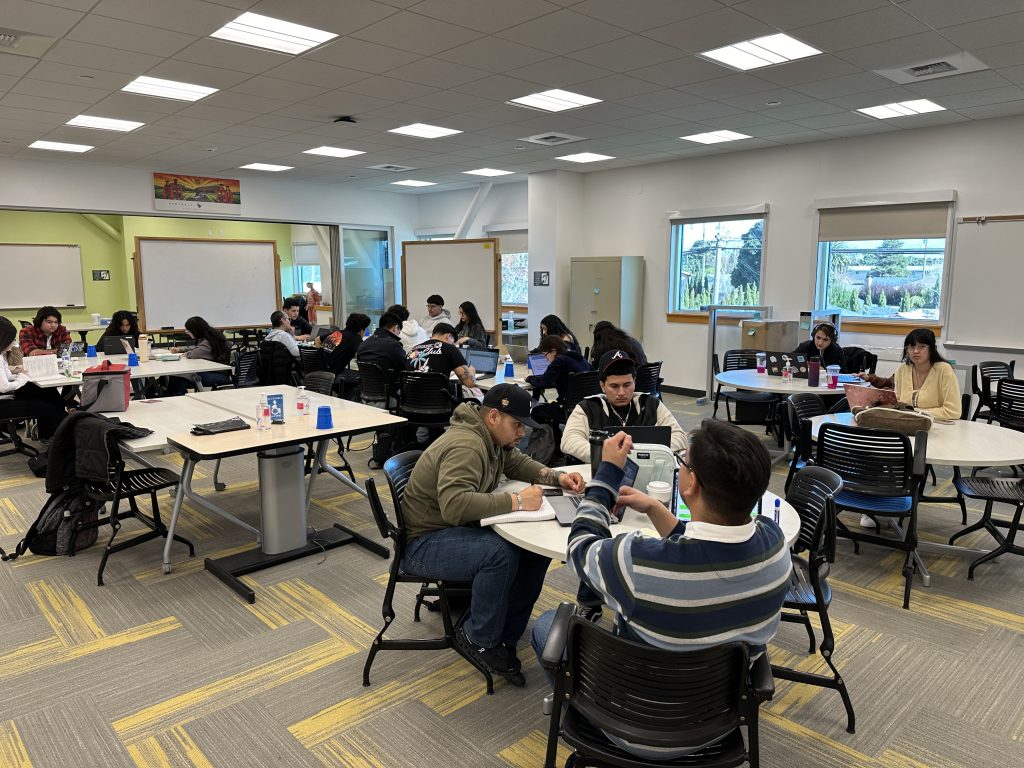
I and other researchers from CCRC were able to visit Hartnell in fall 2025 as part of the Innovation Incubator. We observed statistics and calculus classes that many Math Academy students were enrolled in, and we interviewed faculty, staff, and students to better understand their perceptions of Math Academy and its influence on math education and student success at Hartnell. Throughout our visit, it became clear that the collaboration that Math Academy intends to encourage spills over into courses and the tutoring center.
We observed multiple classes, and in every one students turned to each other to work through problems and check answers, and instructors encouraged this collaboration. In one statistics class, taught by an instructor who also teaches in Math Academy, an hour was dedicated to independent problem-solving—and students worked together in pairs or small groups to complete their problem sets. The instructor said that he wants students to make connections and feel comfortable in class.
“I feel that having those personal connections then makes them much more apt to come to class,” he said. “They feel comfortable in the class, so they keep coming to class.”
In another statistics class taught by a Math Academy instructor, students worked in pairs to check their understanding throughout the session. Additionally, students played a math game in groups where they had to discuss which answer was correct and provide an explanation. As a prize for the winning group, the professor made a class worksheet optional and extra credit. Such collaborative work is integral to these courses, with instructors and students noting that even quizzes are occasionally completed in groups or pairs.
Many students we talked to said collaboration helps them learn.
“I really struggled with working on my own, where I was kind of the lone wolf,” one student said. “It’s extremely helpful to be able to bounce ideas off of another person and to get corrections that you don’t see. And I don’t think I would have done that if I didn’t go to the last Math Academy.”
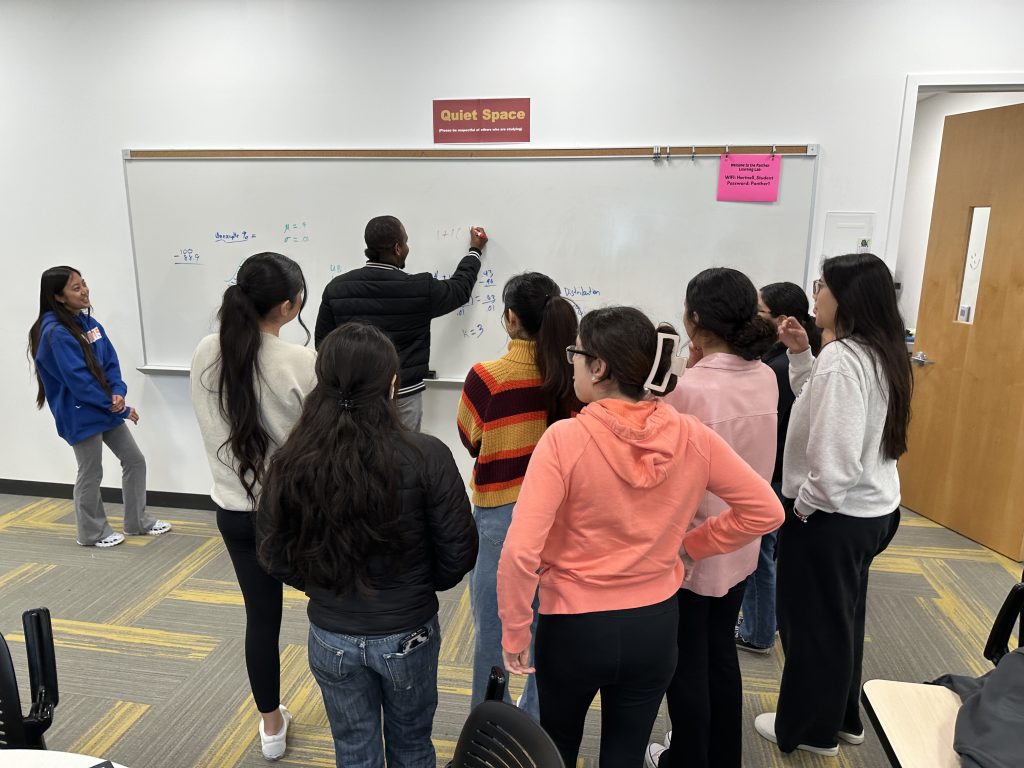
Outside of class, too, peer tutors encourage students to collaborate instead of struggling alone. We spent time at Hartnell’s tutoring center and observed tutors using whiteboards to explain concepts to a room of students, tutors working with groups of students, and students helping each other. The tutoring center was filled with a constant buzz of students discussing problems and reaching breakthroughs in their learning, an atmosphere that suggested most students were regulars who felt a sense of belonging and comfort in the space. The environment in the tutoring center not only fostered collaboration but empowered students to help each other.
Math collaboration happens across Hartnell, from the Math Academy to the classroom to the tutoring center, and this reinforcement allows it to become a habit for students. Instead of struggling alone, students build connections with each other, which helps them both understand math and feel comfortable in class and at the college.