Skip to content
  • About Us
    • About CCRC
    • CCRC Staff
    • Advisory Board
    • Biennial Report
    • Employment
    • Contact
    • About CCRC
    • CCRC Staff
    • Advisory Board
    • Biennial Report
    • Employment
    • Contact
  • News
    • CCRC in the News
    • Opinion
    • Press Releases
    • CCRC in the News
    • Opinion
    • Press Releases
  • Community College FAQs
  • Research Areas
    • Dual Enrollment
    • Developmental Education
    • Guided Pathways
    • Advising & Student Supports
    • Teaching & Learning
    • Transfer
    • Workforce Education
    • Dual Enrollment
    • Developmental Education
    • Guided Pathways
    • Advising & Student Supports
    • Teaching & Learning
    • Transfer
    • Workforce Education
  • Publications
  • Blog
  • Resources
    • Policy Resources
    • Guided Pathways Workshops
    • Policy Resources
    • Guided Pathways Workshops
  • More
    • Events
    • Research Projects
    • Events
    • Research Projects
  • Overview
  • Important Dates
  • FAQs
  • Overview
  • Important Dates
  • FAQs
  • Overview
  • Important Dates
  • FAQs
Filter

Category

  • All publications
  • High school to college
  • Dual enrollment
  • Developmental education
  • Assessment and placement
  • Guided pathways
  • Transfer
  • Advising and student supports
  • Financial aid
  • Teaching and learning
  • Workforce education
  • Returns to degrees
  • Community college policy and finance
  • Peformance funding
  • For-profit colleges

Filter by

Clear all

Author

Publication type

State

Year

Publications

Workforce education

61–80 of 134 results
  • Results per page
  • 10
  • 20
  • 50
  • All
What Explains Trends in Labor Supply Among U.S. Undergraduates, 1970-2009?
February 2012

What Explains Trends in Labor Supply Among U.S. Undergraduates, 1970-2009?

Judith Scott-Clayton
This National Bureau of Economic Research (NBER) working paper examines working patterns among traditional-age college students from 1970–2009, considers several explanations for the long-term trend of rising employment, and examines whether the upward trend is likely to resume when economic conditions improve.
Institutional Variation in Credential Completion: Evidence From Washington State Community and Technical Colleges
April 2011

Institutional Variation in Credential Completion: Evidence From Washington State Community and Technical Colleges

Judith Scott-ClaytonMadeline Joy Trimble
This paper uses administrative data from Washington State to compare the outcomes of young career-technical students across both technical colleges and comprehensive community colleges
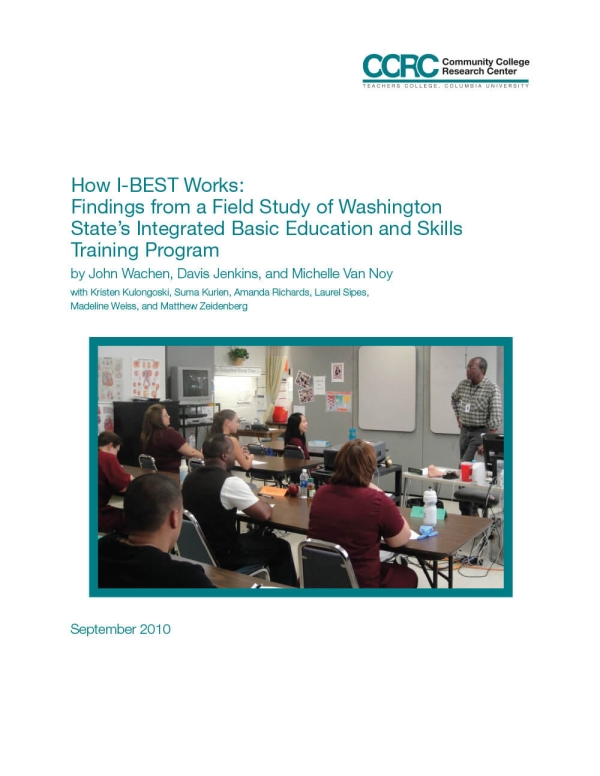
How I-BEST Works: Findings From a Field Study of Washington State’s Integrated Basic Education and Skills Training Program
April 2011

How I-BEST Works: Findings From a Field Study of Washington State’s Integrated Basic Education and Skills Training Program

John WachenDavis JenkinsMichelle Van Noy
The I-BEST program at Washington State's community and technical colleges integrates basic skills education with vocational training and has increased completion rates for participating students.
The Benefits of Attending Community College: A Review of the Evidence
January 2011

The Benefits of Attending Community College: A Review of the Evidence

Clive BelfieldThomas Bailey
This article reviews the existing literature on the economic and other benefits of attending community college and considers the methodological challenges associated with calculating earnings gains from attending a community college.
The Role of Community College Education in the Employment of Information Technology Workers in Washington State
October 2010

The Role of Community College Education in the Employment of Information Technology Workers in Washington State

Michelle Van NoyMadeline Joy Trimble
Using data on students in Washington State who pursued IT coursework at community colleges and then entered the labor market, this paper presents findings on the employment outcomes of IT students by the type of preparation they completed, and on the types of employers that hired these students.
Washington State’s Integrated Basic Education and Skills Training Program (I-BEST): New Evidence of Effectiveness
September 2010

Washington State’s Integrated Basic Education and Skills Training Program (I-BEST): New Evidence of Effectiveness

Matthew ZeidenbergSung-Woo ChoDavis Jenkins
CCRC examined educational and labor market outcomes of participants in I-BEST, which aims to help adult basic skills students succeed in postsecondary occupational education and training.
Using State Data to Promote Continuous Improvement of Workforce Programs: Guidance for States Preparing Applications to the U.S. DOL Workforce Data Quality Initiative
July 2010

Using State Data to Promote Continuous Improvement of Workforce Programs: Guidance for States Preparing Applications to the U.S. DOL Workforce Data Quality Initiative

Davis JenkinsTimothy Harmon
This brief describes how state workforce agencies can link education and workforce data to monitor how well their education and workforce development investments are meeting labor market needs.
Human Resource Development and Career and Technical Education in American Community Colleges
March 2010

Human Resource Development and Career and Technical Education in American Community Colleges

Matthew ZeidenbergThomas Bailey
Prepared for a Human Resources Development Group Meeting of the Asia-Pacific Economic Cooperation (APEC), this paper discusses a range of issues relevant to the community college mission of helping prepare a skilled workforce for jobs offering reasonable wages.
Counting the Hidden Assets: First Steps in Assessing the Impact of Community College Noncredit Education Programs on the Workforce and Local Economies
December 2009

Counting the Hidden Assets: First Steps in Assessing the Impact of Community College Noncredit Education Programs on the Workforce and Local Economies

Multiple Authors
This paper makes the case for the training hour as the basic unit of measurement for noncredit workforce education programs and proposes a taxonomy of community college noncredit activities.
The Outlook for Noncredit Workforce Education
June 2009

The Outlook for Noncredit Workforce Education

Michelle Van NoyJames Jacobs
Drawing on a national review of state policies and case studies of 20 community colleges, this article examines trends in noncredit courses connected with workforce instruction and contract training.
American Community Colleges in the Downturn
June 2009

American Community Colleges in the Downturn

Michelle Van NoyMatthew Zeidenberg
This article elaborates on the increased importance of community colleges in training, retraining, and providing higher education in the recent economic downturn.
Educational Outcomes of I-BEST, Washington State Community and Technical College System’s Integrated Basic Education and Skills Training Program: Findings From a Multivariate Analysis
May 2009

Educational Outcomes of I-BEST, Washington State Community and Technical College System’s Integrated Basic Education and Skills Training Program: Findings From a Multivariate Analysis

Davis JenkinsMatthew ZeidenbergGregory S. Kienzl
This paper presents findings from a study on the outcomes of students participating in Washington State's I-BEST program, which combines basic skills instruction with career-technical instruction.
The Landscape of Noncredit Workforce Education: State Policies and Community College Practices
April 2009

The Landscape of Noncredit Workforce Education: State Policies and Community College Practices

Michelle Van NoyJames JacobsSuzanne KoreyThomas BaileyKatherine L. Hughes
This report provides detailed findings on state policies and community college practice from CCRC's study of community college noncredit workforce education.
Bridges to Opportunity for Underprepared Adults: A State Policy Guide for Community College Leaders
December 2008

Bridges to Opportunity for Underprepared Adults: A State Policy Guide for Community College Leaders

Multiple Authors
This guide offers strategies for providing adults with education and training to help them access opportunities for social mobility and secure jobs that pay wages sufficient to support a family.
From Compliance to Capacity Building: Community Colleges and Federal Workforce Education Policy
June 2008

From Compliance to Capacity Building: Community Colleges and Federal Workforce Education Policy

James Jacobs
In this paper, the author argues for a new paradigm in federal workforce education policy, one that privileges capacity-building over compliance.
A Typology of Community College-Based Partnership Activities
June 2008

A Typology of Community College-Based Partnership Activities

Belkis Suazo DeCastroMelinda Mechur Karp
This paper presents a typology of the institutional partnerships in which community colleges engage so that policymakers can develop fiscal and regulatory policy to support such activities.
CCRC Research Tools No. 3: A Short Guide to “Tipping Point” Analyses of Community College Student Labor Market Outcomes
April 2008

CCRC Research Tools No. 3: A Short Guide to “Tipping Point” Analyses of Community College Student Labor Market Outcomes

Davis Jenkins
This guide aims to help community colleges and state agencies analyze the labor market outcomes of their programs and identify opportunities for improving students' employment outcomes.
Beyond Traditional College: The Role of Community Colleges, Career and Technical Postsecondary Education in Preparing a Globally Competitive Work Force
February 2008

Beyond Traditional College: The Role of Community Colleges, Career and Technical Postsecondary Education in Preparing a Globally Competitive Work Force

Thomas Bailey
This essay describes the characteristics of community college students and discusses the role of the community college in increasing access to higher education by traditionally underserved students.
ATE Regional Centers: CCRC Final Report
January 2008

ATE Regional Centers: CCRC Final Report

Monica Reid KerriganJames JacobsAnalia IvanierVanessa Smith Morest
This paper analyzes how effective ATE regional centers, which work with community colleges and businesses in a single region to improve technical education, have been in meeting their goals.
The Uncertain Future of the Community College Workforce Development Mission
January 2007

The Uncertain Future of the Community College Workforce Development Mission

James JacobsKevin Dougherty
This article explores the evolution of the workforce development role of the community college, its interactions with other missions of the college, and the current crisis facing workforce development.
« Previous Page 1 Page 2 Page 3 Page 4 Page 5 Page 6 Page 7 Next »

Stay in Touch!

Subscribe to our newsletter for the latest on our research, including publications, blog posts, and upcoming events.
Subscribe

Community College Research Center, Teachers College, Columbia University
Box 174 | 525 West 120th Street, New York, NY 10027

  • 212.678.3091
  • ccrc@columbia.edu
Facebook-f Twitter Linkedin Youtube Instagram

© 2025. All rights reserved.

RESEARCH AREAS

  • Dual Enrollment
  • Developmental Education
  • Guided Pathways
  • Advising & Student Supports
  • Teaching & Learning
  • Transfer
  • Workforce Education
  • Dual Enrollment
  • Developmental Education
  • Guided Pathways
  • Advising & Student Supports
  • Teaching & Learning
  • Transfer
  • Workforce Education
  • CC FAQs
  • About CCRC
  • Biennial Report
  • CCRC Staff
  • Employment
  • CC FAQs
  • About CCRC
  • Biennial Report
  • CCRC Staff
  • Employment
  • Publications
  • Blog
  • Policy Resources
  • Events
  • Publications
  • Blog
  • Policy Resources
  • Events
  • About Us
    • About CCRC
    • CCRC Staff
    • Advisory Board
    • Biennial Report
    • Employment
    • Contact
  • Research Areas
    • Dual Enrollment
    • Developmental Education
    • Guided Pathways
    • Advising & Student Supports
    • Teaching & Learning
    • Transfer
    • Workforce Education
  • Publications
  • Blog
  • Community College FAQs
  • News
    • CCRC in the News
    • Opinion
    • Press Releases
  • More
    • Events
    • Guided Pathways Workshops
    • Policy Resources
    • Research Projects