Using administrative data from the City University of New York (CUNY), this paper examines the impact of the summer Pell program on community college student persistence, completion, and employment outcomes.
Using an innovative text mining technique on transcript data from a large public college system, this paper examines patterns and post-degree labor market outcomes of taking work-based courses at two-year and four-year colleges in that system.
Using employer-employee-student matched administrative data from Ohio, this paper provides the first direct evidence of workers' enrollment responses following mass layoffs in the United States.
Maria S. CormierThomas BrockJames JacobsRichard KazisHayley Glatter
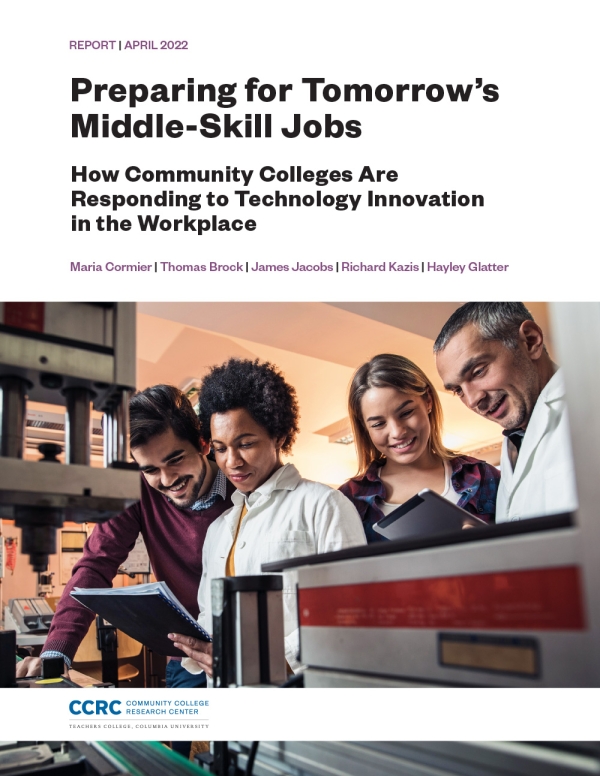
Based on fieldwork at eight institutions, this report describes how community colleges are responding to workplace technology innovation by adapting their workforce programming, diversifying pathways to certificates and degrees, and addressing equity concerns.
This brief describes results from a nationally representative survey of American workers aged 24–64 to learn what training providers they have used and what their experiences have been with these providers.
This set of three studies examines what states and community colleges can do to address the needs of racially minoritized adult learners who are pursuing postsecondary education and training as a path to re-employment, better jobs, and higher incomes.
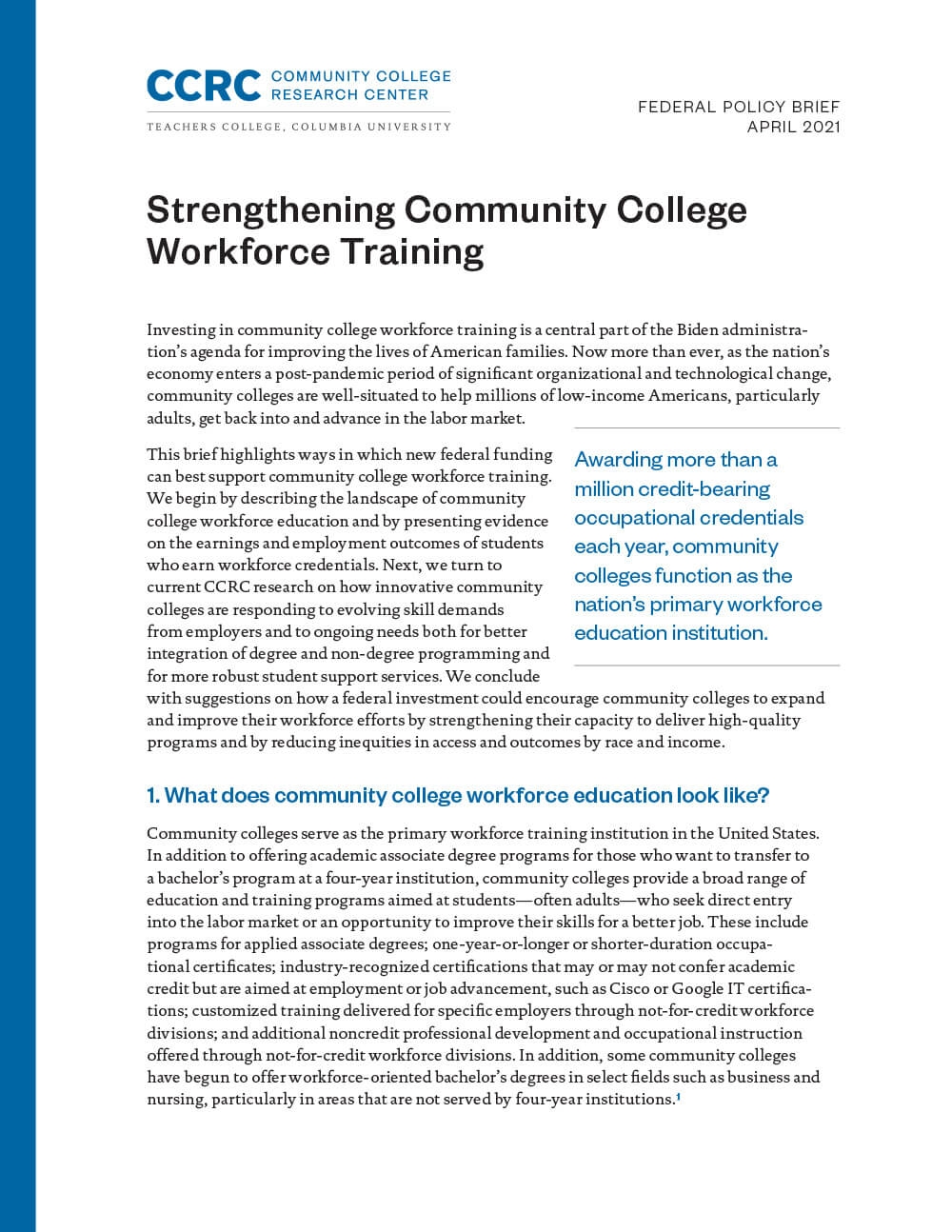
This brief describes the substantial role community colleges play in workforce education, what innovative colleges are doing to improve programming and labor market outcomes for participants, and how the federal government can support these efforts.
This paper examines returns to terminal associate degrees and certificates up to 11 years after students initially entered a community college in Ohio. The authors use an individual fixed-effects approach that controls for students’ pre-enrollment earnings and allows the returns to credential completion to vary over time.
This paper examines the labor market gains for students who enrolled at for-profit colleges after beginning their postsecondary education in community college.
This essay compares broad academic and vocational program goals, embodied skills, tasks, and jobs, with a focus primarily on community college students.
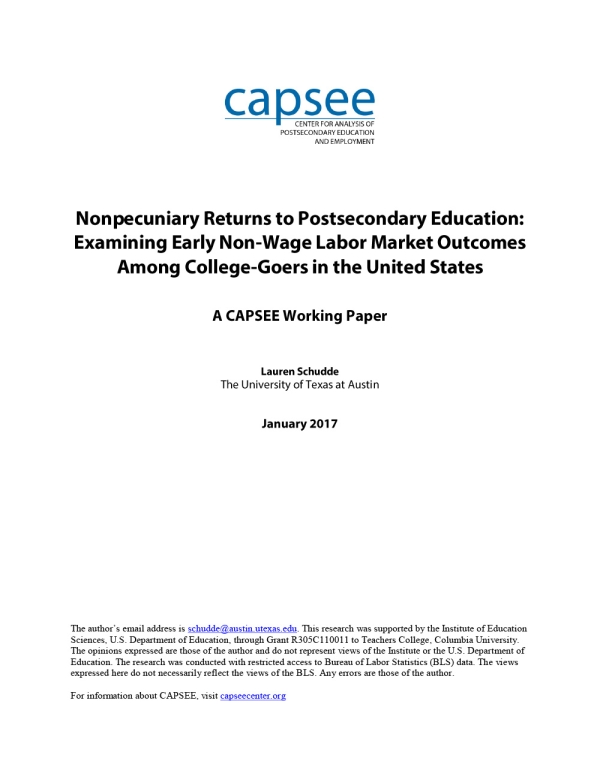
Using data from the National Longitudinal Survey of Youth 1997, this CAPSEE working paper examines nonpecuniary labor market outcomes associated with different levels of postsecondary educational attainment.
This paper describes how community colleges became a major resource for the nation's workforce development requirements and discusses how this role continues to evolve to meet the needs of students, employers, and local communities.
Using data from the National Longitudinal Survey of Youth 1997, this paper compares the academic and labor market outcomes of high school graduates who delay college enrollment and those who enroll in college immediately up to 13 years after high school completion.
This CAPSEE working paper compares credential production patterns of minority-serving institutions (MSIs) and non-MSIs by field of study and examines the extent to which they correspond to employment industry clusters in Alabama and California.
Katherine L. HughesClive BelfieldFlorence Xiaotao RanDavis Jenkins
This report evaluates the implementation and impacts of Enhancing Programs for IT Certification (EPIC), a program that aims to expand access to computer and medical information technology credentials at six Kentucky community colleges.
This paper identifies the effects of licenses on a set of labor market outcomes for the college-educated workforce using newly available national Current Population Survey data merged with data from the U.S. Department of Labor on state-level, occupation-specific licensing requirements.
In this article for Change: The Magazine for Higher Learning, CCRC Founding Director and Teachers College President Thomas Bailey outlines the tradeoff between degrees and short-term credentials offered to community college students and describes how the colleges themselves may be able to help resolve this conflict.
Using national, survey, and college-system-level datasets, this paper estimates the association between stackable credentials and earnings, finding weakly positive and inconsistent gains from these award combinations.
This paper addresses empirical challenges in identifying stackable credentials, distinguishes three types of stackable awards, and estimates the number of persons who earn such awards. It then discusses the utility of these awards in meeting labor market demands and needs of students.
This CAPSEE working paper reviews results from fixed effects models of the earnings gains from completing an associate degree and compares them with ordinary least squares model estimates.