The research described in this report uses student enrollment, credit accumulation, and outcome attainment data to assess the extent to which CUNY provides access to postsecondary educational opportunity and achievement for these students.
This article examines horizontal and vertical workforce transitions and how a global economy and the need to train new subpopulations of future workers will cause community colleges to approach their roles in workforce training differently.
Peter M. CrostaD. Timothy LeinbachDavis JenkinsDavid PrinceDoug Whittaker
This brief describes the methodology CCRC researchers used to estimate the socioeconomic status of individual students in the Washington State community and technical college system.
This study seeks to identify policies and practices of community colleges that are effective in enabling their students to succeed in postsecondary education.
In this book, CCRC researchers analyze how colleges have tried to improve their performance with respect to low-income students, students of color, and nontraditional students.
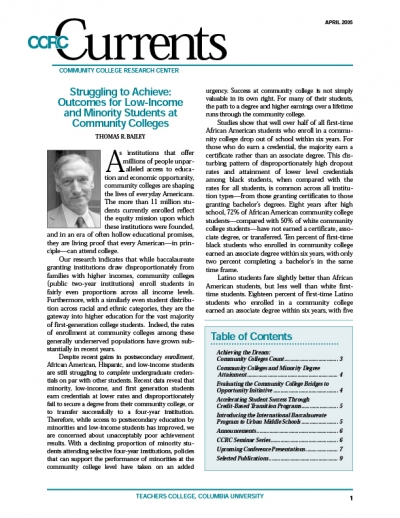
In CCRC's 2006 newsletter, Director Thomas Bailey discusses how attention to the postsecondary achievement of community college students has grown over the past 10 years and how that attention represents a shift from an exclusive focus on access and equity.
This article advances the literature on the impact of community colleges on baccalaureate attainment by estimating new models that allow controlling for pathways of enrollment while using different measures of educational expectations and correcting for college choice.
This article details the qualitative case study that investigated state and institutional practices for remediation in 15 community colleges selected for region, size, and urbanicity.
This article analyzes two nationally representative datasets to examine how the likelihood of transfer is affected by social background, precollege academic characteristics, external demands at college entrance, and experiences during college
The rise of articulation agreements constitutes a new state strategy to cope with the stagnation of higher education appropriations, rising tuition, and high demand for affordable higher education.
Sub-baccalaureate institutions have traditionally been seen as the primary point of access to higher education for economically and academically disadvantaged students.
This report identifies ways in which state policies can support students’ academic and labor market success by creating coherent systems of preparation for students entering technical fields.
This paper discusses how economic, political, social, and demographic factors are changing in ways that will likely increase educational inequality in the United States and hamper productivity growth.
Katherine L. HughesMelinda Mechur KarpBaranda Fermin
This report reviews findings from a study of five programs that allow high school students to take classes for college credit, or "credit-based transition programs."
Thomas BaileyJuan Carlos CalcagnoDavis JenkinsGregory S. KienzlD. Timothy Leinbach
This working paper presents a research model that CCRC has developed to better understand the effects of institutional characteristics on student outcomes.
Melinda Mechur KarpThomas BaileyKatherine L. HughesBaranda Fermin
This report analyzes dual enrollment legislation in all 50 states and examines whether these policies promote or inhibit the spread of dual enrollment programs.
Katherine L. HughesMelinda Mechur KarpDavid BuntingJanice Friedel
This chapter in Career Pathways: Education With a Purpose explains the differences between articulation (which is predominant in typical Tech Prep consortia) and dual enrollment.
Thomas BaileyMariana AlfonsoMarc ScottD. Timothy Leinbach
The authors examine whether postsecondary occupational students, particularly sub-baccalaureate students, are more likely than other types of postsecondary students to achieve educational goals.
David MarcotteThomas BaileyCarey BorkoskiGregory S. Kienzl
This article discusses the economic effects of a community college education using the latest available nationally representative dataset. The authors find substantial evidence that a community college education has positive effects on earnings among young workers, especially those who earn an associate degree.
The authors reveal the allure and the fallacy of the American belief that more schooling for more people is the remedy for all our social and economic problems.
In CCRC's 2005 newsletter, Director Thomas Bailey discusses CCRC's research on the achievement and outcomes of underrepresented students at community colleges.
This chapter discusses the challenge of aligning four necessary elements—instructor approach, student needs, curricular content, and instructional support—in the developmental classroom.
This report presents a critical analysis of the state of the research on the effectiveness of specific practices in increasing persistence and completion at community colleges.
This report summarizes statistics on access and attainment in higher education, focusing on community college students, using data from the National Education Longitudinal Study of 1988.
Thomas BaileyJuan Carlos CalcagnoDavis JenkinsGregory S. KienzlD. Timothy Leinbach
This paper examines institutional characteristics that affect the success of community college students as measured by the individual student probability of completing a certificate or degree or transferring to a baccalaureate institution.
This publication identifies current organizational and instructional approaches to developmental education in community colleges and recommends a process by which colleges can make institutionally appropriate decisions to improve developmental education outcomes.
This report summarizes the latest available national statistics on access and attainment by low-income and racial/ethnic minority community college students.
Thomas BaileyMariana AlfonsoJuan Carlos CalcagnoDavis JenkinsGregory S. KienzlD. Timothy Leinbach
This report reviews the state of research on the determinants of student outcomes in community colleges and initiates a program of empirical research on institutional graduation rates.
This report estimates the returns to a sub-baccalaureate education in response to the debate centered on whether vocational education restricts access to a four-year college.
This journal article details a case study on 15 community colleges across the United States and includes findings revealing important means of increasing students' academic preparedness for postsecondary study.
Thomas BaileyMariana AlfonsoGregory S. KienzlBenjamin KennedyMarc ScottD. Timothy Leinbach
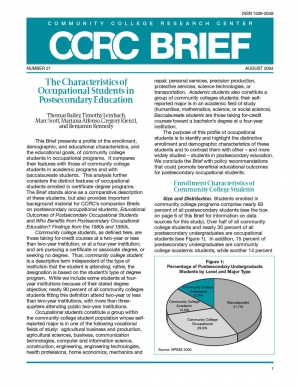
This brief presents a profile of the enrollment, demographic, and educational characteristics and educational goals of community college students in occupational programs.
In CCRC's 2004 newsletter, Director Thomas Bailey discusses CCRC’s analyses of national survey data to identify demographic and educational characteristics of community college students, assess community college student outcomes, and determine the economic benefits of a community college education.
Using case study research conducted at eight community colleges in five states, this report examines the issue of, and controversy over, the ever-expanding missions of community colleges.
This article examines the logic of the "improved school finance," which posits that understanding how resources are used at the school and classroom levels is necessary for determining equitable funding.
This report presents the findings of exploratory research designed to identify the characteristics of the outsourcing of instruction at community colleges and the forces that promote or block its spread.
Focusing on dual enrollment, Tech Prep, AP, IB, and middle college high schools, this report offers a comprehensive look at the evidence base on this rapidly growing group of education initiatives.