This literature review explores the evidence on the effects of acceleration on student outcomes and describes the various acceleration models that are used with developmental education students.
This paper uses administrative data from Washington State to compare the outcomes of young career-technical students across both technical colleges and comprehensive community colleges
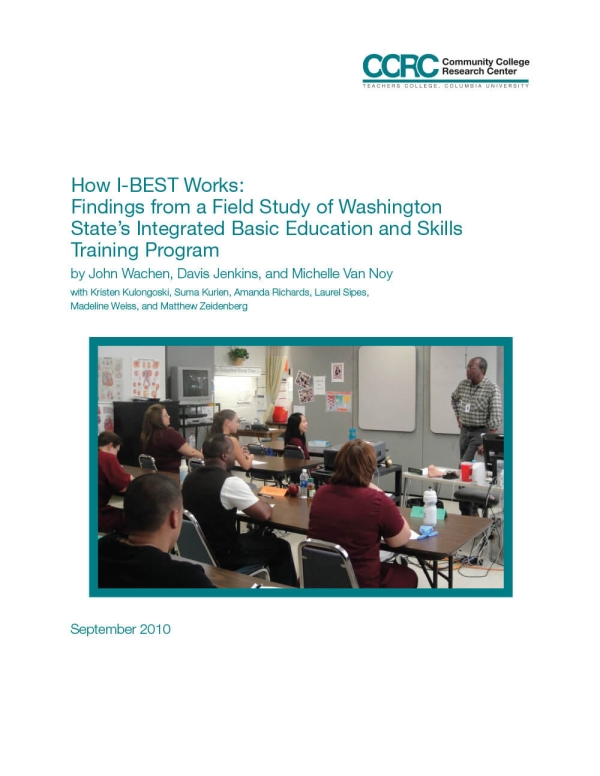
The I-BEST program at Washington State's community and technical colleges integrates basic skills education with vocational training and has increased completion rates for participating students.
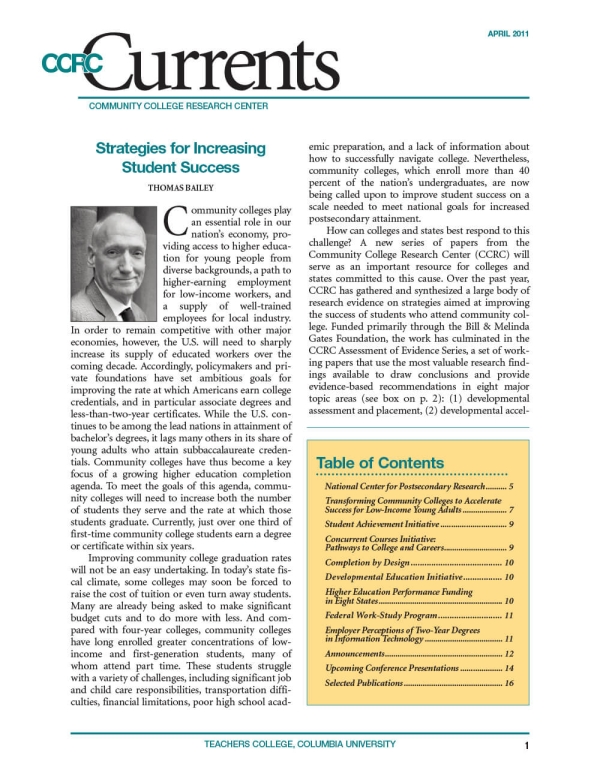
In CCRC's 2011 newsletter, Director Thomas Bailey discusses what we have learned about effective practices in community college from CCRC’s Assessment of Evidence Series.
Effective nonacademic supports work by creating social relationships, clarifying goals and enhancing commitment, developing college know-how, and addressing conflicting demands on students.
This policy brief examines key issues raised by Washington State's experience with the Student Achievement Initiative model of performance funding for community and technical colleges.
This review of the postsecondary literature on online learning suggests that online coursework hinders progression for low-income and underprepared students, explores why students might struggle in these courses, and offers suggestions on how public policy and institutional practice could be changed to improve online learning.
This working paper investigates enrollment patterns and academic outcomes over five years in online, hybrid, and face-to-face courses among students who enrolled in Washington State community and technical colleges in the fall of 2004.
This paper summarizes findings from eight working papers (the Assessment of Evidence Series) that synthesized research on strategies for improving outcomes for community college students, and makes four broad recommendations based on these findings.
This paper reviews the evidence base for pedagogical reforms in the developmental mathematics classroom, examining the theoretical and empirical evidence on six innovative instructional approaches.
Kevin DoughertyRebecca NatowRachel Hare BorkSosanya JonesBlanca Vega
This report discusses political forces that shaped performance funding policies in eight states: Florida, Illinois, Missouri, South Carolina, Tennessee, Washington, California, and Nevada.
The experiences of three states that dropped performance funding (Missouri, Washington, and Florida) are contrasted with those of a fourth (Tennessee) that has retained it more than 30 years.
Based on practices found to be effective among a broad range of high-performance organizations, this paper outlines practical steps community colleges can take to bring about continuous improvement in student learning and progression.
Evidence from behavioral economics and psychology lends support for the idea that students are more likely to persist and succeed in programs with highly structured paths to completion.
This article reviews the existing literature on the economic and other benefits of attending community college and considers the methodological challenges associated with calculating earnings gains from attending a community college.
Dolores PerinRachel Hare BorkStephen T. PeverlyLinda H. MasonMegan Vaselewski
This paper provides evidence on the potential efficacy of a contextualized approach in helping students develop an important academic skill, written summarization.
Elizabeth Zachry RutschowLashawn Richburg-HayesThomas BrockGenevieve OrrOscar CernaDan CullinanMonica Reid KerriganDavis JenkinsSusan GoodenKasey Martin
This interim report examines the experiences of the first 26 colleges to join Achieving the Dream, which helps community colleges collect and analyze student performance data to increase student success.
Using data on students in Washington State who pursued IT coursework at community colleges and then entered the labor market, this paper presents findings on the employment outcomes of IT students by the type of preparation they completed, and on the types of employers that hired these students.
Prepared for the 2010 White House Summit on Community College, this brief discusses partnerships that promote college enrollment, college readiness, and postsecondary persistence.
Prepared for the 2010 White House Summit on Community College, this brief discusses developmental education challenges and describes initiatives designed to improve remedial services.
Davis JenkinsClive BelfieldCecilia SperoniShanna Smith JaggarsNikki Edgecombe
This paper presents findings from a quantitative analysis of the Community College of Baltimore County's Accelerated Learning Program (ALP) for upper level developmental writing students.
This study examines online course taking patterns among students in the Virginia Community College System, as well as retention and performance in online versus face-to-face courses, and subsequent educational outcomes.
The eligibility of undocumented students to apply for in-state tuition varies by state. This article analyzes the political origins of divergent responses among states, drawing on the advocacy coalition framework and policy entrepreneurship theory of policymaking.
CCRC examined educational and labor market outcomes of participants in I-BEST, which aims to help adult basic skills students succeed in postsecondary occupational education and training.
This paper demonstrates that a close analysis of the studies of online learning included in a Department of Education meta-analysis reveals no trend in favor of the online course mode.
This brief describes how state workforce agencies can link education and workforce data to monitor how well their education and workforce development investments are meeting labor market needs.
This article describes some of the ways in which dual enrollment requires the engagement of college faculty with high school personnel and their students, and it reviews the challenges and potential benefits of these relationships.
Melinda Mechur KarpLauren O’GaraKatherine L. Hughes
This paper examines whether Tinto's integration framework—commonly used to examine student persistence in the four-year sector—is applicable to two-year institutions.
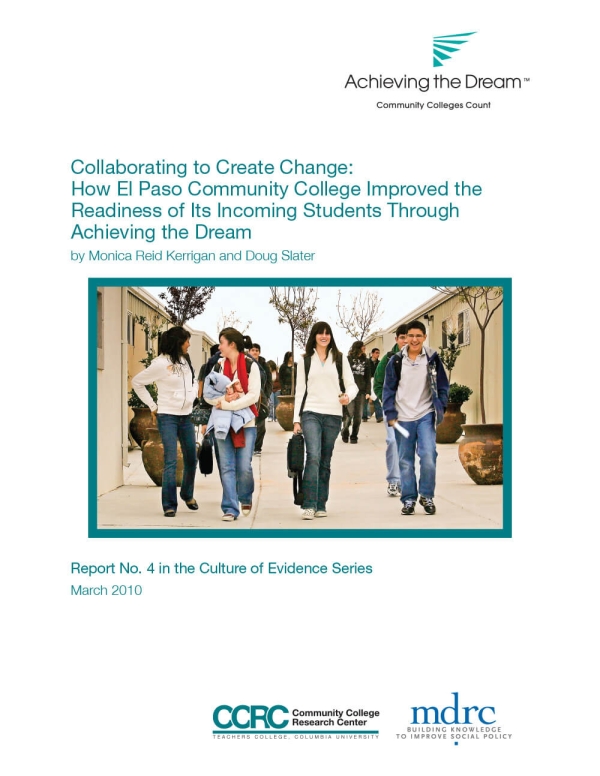
This report describes how this Achieving the Dream college collaborated with the University of Texas at El Paso and 12 local independent school districts in the El Paso area to develop and bring to scale an improved process for helping high school students prepare for entry into college.
Part of the collected volume Colleges 2020, published by a U.K. think tank, this chapter provides an international comparison to British further education by discussing U.S. community colleges.
Prepared for a Human Resources Development Group Meeting of the Asia-Pacific Economic Cooperation (APEC), this paper discusses a range of issues relevant to the community college mission of helping prepare a skilled workforce for jobs offering reasonable wages.
This paper examines how performance funding systems in two states with long-lasting systems have changed over time and what political and social conditions explain the changes.
Based on analysis of nationally representative AP exam data taken from the Education Longitudinal Study of 2002, this article examines whether incentives provided to students, teachers, and schools help students enroll and succeed in AP exams.
This paper makes the case for the training hour as the basic unit of measurement for noncredit workforce education programs and proposes a taxonomy of community college noncredit activities.
Davis JenkinsShanna Smith JaggarsJosipa RoksaMatthew ZeidenbergSung-Woo Cho
CCRC examined student characteristics, course-taking patterns, and other factors associated with higher probabilities that students who require remediation will take and pass gatekeeper courses.
This report discusses findings and implications of a study commissioned by the College Board to inform the development of the Voluntary Framework of Accountability for Community Colleges.
This article examines various commonalities and divergences between the English further education system and its nearest U.S. equivalent, the community college system.
W. G. TierneyThomas BaileyJ. ConstantineNeil FinkelsteinN. F. Hurd
This guide for district administrators, teachers, and counselors aims to help schools and districts develop practices to increase access to higher education and details the research evidence informing its recommendations.
This NCPR working paper reports findings from a study that used a detailed dataset and a regression discontinuity design to identify the causal effect of remediation on the educational outcomes of nearly 100,000 college students in Florida.
Drawing on a national review of state policies and case studies of 20 community colleges, this article examines trends in noncredit courses connected with workforce instruction and contract training.
This article elaborates on the increased importance of community colleges in training, retraining, and providing higher education in the recent economic downturn.
To investigate the unstable institutionalization of performance funding in higher education, this paper examines the cessation of performance funding programs in Illinois, Washington, and Florida.
This paper presents findings from a study on the outcomes of students participating in Washington State's I-BEST program, which combines basic skills instruction with career-technical instruction.
Michelle Van NoyJames JacobsSuzanne KoreyThomas BaileyKatherine L. Hughes
This report provides detailed findings on state policies and community college practice from CCRC's study of community college noncredit workforce education.
In CCRC's 2009 newsletter, Director Thomas Bailey discusses CCRC research that tracked the enrollment and progression of community college students into and through remediation, and outlines directions for reform.
Davis JenkinsTodd EllweinJohn WachenMonica Reid KerriganSung-Woo Cho
This report describes the progress made by the 13 Pennsylvania and Washington State community colleges that comprise Round 3 of the Achieving the Dream initiative after planning and one year of implementation.