Researchers explore new students’ decision-making process around programs and careers through a study conducted in partnership with four community colleges in California, Maryland, Ohio, and Texas.
CCRC intern Melissa Cruz Duque examines two CUNY pathways for English learners: the intensive English Language Immersion Program (CLIP) and traditional academic ESL courses.
How does dance education function in the community college setting? Dance instructor Heather Dougherty shares what she learned from surveying dance instructors at community colleges across the country.
Community college faculty are finding creative ways to infuse climate literacy into students' required courses. In this blog post, Achieving the Dream's Bret Eynon explores how instructors are addressing climate topics in their classrooms.
CCRC is studying how colleges in the Louisiana Community and Technical College System are designing and delivering corequisite models in practice and how students and faculty are experiencing these changes.
To facilitate high school students earning college credit, postsecondary and K-12 educators must collaborate to make decisions about dual enrollment course offerings. In a new CCRC working paper, the authors examined variation in dual enrollment partnerships across Texas and estimated how characteristics of these partnerships predict student success.
As high school dual enrollment continues to expand across the country, an increasing number of students are taking their early college coursework online. In this blog post, CCRC researchers share strategies for implementing online dual enrollment courses in a way that mitigates the risk of sacrificing course quality for access.
Five years after the onset of the pandemic, students enrolled in online classes are still reporting a lack of social connection and feelings of isolation. CCRC researcher Akilah Thompson shares strategies in this blog post to help students feel more engaged, confident, and human in their online courses.
This blog post introduces the dual enrollment pathways scale of adoption assessment, a self-assessment tool for colleges and college–K-12 partnerships to compare their current dual enrollment practices against the DEEP framework.
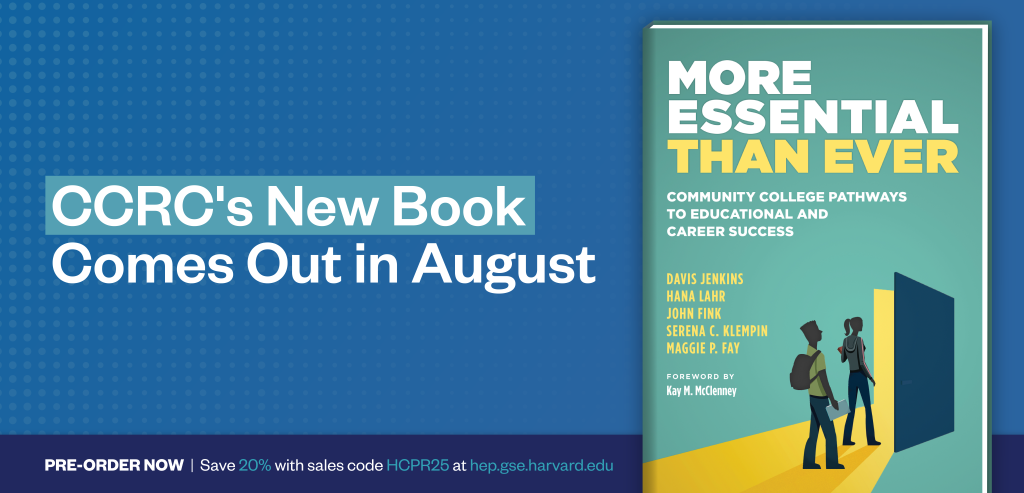
A forthcoming book to be published in August 2025 takes stock of what we have learned over nearly a decade of research on the guided pathways model for whole-college transformation. This blog post, the first in a series, features insights from the book, including practical guidance for community colleges on meeting the challenges they face today.