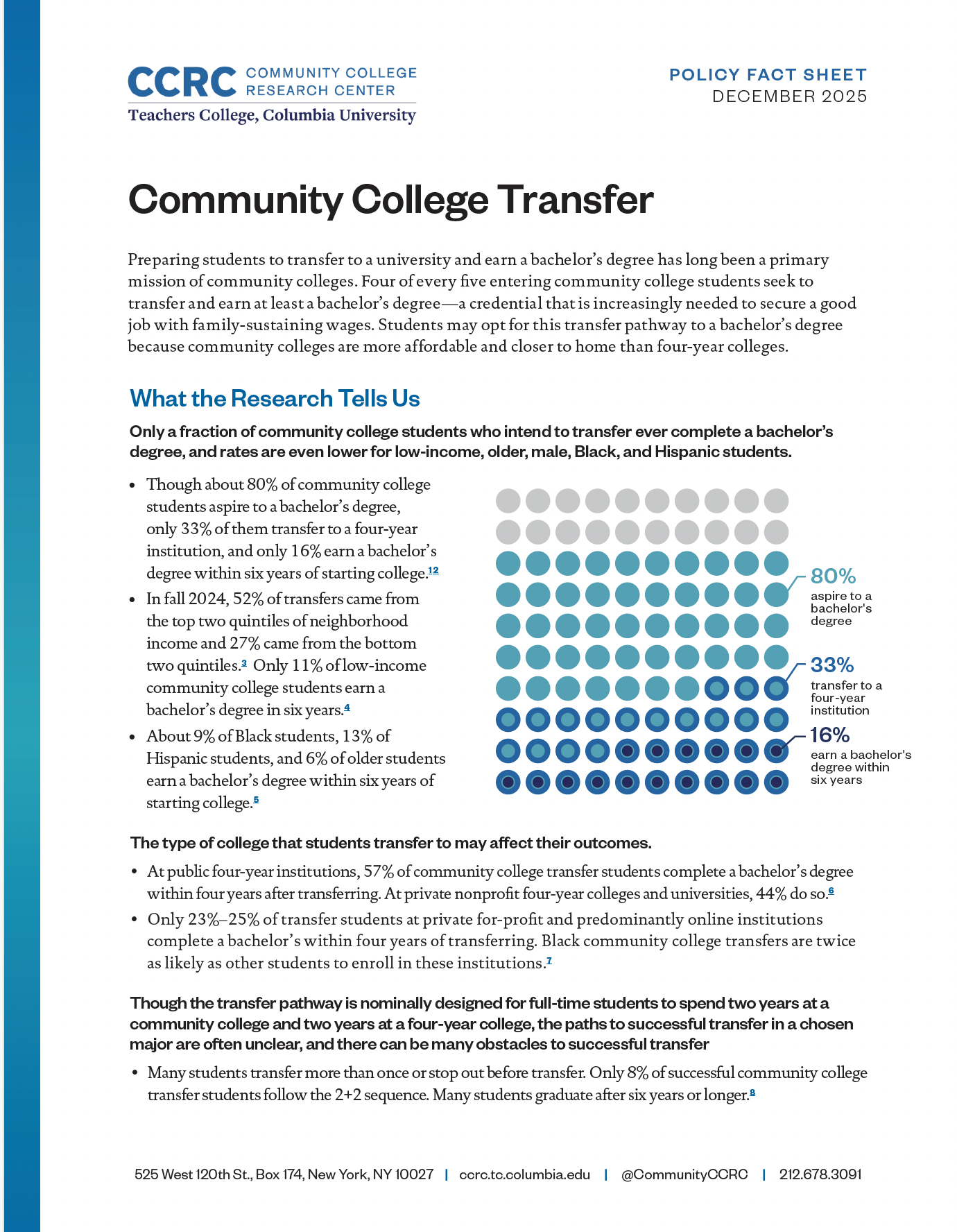
This updated fact sheet outlines challenges in supporting successful student transfer from community colleges to four-year institutions and considerations for improving the transfer process.
The second edition of the Transfer Playbook provides guidance for achieving excellence in transfer and bachelor’s attainment for community college students based on practices observed at exemplary community college and university partnerships.
These two reports use student data disaggregated by race/ethnicity, neighborhood income, and age to measure the performance of two- and four-year institutions in enabling students who start college at a community college to transfer and complete bachelor’s programs. State-by-state breakdowns of transfer metrics designed for use by college and state system leaders are included in the reports and in an online data dashboard.
John FinkAurely Garcia TullochJessica SteigerVikash Reddy
This brief, published by The Campaign for College Opportunity, explores ways transfer reform can close equity gaps in bachelor’s degree attainment by providing vital degree pathways for students from minoritized backgrounds.
This report argues that a more inclusive definition of STEM that accounts for STEM-oriented technical training programs would better represent the contribution community colleges make to STEM education and the STEM workforce.
John FinkTaylor MyersDaniel SparksShanna Smith Jaggars
Drawing on administrative records from transfer-intending community college starters across three states, this paper develops a set of early STEM momentum metrics that are useful indicators of subsequent STEM transfer and bachelor’s degree attainment.
This report describes the rationale, goals, and activities of the Strengthening Michigan Humanities project, and it provides statewide statistics and trends on community college enrollment, transfer, and bachelor’s degree completion in humanities fields.
Using nine years of data from one state, this paper tracks completion and transfer outcomes to examine when gaps between Black, Hispanic, and White community college students occur, and it estimates the benefits of reaching early academic milestones for such students.
This journal article examines how students at six community colleges identified and weighed possible transfer destination colleges, and how dedicated and personalized advisement shaped students’ transfer plans and contributed to their transfer outcomes.
John FinkTaylor MyersDaniel SparksShanna Smith Jaggars
Drawing on findings from a study of postsecondary college transcript and degree records, this brief describes metrics that may be useful in assessing efforts to improve STEM transfer outcomes.