Skip to content
  • About Us
    • About CCRC
    • CCRC Staff
    • Advisory Board
    • Biennial Report
    • Employment
    • Contact
    • About CCRC
    • CCRC Staff
    • Advisory Board
    • Biennial Report
    • Employment
    • Contact
  • News
    • CCRC in the News
    • Opinion
    • Press Releases
    • CCRC in the News
    • Opinion
    • Press Releases
  • Community College FAQs
  • Research Areas
    • Dual Enrollment
    • Developmental Education
    • Guided Pathways
    • Advising & Student Supports
    • Teaching & Learning
    • Transfer
    • Workforce Education
    • Dual Enrollment
    • Developmental Education
    • Guided Pathways
    • Advising & Student Supports
    • Teaching & Learning
    • Transfer
    • Workforce Education
  • Publications
  • Blog
  • Resources
    • Policy Resources
    • Guided Pathways Workshops
    • Policy Resources
    • Guided Pathways Workshops
  • More
    • Events
    • Research Projects
    • Events
    • Research Projects
  • Overview
  • Important Dates
  • FAQs
  • Overview
  • Important Dates
  • FAQs
  • Overview
  • Important Dates
  • FAQs
Filter

Category

  • All publications
  • High school to college
  • Dual enrollment
  • Developmental education
  • Assessment and placement
  • Guided pathways
  • Transfer
  • Advising and student supports
  • Financial aid
  • Teaching and learning
  • Workforce education
  • Returns to degrees
  • Community college policy and finance
  • Peformance funding
  • For-profit colleges

Filter by

Clear all

Author

Publication type

State

Year

Publications

Workforce education

1–10 of 134 results
  • Results per page
  • 10
  • 20
  • 50
  • All
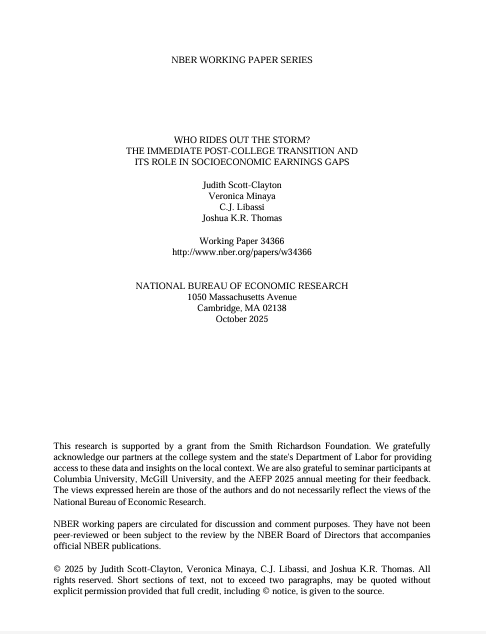
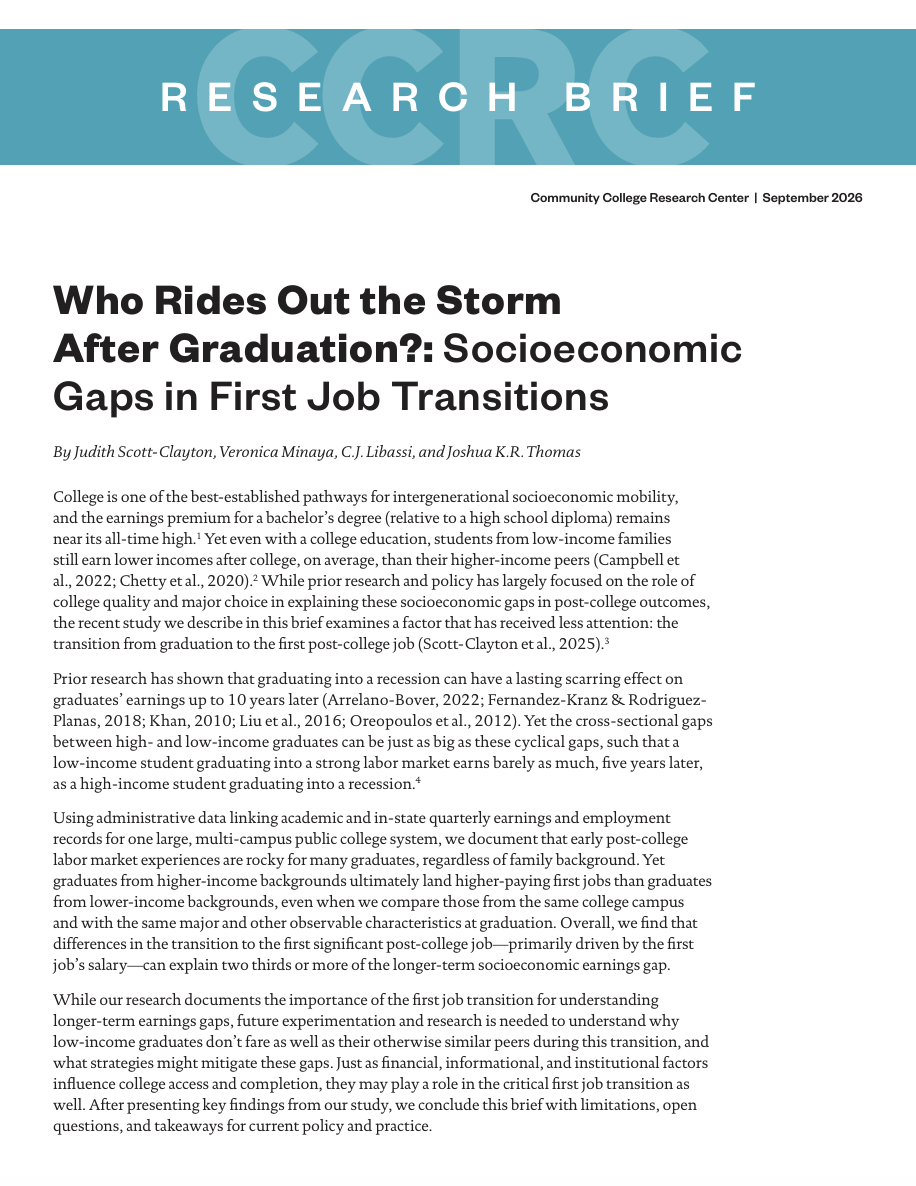
Who Rides Out the Storm? The Immediate Post-College Transition and Its Role in Socioeconomic Earnings Gaps
October 2025

Who Rides Out the Storm? The Immediate Post-College Transition and Its Role in Socioeconomic Earnings Gaps

Judith Scott-ClaytonVeronica MinayaCJ LibassiJoshua Thomas
Using administrative data from a large, urban, public college system, this paper documents large gaps in earnings five years after graduation by SES and the extent to which differences in the first job transition can explain these gaps.
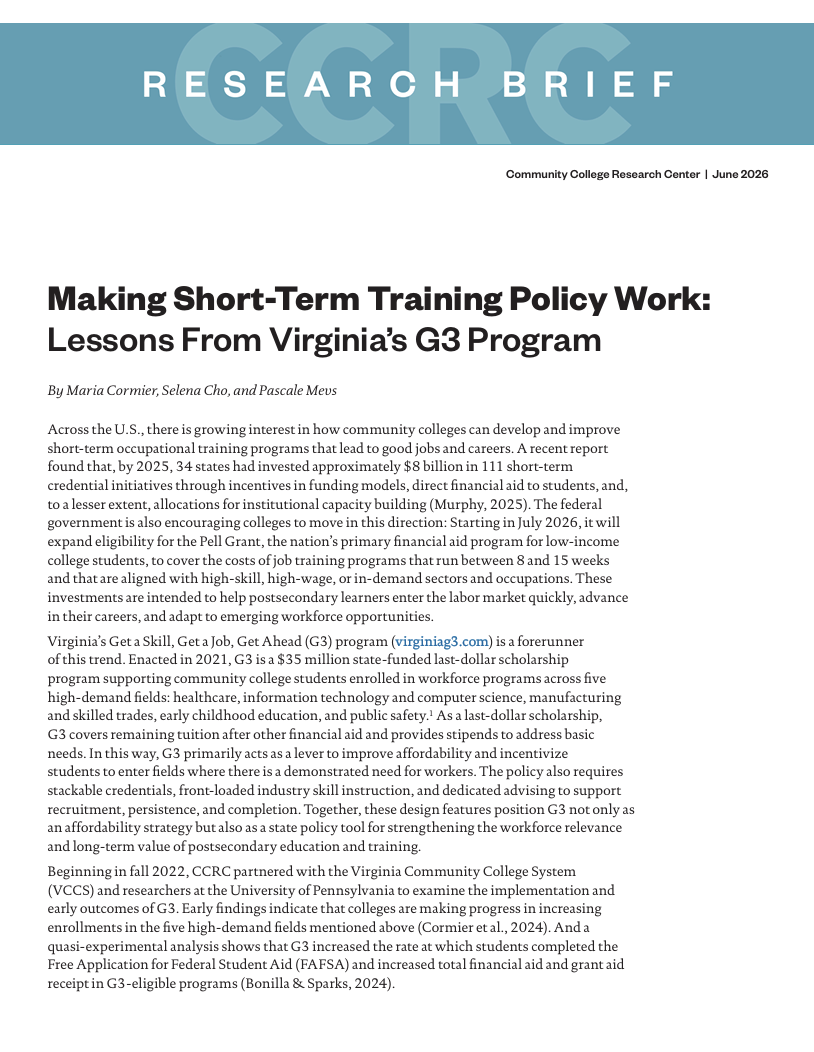
State Policy for Expanding Access to High-Demand Jobs: The Role of G3, GO Virginia, and Virginia’s Community Colleges
July 2025

State Policy for Expanding Access to High-Demand Jobs: The Role of G3, GO Virginia, and Virginia’s Community Colleges

Richard KazisPascale Mevs
This ARCC Network brief examines two statewide workforce-focused initiatives, G3 and GO Virginia. The authors present a snapshot of how these initiatives interact on the ground and describe opportunities for more deliberate and strategic efforts to better align their goals and investments.
What’s the Value of a Master’s Degree?
July 2025

What’s the Value of a Master’s Degree?

Veronica MinayaJudith Scott-Clayton
Using administrative data from Ohio, this Third Way brief compares master’s degree completers’ earnings before and after graduate school and finds that, on average, earning a master’s degree increases earnings, though returns vary by field and student demographics.
Get a Skill, Get a Job, Get Ahead? Evaluating the Effects of Virginia’s Workforce-Targeted Free College Program
April 2025

Get a Skill, Get a Job, Get Ahead? Evaluating the Effects of Virginia’s Workforce-Targeted Free College Program

Sade BonillaDaniel Sparks
Using two quasi-experimental methods, this paper estimates the causal impact of Virginia’s Get a Skill, Get a Job, Get Ahead initiative on financial aid and academic outcomes of community college students.
Which Community College Awards Are Likely to Prepare Students for Post-Completion Success? 
April 2025

Which Community College Awards Are Likely to Prepare Students for Post-Completion Success? 

Davis JenkinsJohn FinkTatiana Velasco
This report uses IPEDS and College Scorecard data to classify the credentials awarded by community colleges in 2022-23 and to assess which credentials are and are not likely to enable students to secure a living-wage job or transfer efficiently in a major.
Institutional and Student Responses to Free College: Evidence From Virginia
September 2024

Institutional and Student Responses to Free College: Evidence From Virginia

Daniel SparksSade Bonilla
Using administrative data, this paper analyzes Get a Skill, Get a Job, Get Ahead (G3)—a free community college initiative that Virginia implemented in 2021—and shows that both institutions and students responded to the tuition-free messaging and eligibility criteria.
Classifying Community College Programs by Post-Completion Success in Transfer and Workforce
August 2024

Classifying Community College Programs by Post-Completion Success in Transfer and Workforce

Davis JenkinsKonrad MugglestoneJosh Wyner
This program classification guidebook and accompanying data analysis and visualization tools from the Aspen Institute and CCRC can be useful for community colleges seeking to increase the number of students in high-value programs and decrease the number in lower value pathways.
Increasing Access to High-Demand Occupational Training: An Exploration of G3’s Recruitment and Enrollment Strategies
July 2024

Increasing Access to High-Demand Occupational Training: An Exploration of G3’s Recruitment and Enrollment Strategies

Maria S. CormierRichard KazisNikki EdgecombeMycaeri Atkinson
This ARCC Network brief uses enrollment and outcome data as well as interview data from eight colleges implementing the Get A Skill, Get A Job, Get Ahead (G3) program to examine college-level G3 outreach, recruitment, and enrollment strategies and the process for awarding G3 aid.
Community Colleges and the Emerging Green Economy: A Call to Action
July 2024

Community Colleges and the Emerging Green Economy: A Call to Action

CCRC
In this Call to Action, CCRC shares five insights from a recent symposium on the role community colleges can play in addressing climate change, with the goal of supporting work currently underway and galvanizing further efforts to prepare workers for the green economy.
Heterogeneity in Labor Market Returns to Master’s Degrees: Evidence from Ohio
February 2024

Heterogeneity in Labor Market Returns to Master’s Degrees: Evidence from Ohio

Veronica MinayaJudith Scott-ClaytonYang “Rachel” Zhou
This Annenberg Institute working paper provides up-to-date causal evidence on labor market returns to master’s degrees and examines heterogeneity in the returns by field area, student demographics, and initial labor market conditions.
Page 1 Page 2 Page 3 … Page 14 Next »

Stay in Touch!

Subscribe to our newsletter for the latest on our research, including publications, blog posts, and upcoming events.
Subscribe

Community College Research Center, Teachers College, Columbia University
Box 174 | 525 West 120th Street, New York, NY 10027

  • 212.678.3091
  • ccrc@columbia.edu
Facebook-f Twitter Linkedin Youtube Instagram

© 2025. All rights reserved.

RESEARCH AREAS

  • Dual Enrollment
  • Developmental Education
  • Guided Pathways
  • Advising & Student Supports
  • Teaching & Learning
  • Transfer
  • Workforce Education
  • Dual Enrollment
  • Developmental Education
  • Guided Pathways
  • Advising & Student Supports
  • Teaching & Learning
  • Transfer
  • Workforce Education
  • CC FAQs
  • About CCRC
  • Biennial Report
  • CCRC Staff
  • Employment
  • CC FAQs
  • About CCRC
  • Biennial Report
  • CCRC Staff
  • Employment
  • Publications
  • Blog
  • Policy Resources
  • Events
  • Publications
  • Blog
  • Policy Resources
  • Events
  • About Us
    • About CCRC
    • CCRC Staff
    • Advisory Board
    • Biennial Report
    • Employment
    • Contact
  • Research Areas
    • Dual Enrollment
    • Developmental Education
    • Guided Pathways
    • Advising & Student Supports
    • Teaching & Learning
    • Transfer
    • Workforce Education
  • Publications
  • Blog
  • Community College FAQs
  • News
    • CCRC in the News
    • Opinion
    • Press Releases
  • More
    • Events
    • Guided Pathways Workshops
    • Policy Resources
    • Research Projects