This paper discusses the organization, roles, and contributions of community colleges, and it analyzes reforms that have been proposed and enacted to meet ongoing challenges.
Using national, survey, and college-system-level datasets, this paper estimates the association between stackable credentials and earnings, finding weakly positive and inconsistent gains from these award combinations.
This journal article offers a set of essential transfer practices culled from national fieldwork to two- and four-year institutional transfer partnerships identified using NSC data as highly effective in supporting transfer student success.
Using student data, this report provides information on the outcomes of students who attended Macomb Community College and then transferred to one of 14 four-year destination colleges.
In this Brookings report, the author examines the policy landscape and reviews available evidence to assess the potential benefits and costs of thinking beyond the box in college admissions. The author then offers six key findings that have emerged from this review.
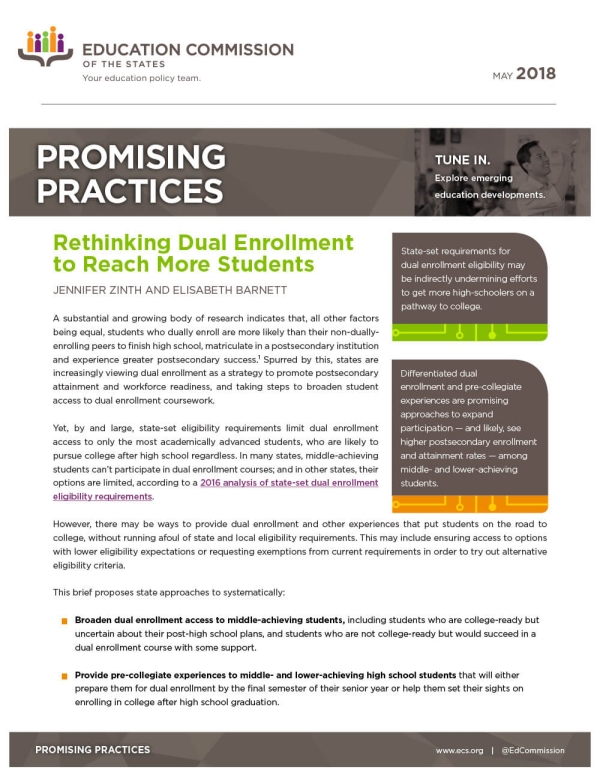
This report uses student enrollment and degree records from the National Student Clearinghouse to examine who enrolls in community college dual enrollment courses and what happens to them after high school.
With the goal of informing federal higher education policy decisions, this brief for the Urban Institute suggests federal student aid reform that simplifies the eligibility and application process.
This report describes how Ohio’s two-year colleges are approaching guided pathways reforms, focusing on innovations they have implemented in recent years that can serve as building blocks as they seek to transform their policies, practices, and culture following the guided pathways model.
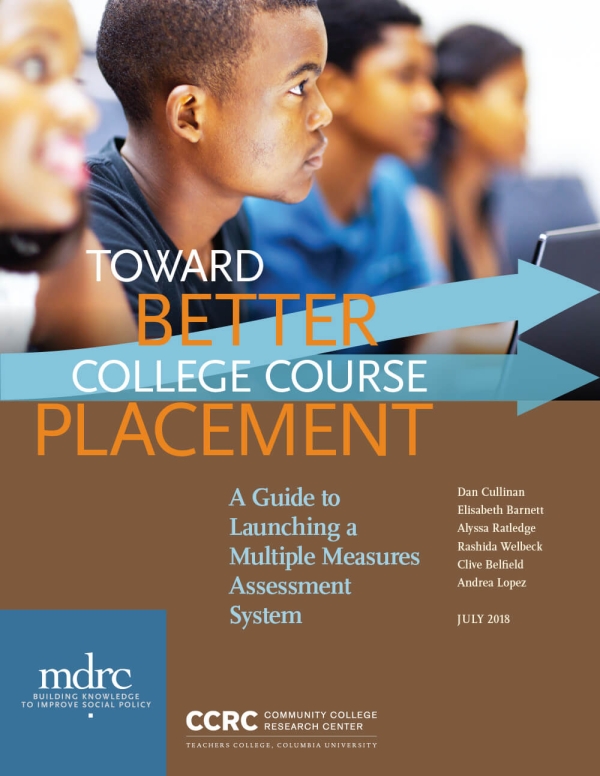
This CAPR working paper provides an overview of the history of college placement testing, with a focus on nonselective colleges. The authors discuss the limitations of placement tests, the consequences of placement errors, and the movement toward changing systems of placement; a typology of approaches to assessment and placement is also described.
This set of tools aims to help community colleges and broad-access four-year colleges assess their work on technology-mediated advising and student support, sometimes referred to as Integrated Planning and Advising for Student Success (iPASS).