

Skip to content
  • About Us
    • About CCRC
    • CCRC Staff
    • Advisory Board
    • Biennial Report
    • Employment
    • Contact
    • About CCRC
    • CCRC Staff
    • Advisory Board
    • Biennial Report
    • Employment
    • Contact
  • News
    • CCRC in the News
    • Opinion
    • Press Releases
    • CCRC in the News
    • Opinion
    • Press Releases
  • Community College FAQs
  • Research Areas
    • Dual Enrollment
    • Developmental Education
    • Guided Pathways
    • Advising & Student Supports
    • Teaching & Learning
    • Transfer
    • Workforce Education
    • Dual Enrollment
    • Developmental Education
    • Guided Pathways
    • Advising & Student Supports
    • Teaching & Learning
    • Transfer
    • Workforce Education
  • Publications
  • Blog
  • Resources
    • Data Tools
    • Policy Fact Sheets & Briefs
    • Guided Pathways Workshops
    • Data Tools
    • Policy Fact Sheets & Briefs
    • Guided Pathways Workshops
  • More
    • Events
    • Research Projects
    • Events
    • Research Projects
  • Overview
  • Important Dates
  • FAQs
  • Overview
  • Important Dates
  • FAQs
  • Overview
  • Important Dates
  • FAQs

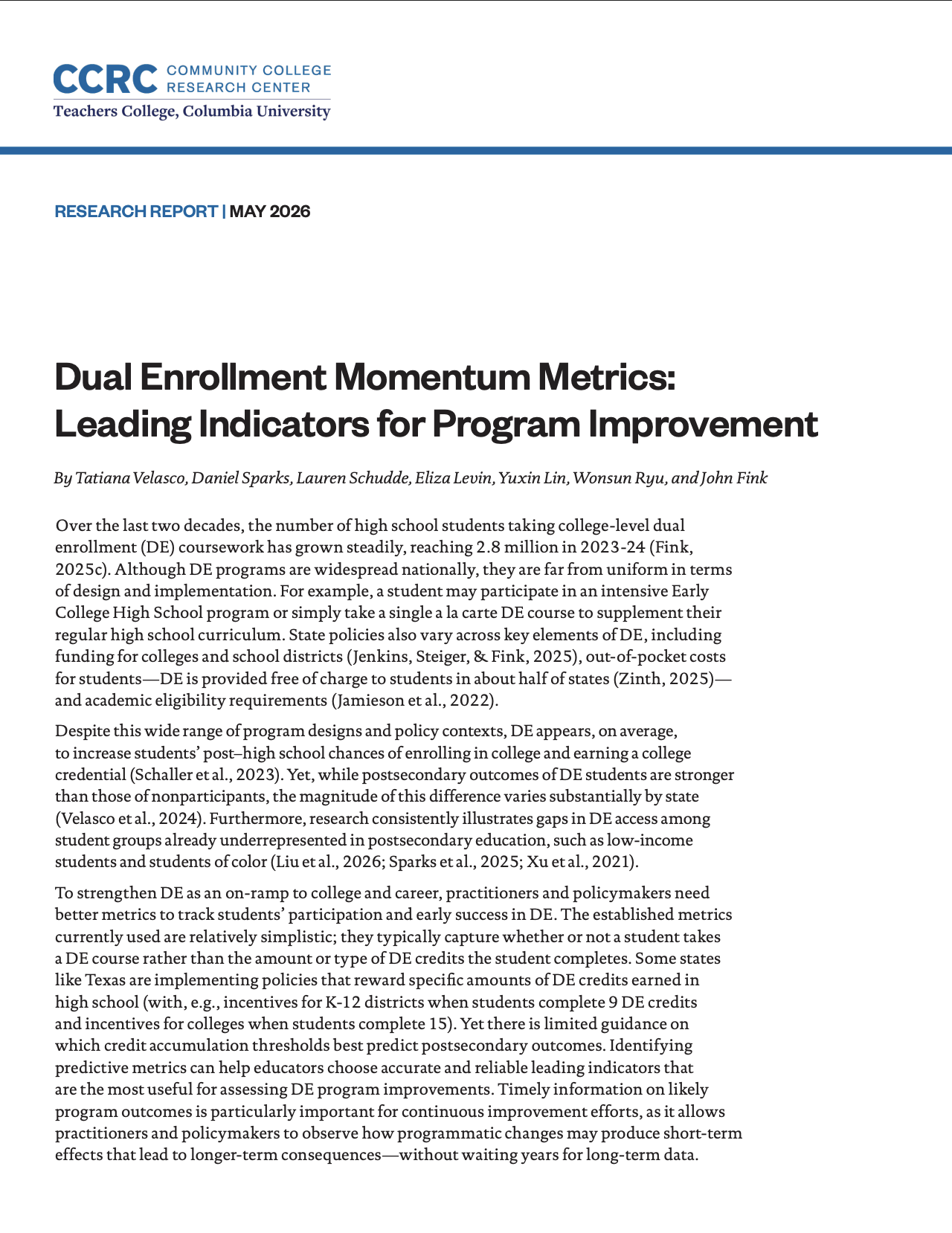
Dual Enrollment Momentum Metrics: Leading Indicators for Program Improvement

By Tatiana Velasco, Daniel Sparks, Lauren Schudde, Eliza Levin, Yuxin Lin, Wonsun Ryu & John Fink

As dual enrollment participation grows—reaching an estimated 2.8 million students in 2023-24—practitioners and policymakers require validated, timely student success metrics to support the improvement of dual enrollment programming as an effective on-ramp to college and career.

This report introduces and validates a set of dual enrollment momentum metrics designed to serve as leading indicators of subsequent postsecondary success. Drawing on longitudinal data from four states, analysis in the report tests three types of metrics capturing college coursetaking in high school: credit accumulation (e.g., 6+ or 15+ credits completed), completion of college math or English, and completion of a college credential in high school.

By assessing how these metrics predict the post–high school outcomes of college enrollment, college completion, and time-to-degree, the report provides evidence for practitioners and policymakers who seek to adopt similar metrics to support efforts to evaluate and improve DE programming. The authors find that dual enrollment momentum metrics are strong predictors of postsecondary outcomes, though the strength varies depending on the metric and outcome: Lower credit thresholds and gateway English completion are stronger predictors of college enrollment, whereas higher credit thresholds and gateway math completion are stronger predictors of college completion and reduced time to a bachelor’s degree. And the findings suggest the dual momentum metrics are reliable predictors of subsequent college outcomes across student gender and race/ethnicity, Title I high school status, and high school urbanicity.

Based on the results in the report, college, K-12, and state or system leaders can prioritize a subset of the metrics examined that best reflect the coursetaking patterns of their students and the specific goals of their dual enrollment programs, be that expanding access to college, increasing likelihood of completion, reducing time to degree, or all of the above.

  • Guidance, Tools, and Field Education for Scaling Dual Enrollment Equity Pathways

Download Links

Download report
May 2026

Related Publications

October 2025

Promising Combinations of Dual Enrollment, AP/IB, and CTE: The College and Earnings Trajectories of Texas High School Students Who Take Accelerated Coursework

October 2024

The Postsecondary Outcomes of High School Dual Enrollment Students: A National and State-by-State Analysis

Additional Resources

For more policy briefs and fact sheets, visit CCRC’s Policy Resources page.

Stay in Touch!

Subscribe to our newsletter for the latest on our research, including publications, blog posts, and upcoming events.
Subscribe

Community College Research Center, Teachers College, Columbia University
Box 174 | 525 West 120th Street, New York, NY 10027

  • 212.678.3091
  • ccrc@columbia.edu
Facebook-f Twitter Linkedin Youtube Instagram

© 2026. All rights reserved.

RESEARCH AREAS

  • Dual Enrollment
  • Developmental Education
  • Guided Pathways
  • Advising & Student Supports
  • Teaching & Learning
  • Transfer
  • Workforce Education
  • Dual Enrollment
  • Developmental Education
  • Guided Pathways
  • Advising & Student Supports
  • Teaching & Learning
  • Transfer
  • Workforce Education
  • CC FAQs
  • About CCRC
  • Biennial Report
  • CCRC Staff
  • Employment
  • CC FAQs
  • About CCRC
  • Biennial Report
  • CCRC Staff
  • Employment
  • Publications
  • Blog
  • Data Tools
  • Policy Fact Sheets & Briefs
  • Events
  • Publications
  • Blog
  • Data Tools
  • Policy Fact Sheets & Briefs
  • Events
  • About Us
    • About CCRC
    • CCRC Staff
    • Advisory Board
    • Biennial Report
    • Employment
    • Contact
  • Research Areas
    • Dual Enrollment
    • Developmental Education
    • Guided Pathways
    • Advising & Student Supports
    • Teaching & Learning
    • Transfer
    • Workforce Education
  • Publications
  • Blog
  • Community College FAQs
  • News
    • CCRC in the News
    • Opinion
    • Press Releases
  • More
    • Data Tools
    • Events
    • Guided Pathways Workshops
    • Policy Fact Sheets & Briefs
    • Research Projects