


A Role for Disciplinary Societies in Supporting Community College Adjunct Faculty
This article establishes the importance of adjunct faculty in supporting student success, describes the experiences of adjunct faculty, and offers suggestions for disciplinary societies that seek to meet the needs of adjunct faculty.
Happy Together? The Peer Effects of Dual Enrollment Students on Community College Student Outcomes
Using administrative data from a large state community college system, this paper examines whether being exposed to a higher percentage of dual enrollment peers influences non-dual enrollment enrollees’ performance in college courses.
College Acceleration for All? Mapping Racial/Ethnic Gaps in Advanced Placement and Dual Enrollment Participation
This paper estimates the patterns and sources of White–Black and White–Hispanic enrollment gaps in Advancement Placement (AP) and dual enrollment programs across several thousand school districts and metropolitan areas in the United States.
Major Decision: The Impact of Major Switching on Academic Outcomes in Community Colleges
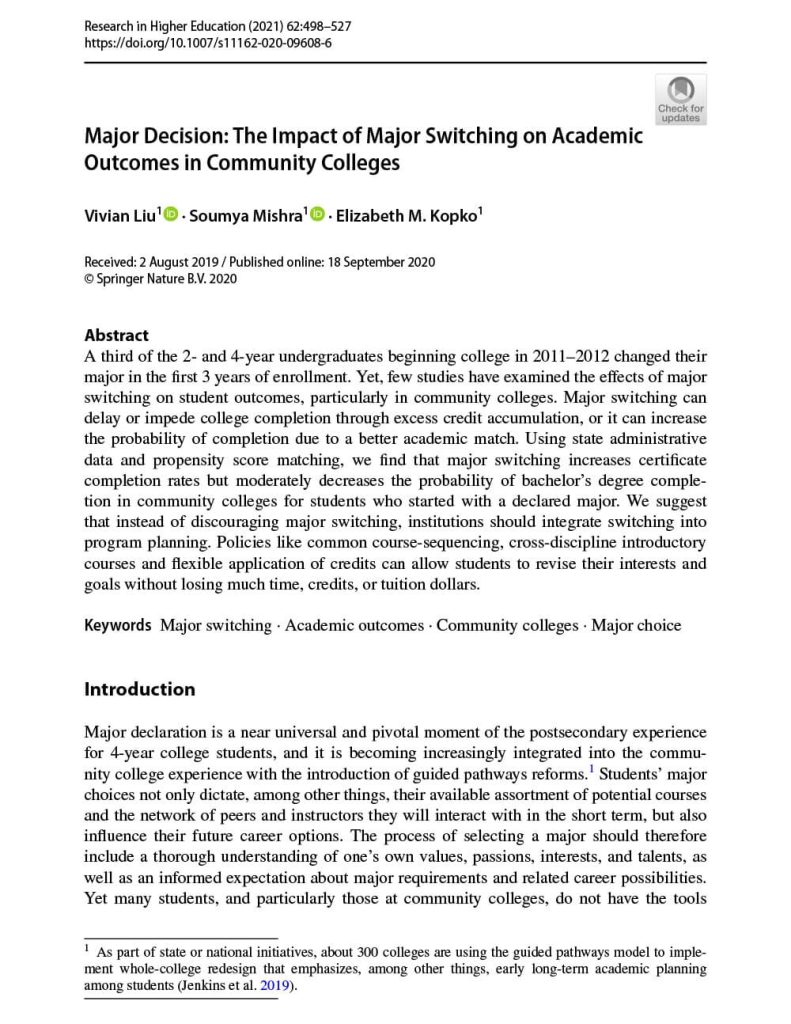
Using state administrative data and propensity score matching, this study examines the characteristics and academic outcomes of community college students who switch majors.
Do Differential Grading Standards Across Fields Matter for Major Choice? Evidence From a Policy Change in Florida
Using administrative data from Florida, this article examines the effect of changing the grading scale from whole-letter grades to plus/minus grades on STEM major choice.