In this updated fact sheet, CCRC offers a short primer on the multiple missions of community colleges, what kinds of students they enroll, what outcomes they produce, and some of the major issues they face.
John FinkDavis JenkinsSarah GriffinAurely Garcia Tulloch
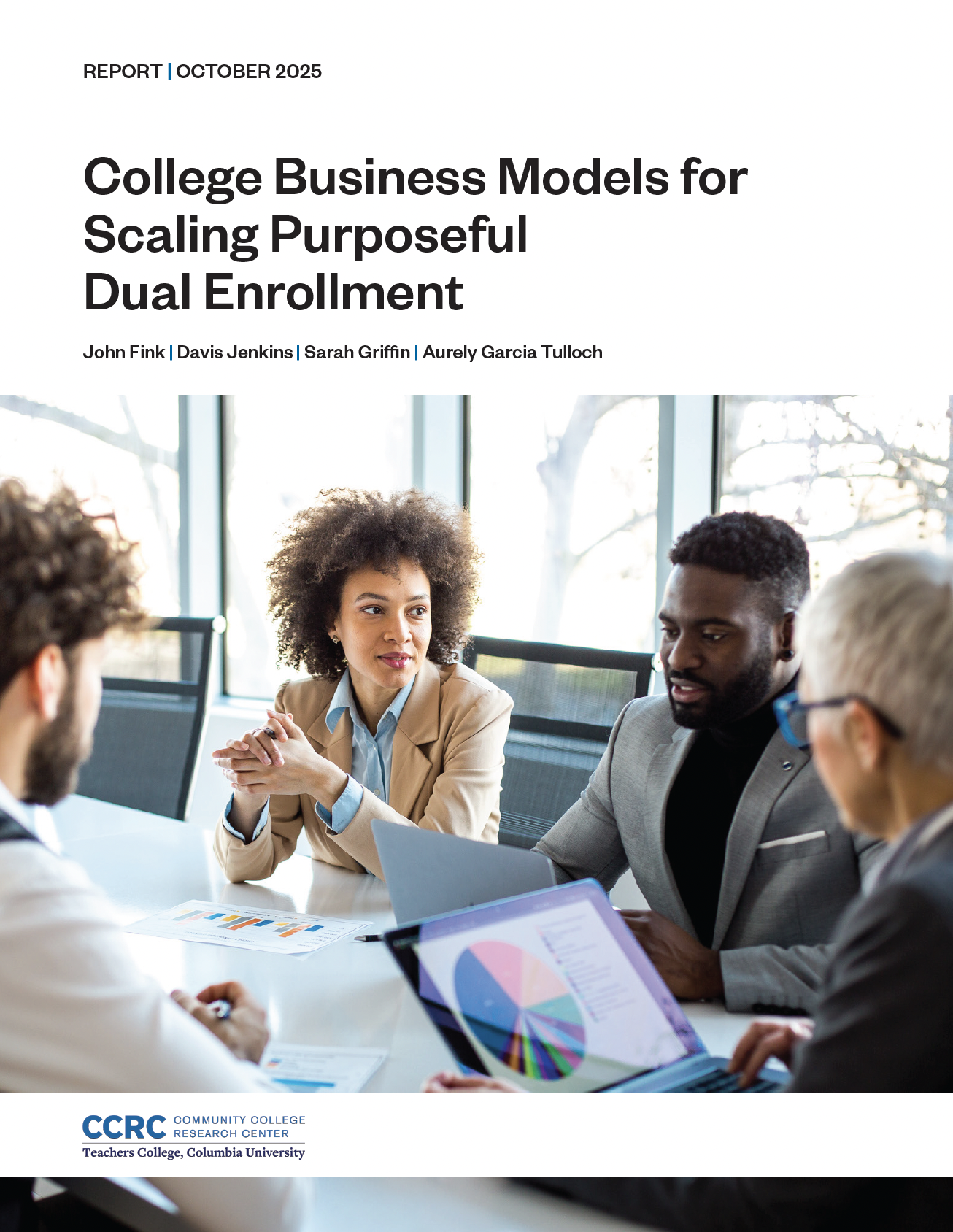
This report describes strategies for providing purposeful dual enrollment, which better guides underserved students into degree- and career-connected education after high school, without shifting the cost burden onto students and families.
This paper documents the annual costs associated with six common community college success strategies; overall costs, the distribution of costs, and costs per student, as well as how costs are borne by various actors are identified.
Serena C. KlempinSarah GriffinTia MonahanMegan AndersonThomas Brock
This book chapter explores the personal support networks and help-seeking preferences of immigrant-origin, first-generation-in-college students (FGCS) as part of a three-year longitudinal mixed-methods study with FGCSs at four public Hispanic-serving institutions in California.
Using financial data from IPEDS, this ARCC Network brief examines what happened to community college revenue and student aid during the pandemic and assesses the importance of Higher Education Emergency Relief (HEER) funding for community colleges and their students.
This ARCC Network report examines how Higher Education Emergency Relief (HEER) funds were distributed to community colleges and the extent to which the colleges spent those funds. It also explores how HEER funding and spending patterns differed by institutional and student characteristics.
This ARCC Network brief describes Higher Education Emergency Relief funding the federal government provided to community colleges, and it provides a first look at how much funding was awarded to and spent by the colleges through February 2023.
This report describes the diversity and complexity of community college state finance systems, and how to identify the often competing incentives within them, by comparing the systems of three very different states: California, Ohio, and Texas.
Using three case studies, this paper examines the conditions under which dual enrollment programming could be made sustainable through efficiency gains, even for colleges that charge discounted tuition (or none at all)
This report and accompanying case studies describe how three small colleges have made large-scale changes in practice based on the guided pathways model and how they funded and are sustaining these changes to improve rates of student progression and completion.