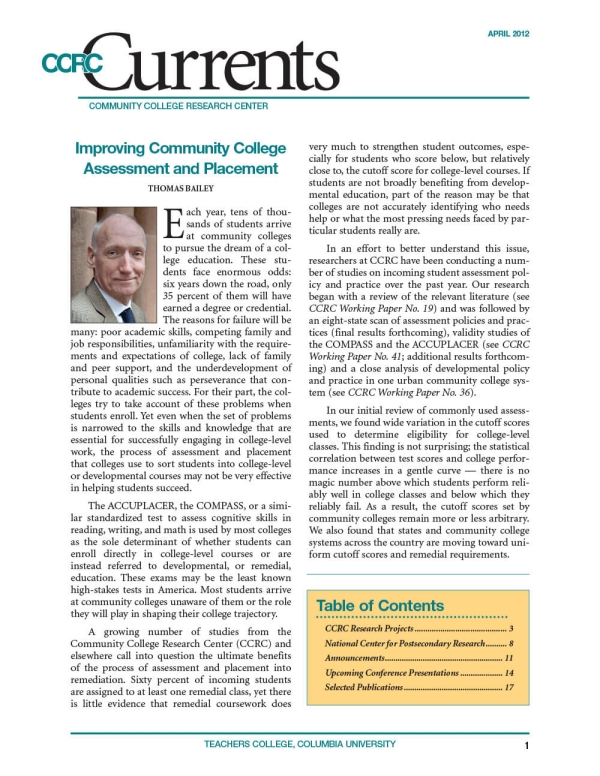
In CCRC's 2012 newsletter, Director Thomas Bailey discusses CCRC’s research on developmental assessment and placement and how colleges might more effectively assess incoming students.
This paper gives a preferred economic definition of college efficiency—fiscal and social cost per degree—and assesses the validity of using IPEDS data to calculate efficiency for a community college system.
This edition of Inside Out, a publication of CCRC's Scaling Innovation project, outlines a three-part framework for colleges looking to adopt and adapt a developmental education reform.
Based on fieldwork in two distinct labor markets, this paper compares how associate and bachelor's degrees are perceived by employers seeking to hire IT technicians.
This paper uses student-level data from a statewide community college system to examine the validity of placement tests and high school information in predicting course grades and college performance.
This paper analyzes the predictive validity of one of the most commonly used placement exams using data on over 42,000 first-time entrants in a large, urban community college system.
This practitioner packet synthesizes CCRC's findings on dual enrollment outcomes, presents a case study, and lays out guiding questions for practitioners implementing dual enrollment programs.
This National Bureau of Economic Research (NBER) working paper examines working patterns among traditional-age college students from 1970–2009, considers several explanations for the long-term trend of rising employment, and examines whether the upward trend is likely to resume when economic conditions improve.
This paper argues that to improve completion rates, colleges must help students enter programs as soon as possible; it presents a method for measuring program entry and completion rates using transcript data.