


How Can Community Colleges Afford to Offer Dual Enrollment College Courses to High School Students at a Discount?
Using three case studies, this paper examines the conditions under which dual enrollment programming could be made sustainable through efficiency gains, even for colleges that charge discounted tuition (or none at all)
Preparing for Tomorrow’s Middle-Skill Jobs: How Community Colleges Are Responding to Technology Innovation in the Workplace
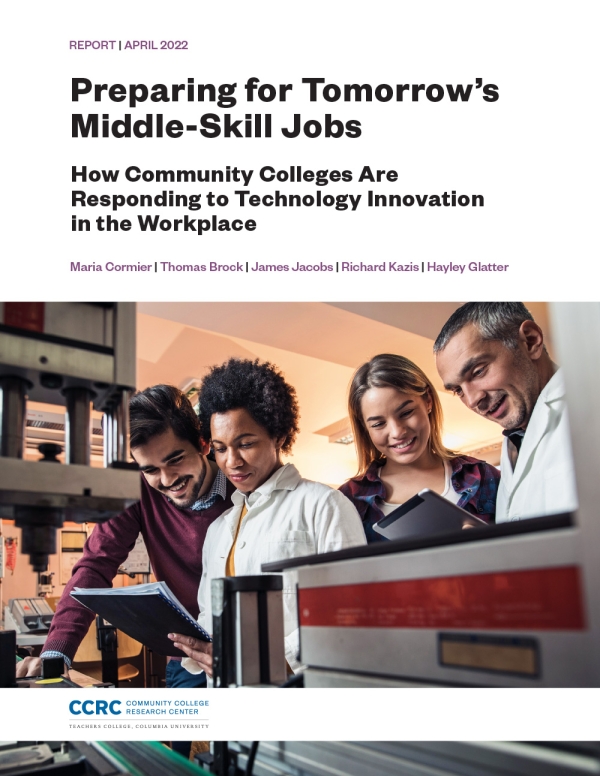
Based on fieldwork at eight institutions, this report describes how community colleges are responding to workplace technology innovation by adapting their workforce programming, diversifying pathways to certificates and degrees, and addressing equity concerns.
Using Guided Pathways to Build Cross-Sector Pathways Partnerships
Based on fieldwork at four guided pathways colleges, this report introduces a cross-sector pathways model and highlights emerging practices and strategies that community colleges are using to build stronger connections with employers, universities, and K-12 schools.
Implementing and Scaling Multiple Measures Assessment in the Context of COVID-19
This brief discusses how community college systems in four states—Indiana, Virginia, Texas, and Washington—supported large-scale changes to student placement practices in reaction to challenges associated with the COVID pandemic.
A Changing Paradigm in High School Mathematics
This paper examines challenges embedded within the prevailing high school mathematics course sequence, which prioritizes algebra, and explores innovations that aim to provide curricula and pedagogy more aligned with students’ academic and career goals.