


How Can Community Colleges Afford to Offer Dual Enrollment College Courses to High School Students at a Discount?
Using three case studies, this paper examines the conditions under which dual enrollment programming could be made sustainable through efficiency gains, even for colleges that charge discounted tuition (or none at all)
Preparing for Tomorrow’s Middle-Skill Jobs: How Community Colleges Are Responding to Technology Innovation in the Workplace
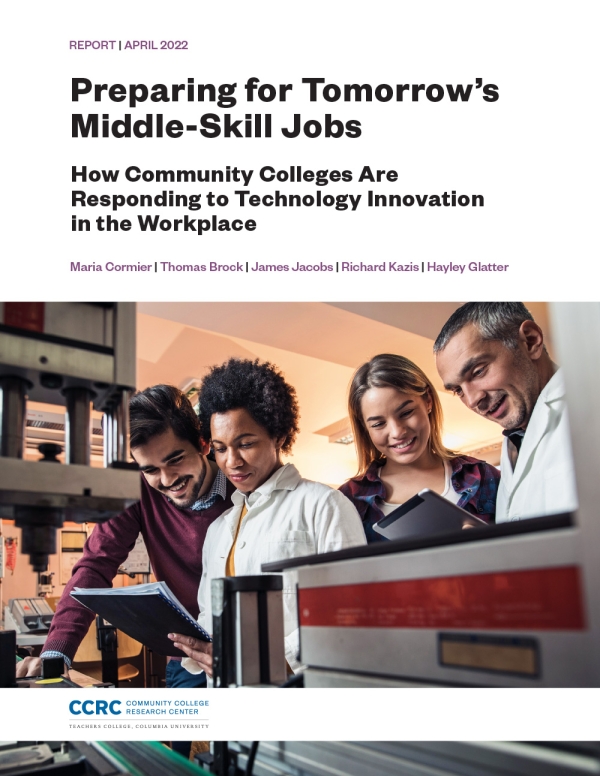
Based on fieldwork at eight institutions, this report describes how community colleges are responding to workplace technology innovation by adapting their workforce programming, diversifying pathways to certificates and degrees, and addressing equity concerns.
Can Dual Enrollment Algebra Reduce Racial/Ethnic Gaps in Early STEM Outcomes? Evidence From Florida
Using descriptive methods as well as a quasi-experimental approach, this report examines the early college outcomes of Florida high school students who enrolled in a dual enrollment college algebra course.
High School Dual Enrollment in Florida: Effects on College Outcomes by Race/Ethnicity and Course Modality
Using data on two cohorts of Florida students who started public high school in 2007 and 2012, this report analyzes dual enrollment course-taking and outcomes by racial/ethnic group (Black, Hispanic, White) and course modality (face-to-face on-college-campus, face-to-face off-campus, and online).
The Dual Enrollment Playbook: A Guide to Equitable Acceleration for Students
Based on research conducted in three states, this report identifies five principles that undergird the strategies and practices of equitable dual enrollment partnerships between high schools and colleges.