

Skip to content
Teachers College logo
CCRC's 30th Anniversary Logo
  • About Us
    • About CCRC
    • CCRC Staff
    • Advisory Board
    • Biennial Report
    • Employment
    • Contact
    • About CCRC
    • CCRC Staff
    • Advisory Board
    • Biennial Report
    • Employment
    • Contact
  • News
    • CCRC in the News
    • Opinion
    • Press Releases
    • CCRC in the News
    • Opinion
    • Press Releases
  • Community College FAQs
  • Research Areas
    • Dual Enrollment
    • Developmental Education
    • Guided Pathways
    • Advising & Student Supports
    • Teaching & Learning
    • Transfer
    • Workforce Education
    • Dual Enrollment
    • Developmental Education
    • Guided Pathways
    • Advising & Student Supports
    • Teaching & Learning
    • Transfer
    • Workforce Education
  • Publications
  • Blog
  • Resources
    • Data Tools
    • Policy Fact Sheets & Briefs
    • Guided Pathways Workshops
    • Data Tools
    • Policy Fact Sheets & Briefs
    • Guided Pathways Workshops
  • More
    • Events
    • Research Projects
    • Events
    • Research Projects
  • Overview
  • Important Dates
  • FAQs
  • Overview
  • Important Dates
  • FAQs
  • Overview
  • Important Dates
  • FAQs

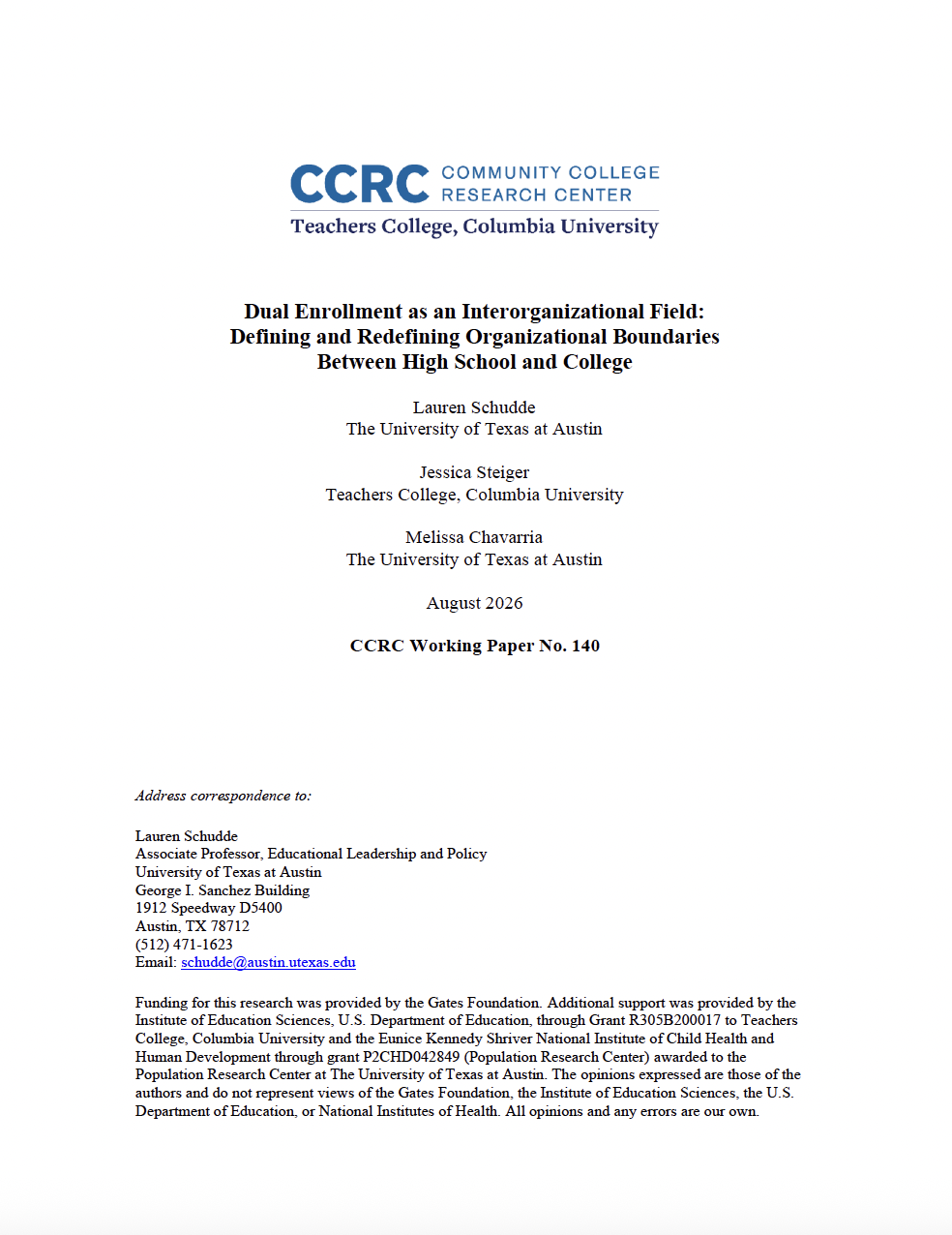
Dual Enrollment as an Interorganizational Field: Defining and Redefining Organizational Boundaries Between High School and College

By Lauren Schudde, Jessica Steiger & Melissa Chavarria

Dual enrollment, in which students earn college credit during high school, is shifting the higher education landscape, particularly at community colleges, where dual enrollment students now represent one fifth of enrollees. To facilitate dual enrollment programming, actors from a partner high school and college must navigate decisions for staffing courses, supporting students, and investing resources.

Drawing on organizational theory and data from 81 interviews and site visits at three community colleges and their partner high schools in Texas, this working paper examines how school and college actors navigate boundaries between their organizations and make decisions about resources to support dual enrollment students and courses. Improving the practical and theoretical understanding of how dual enrollment partnerships operate—including how actors from partnering organizations work together to sustain their dual enrollment programming—offers insights for theory regarding how interorganizational fields operate and illuminates practical evidence to support this growing segment of higher education.

The paper finds that legitimizing and supporting the dual enrollment partnership requires some actors to expand or reenvision their roles, while others redefine boundaries between the high school and college. At times, organizational actors must maintain boundaries, preserving rules and practices of the primary organization to comply with policies and protect funding streams. At other times, actors span and redefine organizational boundaries to meet the needs of and further establish the dual enrollment program.

  • Guidance, Tools, and Field Education for Scaling Dual Enrollment Equity Pathways

Download Links

Download CCRC Working Paper No. 140
August 2026
View related blog post
August 2026

Additional Resources

For more policy briefs and fact sheets, visit CCRC’s Policy Resources page.

Stay in Touch!

Subscribe to our newsletter for the latest on our research, including publications, blog posts, and upcoming events.
Subscribe

Community College Research Center, Teachers College, Columbia University
Box 174 | 525 West 120th Street, New York, NY 10027

  • 212.678.3091
  • ccrc@columbia.edu
Facebook-f Twitter Linkedin Youtube Instagram

© 2026. All rights reserved.

RESEARCH AREAS

  • Dual Enrollment
  • Developmental Education
  • Guided Pathways
  • Advising & Student Supports
  • Teaching & Learning
  • Transfer
  • Workforce Education
  • Dual Enrollment
  • Developmental Education
  • Guided Pathways
  • Advising & Student Supports
  • Teaching & Learning
  • Transfer
  • Workforce Education
  • CC FAQs
  • About CCRC
  • Biennial Report
  • CCRC Staff
  • Employment
  • CC FAQs
  • About CCRC
  • Biennial Report
  • CCRC Staff
  • Employment
  • Publications
  • Blog
  • Data Tools
  • Policy Fact Sheets & Briefs
  • Events
  • Publications
  • Blog
  • Data Tools
  • Policy Fact Sheets & Briefs
  • Events
Accessibility Adjustments

Powered by OneTap

How long do you want to hide the toolbar?
Hide Toolbar Duration
Select your accessibility profile
Vision Impaired Mode
Enhances website's visuals
Seizure Safe Profile
Clear flashes & reduces color
ADHD Friendly Mode
Focused browsing, distraction-free
Blindness Mode
Reduces distractions, improves focus
Epilepsy Safe Mode
Dims colors and stops blinking
Content Modules
Font Size

Default

Line Height

Default

Color Modules
Orientation Modules
  • About Us
    • About CCRC
    • CCRC Staff
    • Advisory Board
    • Biennial Report
    • Employment
    • Contact
  • Research Areas
    • Dual Enrollment
    • Developmental Education
    • Guided Pathways
    • Advising & Student Supports
    • Teaching & Learning
    • Transfer
    • Workforce Education
  • Publications
  • Blog
  • Community College FAQs
  • News
    • CCRC in the News
    • Opinion
    • Press Releases
  • More
    • Data Tools
    • Events
    • Guided Pathways Workshops
    • Policy Fact Sheets & Briefs
    • Research Projects