

Skip to content
Teachers College logo
CCRC's 30th Anniversary Logo
  • About Us
    • About CCRC
    • CCRC Staff
    • Advisory Board
    • Biennial Report
    • Employment
    • Contact
    • About CCRC
    • CCRC Staff
    • Advisory Board
    • Biennial Report
    • Employment
    • Contact
  • News
    • CCRC in the News
    • Opinion
    • Press Releases
    • CCRC in the News
    • Opinion
    • Press Releases
  • Community College FAQs
  • Research Areas
    • Dual Enrollment
    • Developmental Education
    • Guided Pathways
    • Advising & Student Supports
    • Teaching & Learning
    • Transfer
    • Workforce Education
    • Dual Enrollment
    • Developmental Education
    • Guided Pathways
    • Advising & Student Supports
    • Teaching & Learning
    • Transfer
    • Workforce Education
  • Publications
  • Blog
  • Resources
    • Data Tools
    • Policy Fact Sheets & Briefs
    • Guided Pathways Workshops
    • Data Tools
    • Policy Fact Sheets & Briefs
    • Guided Pathways Workshops
  • More
    • Events
    • Research Projects
    • Events
    • Research Projects
  • Overview
  • Important Dates
  • FAQs
  • Overview
  • Important Dates
  • FAQs
  • Overview
  • Important Dates
  • FAQs

Beyond Financial Aid: How CUNY Colleges Connect Students to Federal Work-Study Jobs

By Adela Soliz, Veronica Minaya & Judith Scott-Clayton
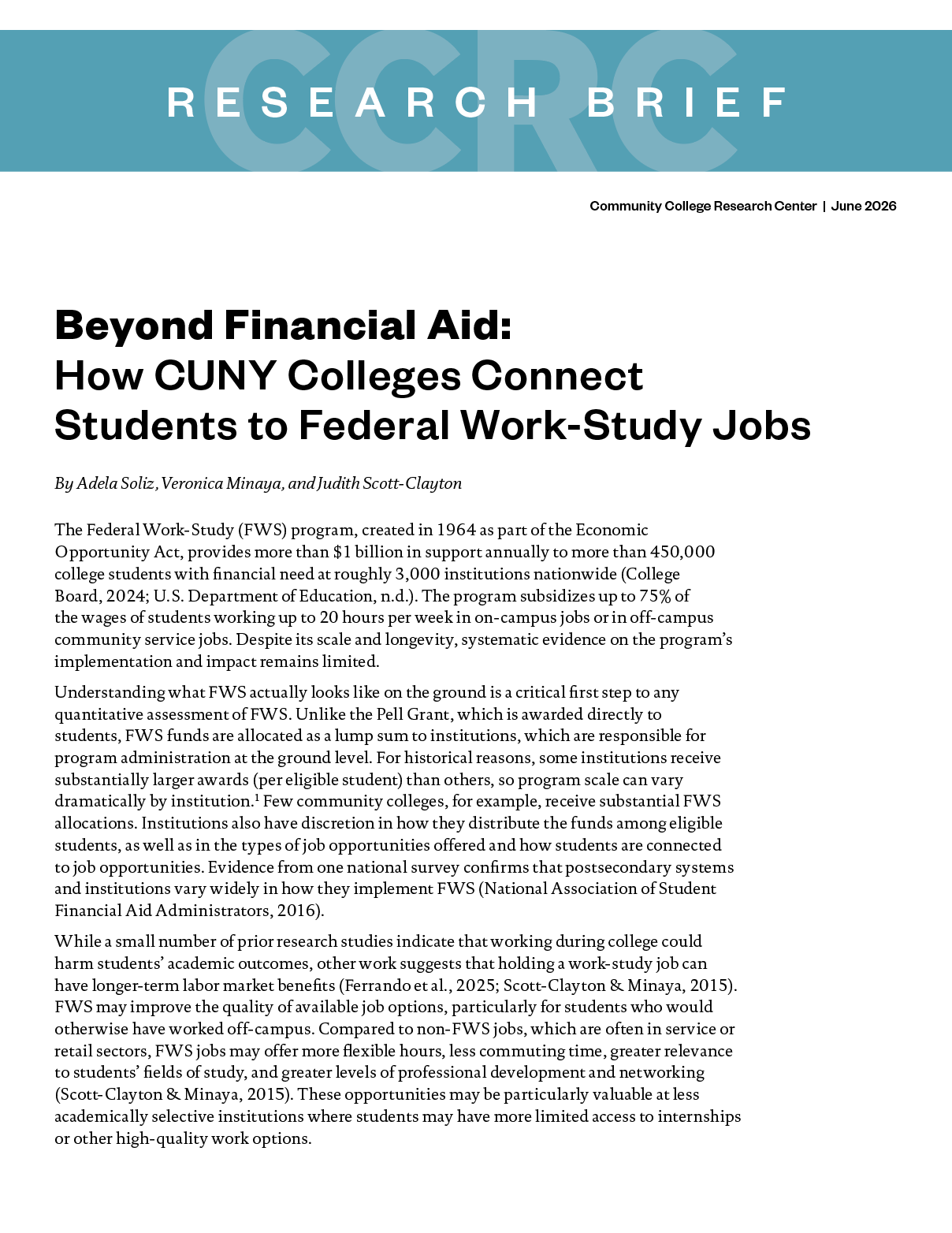
Front cover of brief titled Beyond Financial Aid: How CUNY Colleges Connect Students to Federal Work-Study Jobs

The Federal Work-Study (FWS) program provides more than $1 billion in support annually to more than 450,000 college students with financial need nationwide. Despite its scale and longevity, systematic evidence on the program’s implementation and impact remains limited.

Drawing on student surveys, interviews with students and college personnel, and administrative data, this brief describes the implementation and evolution of FWS at undergraduate institutions within the City University of New York (CUNY) system during and after the pandemic, highlighting aspects of program operations and adaptability that have implications for understanding the program nationally.

Among other topics, the findings discuss the pandemic’s influence on program participation, post-pandemic administrative adjustments, program management variation among colleges, student access barriers, and potential academic advantages of FWS jobs compared to outside employment. The authors find that the complex structure of the FWS program can be a double-edged sword: It creates a heavy workload for administrators and may be mysterious for students, but the flexibility it permits also gives campuses opportunities to modify the program.

Some of the steps taken by CUNY campuses after the pandemic to increase FWS uptake—including more proactive marketing of the program, using tools to streamline paperwork, and increasing the hourly wage—may be valuable strategies for other institutions. This new phase of program evolution could also be leveraged to further connect with broader efforts to expand work-based learning opportunities and internships tied to students’ field of study.

  • Does Federal Work-Study Work for Students?

Download Links

Download brief
June 2026
Download appendices
June 2026

Related Publications

February 2026

The Causal Effects of Federal Work-Study Offers on College Enrollment and Program Participation

Additional Resources

For more policy briefs and fact sheets, visit CCRC’s Policy Resources page.

Stay in Touch!

Subscribe to our newsletter for the latest on our research, including publications, blog posts, and upcoming events.
Subscribe

Community College Research Center, Teachers College, Columbia University
Box 174 | 525 West 120th Street, New York, NY 10027

  • 212.678.3091
  • ccrc@columbia.edu
Facebook-f Twitter Linkedin Youtube Instagram

© 2026. All rights reserved.

RESEARCH AREAS

  • Dual Enrollment
  • Developmental Education
  • Guided Pathways
  • Advising & Student Supports
  • Teaching & Learning
  • Transfer
  • Workforce Education
  • Dual Enrollment
  • Developmental Education
  • Guided Pathways
  • Advising & Student Supports
  • Teaching & Learning
  • Transfer
  • Workforce Education
  • CC FAQs
  • About CCRC
  • Biennial Report
  • CCRC Staff
  • Employment
  • CC FAQs
  • About CCRC
  • Biennial Report
  • CCRC Staff
  • Employment
  • Publications
  • Blog
  • Data Tools
  • Policy Fact Sheets & Briefs
  • Events
  • Publications
  • Blog
  • Data Tools
  • Policy Fact Sheets & Briefs
  • Events
Accessibility Adjustments

Powered by OneTap

How long do you want to hide the toolbar?
Hide Toolbar Duration
Select your accessibility profile
Vision Impaired Mode
Enhances website's visuals
Seizure Safe Profile
Clear flashes & reduces color
ADHD Friendly Mode
Focused browsing, distraction-free
Blindness Mode
Reduces distractions, improves focus
Epilepsy Safe Mode
Dims colors and stops blinking
Content Modules
Font Size

Default

Line Height

Default

Color Modules
Orientation Modules
  • About Us
    • About CCRC
    • CCRC Staff
    • Advisory Board
    • Biennial Report
    • Employment
    • Contact
  • Research Areas
    • Dual Enrollment
    • Developmental Education
    • Guided Pathways
    • Advising & Student Supports
    • Teaching & Learning
    • Transfer
    • Workforce Education
  • Publications
  • Blog
  • Community College FAQs
  • News
    • CCRC in the News
    • Opinion
    • Press Releases
  • More
    • Data Tools
    • Events
    • Guided Pathways Workshops
    • Policy Fact Sheets & Briefs
    • Research Projects