

Skip to content
  • About Us
    • About CCRC
    • CCRC Staff
    • Advisory Board
    • Biennial Report
    • Employment
    • Contact
    • About CCRC
    • CCRC Staff
    • Advisory Board
    • Biennial Report
    • Employment
    • Contact
  • News
    • CCRC in the News
    • Opinion
    • Press Releases
    • CCRC in the News
    • Opinion
    • Press Releases
  • Community College FAQs
  • Research Areas
    • Dual Enrollment
    • Developmental Education
    • Guided Pathways
    • Advising & Student Supports
    • Teaching & Learning
    • Transfer
    • Workforce Education
    • Dual Enrollment
    • Developmental Education
    • Guided Pathways
    • Advising & Student Supports
    • Teaching & Learning
    • Transfer
    • Workforce Education
  • Publications
  • Blog
  • Resources
    • Policy Resources
    • Guided Pathways Workshops
    • Policy Resources
    • Guided Pathways Workshops
  • More
    • Events
    • Research Projects
    • Events
    • Research Projects
  • Overview
  • Important Dates
  • FAQs
  • Overview
  • Important Dates
  • FAQs
  • Overview
  • Important Dates
  • FAQs

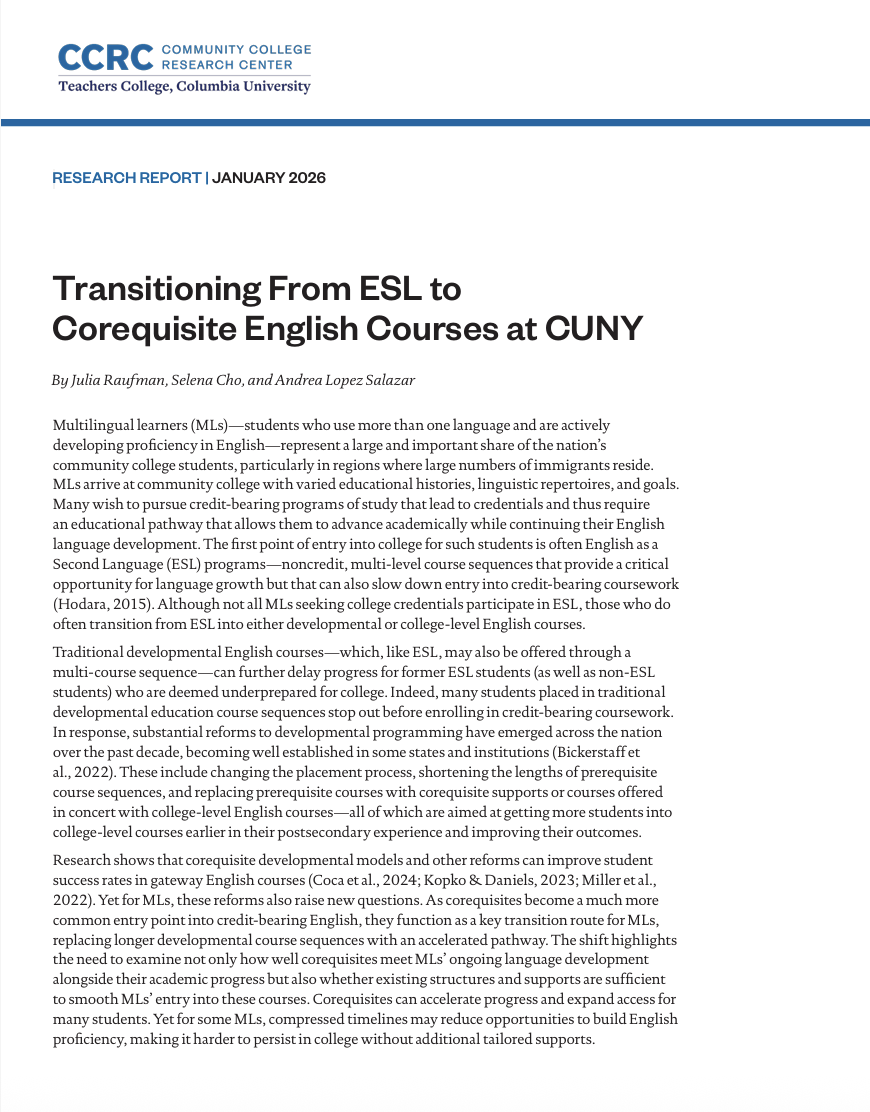
Transitioning From ESL to Corequisite English Courses at CUNY

By Julia Raufman, Selena Cho & Andrea Lopez Salazar

This report examines how multilingual learners (MLs) at five CUNY community colleges navigate pathways from English as a Second Language (ESL) into corequisite and other credit-bearing English courses—a critical yet understudied transition in higher education. Drawing on interviews and institutional documents, the study describes how placement processes, departmental structures, ESL course sequences, and instructional models shape MLs’ access to and experiences in corequisite or standalone college-level English.

The findings suggest that, while the corequisite model—along with changes to ESL placement and ESL course structure—can help many MLs by accelerating their progression into credit-bearing coursework, rigid placement systems, departmental silos, and the elimination of prerequisite developmental English may compress timelines in ways that do not always benefit some MLs and that reduce the number of entry points that MLs have into lower-level ESL courses.

Yet the findings also highlight promising practices—including the use of ESL-specific corequisites and paired ESL/general education courses, extended instructional time, and culturally affirming pedagogy—that integrate language development with credit-bearing coursework. The report concludes with considerations for strengthening ML pathways, emphasizing the need for flexible, coordinated, and linguistically responsive approaches that balance acceleration with sustained language development.

Funding for this research was provided by Ascendium Education Group.

  • Center for the Analysis of Postsecondary Readiness (CAPR)

Download Links

Download report
January 2026

Related Publications

July 2025

Student Experiences in Corequisite Courses at CUNY

November 2024

Lessons on Scaling Corequisites: The City University of New York’s Transition From Prerequisite to Corequisite Academic Support

Additional Resources

For more policy briefs and fact sheets, visit CCRC’s Policy Resources page.

Stay in Touch!

Subscribe to our newsletter for the latest on our research, including publications, blog posts, and upcoming events.
Subscribe

Community College Research Center, Teachers College, Columbia University
Box 174 | 525 West 120th Street, New York, NY 10027

  • 212.678.3091
  • ccrc@columbia.edu
Facebook-f Twitter Linkedin Youtube Instagram

© 2026. All rights reserved.

RESEARCH AREAS

  • Dual Enrollment
  • Developmental Education
  • Guided Pathways
  • Advising & Student Supports
  • Teaching & Learning
  • Transfer
  • Workforce Education
  • Dual Enrollment
  • Developmental Education
  • Guided Pathways
  • Advising & Student Supports
  • Teaching & Learning
  • Transfer
  • Workforce Education
  • CC FAQs
  • About CCRC
  • Biennial Report
  • CCRC Staff
  • Employment
  • CC FAQs
  • About CCRC
  • Biennial Report
  • CCRC Staff
  • Employment
  • Publications
  • Blog
  • Policy Resources
  • Events
  • Publications
  • Blog
  • Policy Resources
  • Events
Accessibility Adjustments

Powered by OneTap

How long do you want to hide the toolbar?
Hide Toolbar Duration
Select your accessibility profile
Vision Impaired Mode
Enhances website's visuals
Seizure Safe Profile
Clear flashes & reduces color
ADHD Friendly Mode
Focused browsing, distraction-free
Blindness Mode
Reduces distractions, improves focus
Epilepsy Safe Mode
Dims colors and stops blinking
Content Modules
Font Size

Default

Line Height

Default

Color Modules
Orientation Modules
  • About Us
    • About CCRC
    • CCRC Staff
    • Advisory Board
    • Biennial Report
    • Employment
    • Contact
  • Research Areas
    • Dual Enrollment
    • Developmental Education
    • Guided Pathways
    • Advising & Student Supports
    • Teaching & Learning
    • Transfer
    • Workforce Education
  • Publications
  • Blog
  • Community College FAQs
  • News
    • CCRC in the News
    • Opinion
    • Press Releases
  • More
    • Events
    • Guided Pathways Workshops
    • Policy Resources
    • Research Projects