


College Acceleration for All? Mapping Racial/Ethnic Gaps in Advanced Placement and Dual Enrollment Participation
This paper estimates the patterns and sources of White–Black and White–Hispanic enrollment gaps in Advancement Placement (AP) and dual enrollment programs across several thousand school districts and metropolitan areas in the United States.
Can Dual Enrollment Algebra Reduce Racial/Ethnic Gaps in Early STEM Outcomes? Evidence From Florida
Using descriptive methods as well as a quasi-experimental approach, this report examines the early college outcomes of Florida high school students who enrolled in a dual enrollment college algebra course.
How Guided Pathways Reforms Can Improve Support for Adult Students: Lessons From Three Tennessee Community Colleges
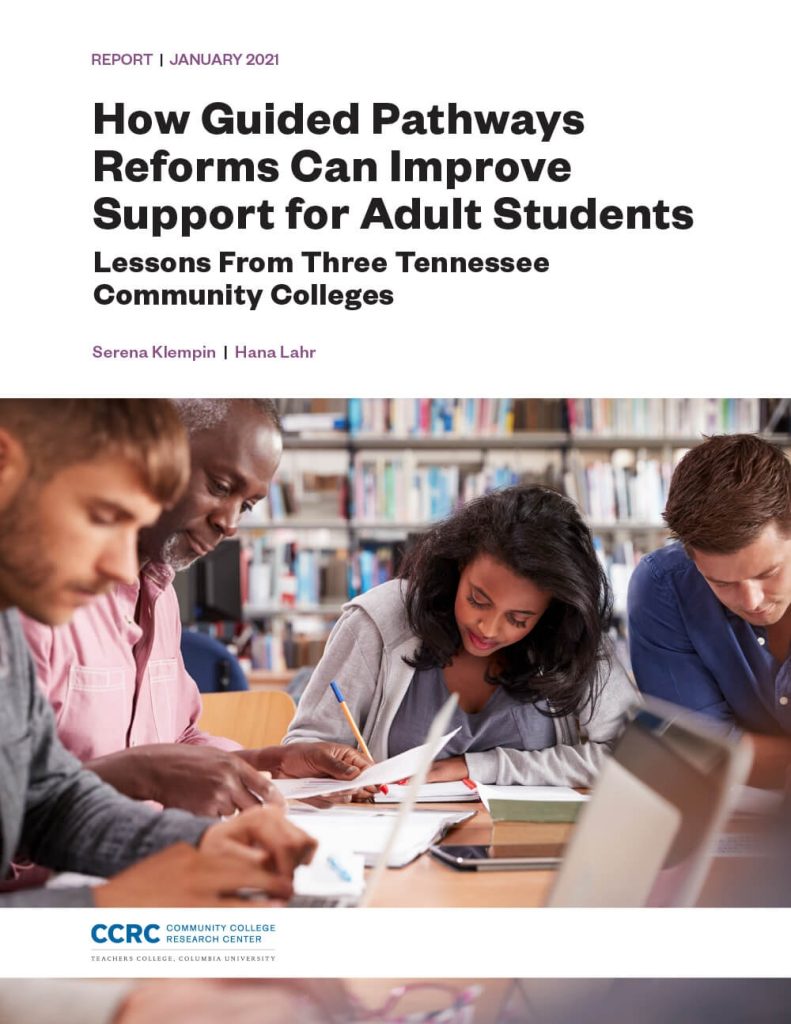
Drawing on interview data, this report discusses strategies that three guided pathways colleges use to help adult students enter programs of study, stay on path, and enhance learning.
Using Technology to Redesign College Advising and Student Support: Findings and Lessons From Three Colleges’ Efforts to Build on the iPASS Initiative
This report summarizes enhancements to technology-based advising at three institutions and their effects on students’ academic outcomes for four semesters after study entry.
A Changing Paradigm in High School Mathematics
This paper examines challenges embedded within the prevailing high school mathematics course sequence, which prioritizes algebra, and explores innovations that aim to provide curricula and pedagogy more aligned with students’ academic and career goals.