Unlocking More STEM Talent Through Transfer
CCDaily covered findings from a new report that finds that community college transfers are less likely than students who start at four-year institutions to complete a bachelor’s degree in a STEM field.



New York, November 5, 2026 — Each year, tens of thousands of graduates awarded STEM bachelor’s degrees are community college transfer students.
But transfer students are less likely to earn degrees in STEM than graduates who start at four-year institutions. Those who earn STEM degrees face longer paths to graduation and are less likely to pursue graduate education—even though prior research shows that their academic performance after transfer is comparable to that of non-transfer students.
A new report from the Community College Research Center at Teachers College, Columbia University—Unlocking STEM Talent: What Happens to Transfer Students at the Four-Year College? by Tatiana Velasco and Lois Miller—is the first to provide a national and state-by-state breakdown on the trajectories of community college transfer students in STEM fields and to provide evidence on the extent to which transfer bachelor’s completers in STEM pursue graduate education. A central finding from this study is that if transfer students graduated in STEM at the same rate as students who started at universities, there would have been 18,000 more STEM bachelor’s graduates in the cohort studied.
Read the report and executive summary | View state-by-state data on the data dashboard
As four-year colleges face growing pressure to expand the number of students pursuing STEM degrees, community colleges offer a largely untapped source of talent. This new report highlights opportunities to increase STEM bachelor’s attainment and graduate enrollment while broadening socioeconomic and racial diversity.
“For transfer students, the path to a STEM bachelor’s degree is often harder than it needs to be. Our report shows where students fall behind—even compared with transfer students in other fields—and what colleges and state systems can do to strengthen these pathways,” said Tatiana Velasco, senior research associate at CCRC, and lead author of the report.
Using data from the National Student Clearinghouse Research Center, the report examines students who entered four-year institutions in 2015–16 and earned bachelor’s degrees within six years. It identifies differences across states and opportunities to improve STEM transfer pathways. Here are the major findings:
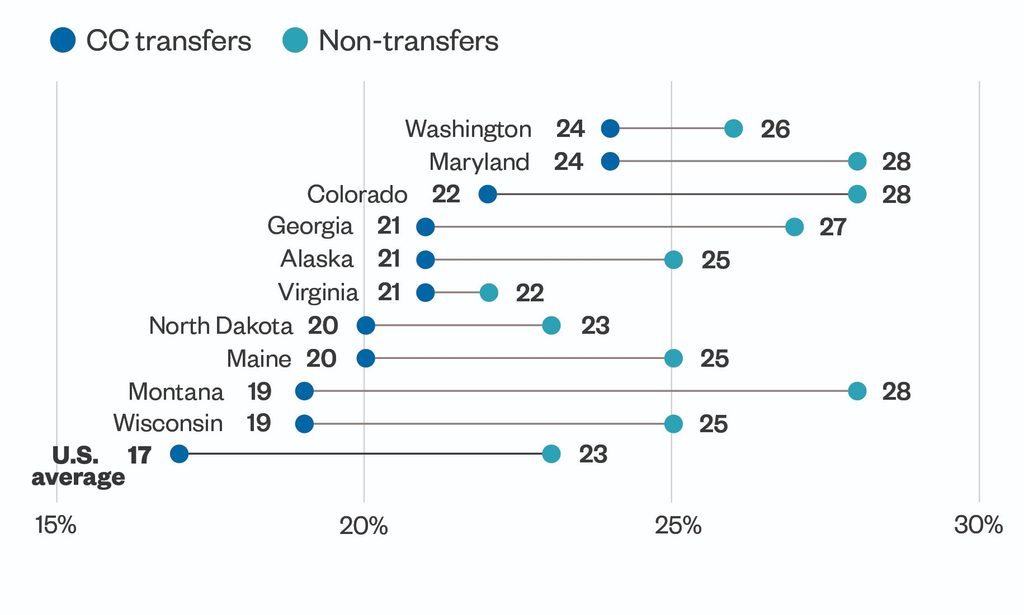
Transfer and timely graduation are challenges across fields, but tightly sequenced STEM programs make course planning and credit alignment especially important. Drawing on these findings and prior transfer research, the authors recommend three priorities for universities, community colleges, and state systems:
The findings in this report are aimed at helping college and state leaders assess challenges and opportunities in expanding STEM talent through community college transfer pathways. By focusing on the post-transfer pathway, this report highlights that broadening STEM attainment requires sustained collaboration among community colleges, universities, and state systems—from helping students explore STEM careers to supporting bachelor’s completion and graduate study.
###
The Community College Research Center (CCRC), Teachers College, Columbia University, has been a leader in the field of community college research and reform for 30 years. CCRC’s work provides a foundation for innovations in policy and practice that help give every community college student the best chance of success. For more information, visit ccrc.tc.columbia.edu.