


Addressing student basic needs is essential for college enrollment and persistence. Supporting students with nutrition, housing, childcare, transportation, and access to healthcare can head off challenges that derail their education. Basic needs are a particular concern for community colleges, which generally serve more low-income students and student parents than four-year colleges and universities.
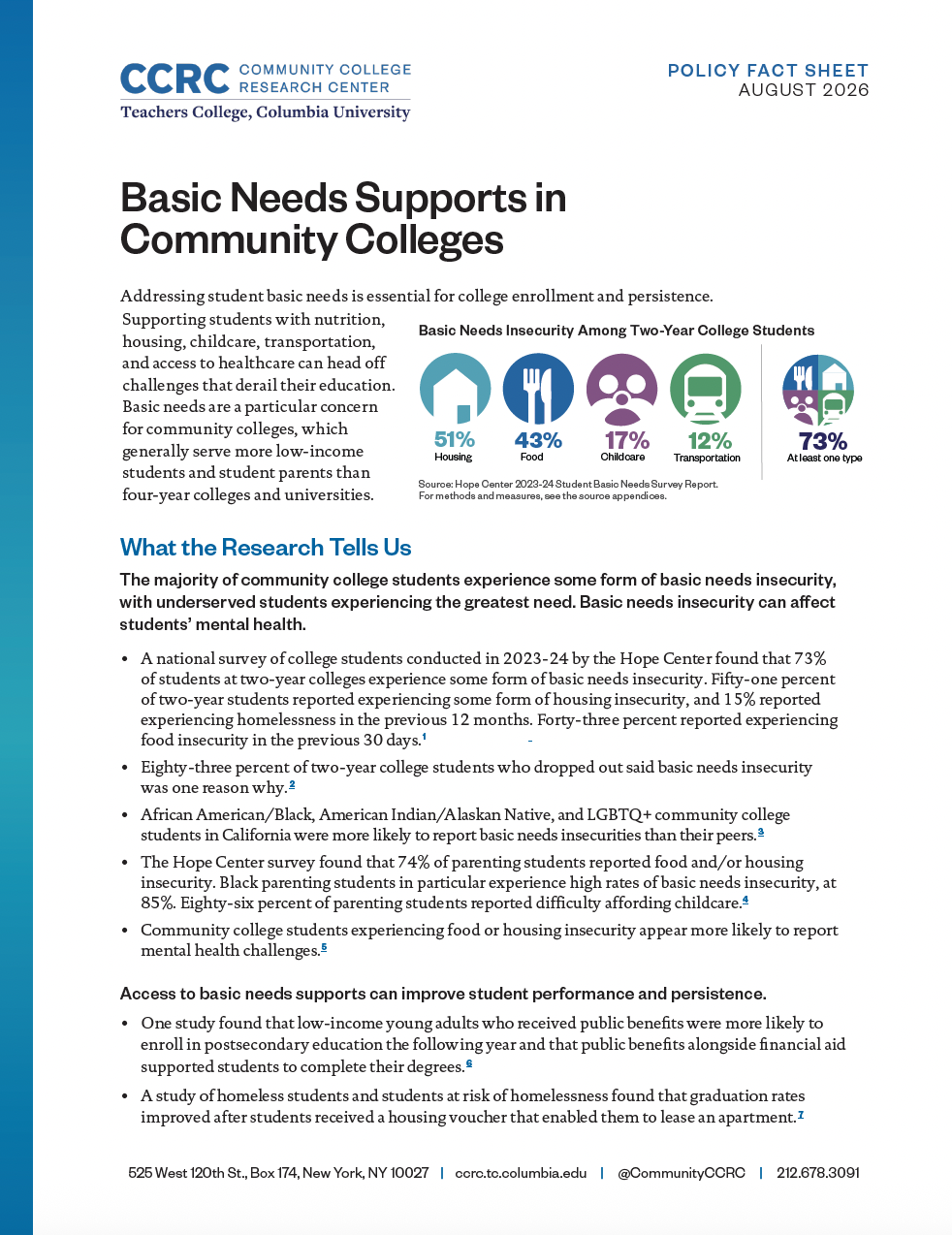
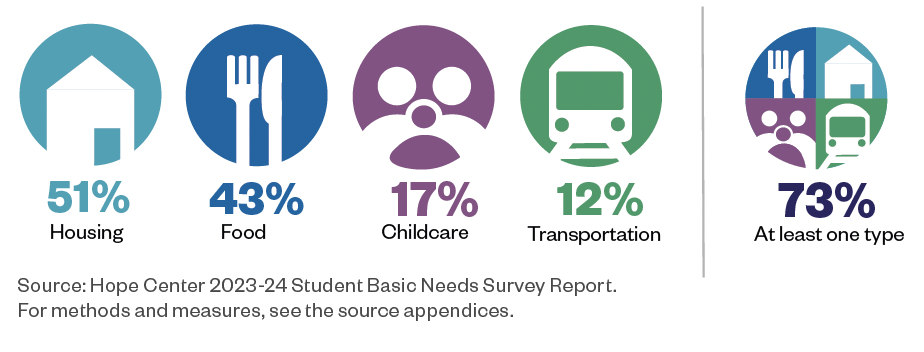
Basic Needs Insecurity Among Two-Year College Students
What the Research Tells Us
The majority of community college students experience some form of basic needs insecurity, with some student groups experiencing greater need. Basic needs insecurity can affect students’ mental health.
- A national survey of college students conducted in 2023-24 by the Hope Center found that 73% of students at two-year colleges experience some form of basic needs insecurity. Fifty-one percent of two-year students reported experiencing some form of housing insecurity, and 15% reported experiencing homelessness in the previous 12 months. Forty-three percent reported experiencing food insecurity in the previous 30 days.[1]
- Eighty-three percent of two-year college students who dropped out said basic needs insecurity was one reason why.[2]
- African American/Black, American Indian/Alaskan Native, and LGBTQ+ community college students in California were more likely to report basic needs insecurities than their peers.[3]
- The Hope Center survey found that 74% of parenting students reported food and/or housing insecurity. Black parenting students in particular experience high rates of basic needs insecurity, at 85%. Eighty-six percent of parenting students reported difficulty affording childcare.[4]
- Community college students experiencing food or housing insecurity appear more likely to report mental health challenges.[5]
Access to basic needs supports can improve student performance and persistence.
- One study found that low-income young adults who received public benefits were more likely to enroll in postsecondary education the following year and that public benefits alongside financial aid supported students to complete their degrees.[6]
- A study of homeless students and students at risk of homelessness found that graduation rates improved after students received a housing voucher that enabled them to lease an apartment.[7]
- While the Pell Grant provides essential support to students, it is often insufficient on its own to meet student needs.
- Food insecurity is higher and credential persistence and attainment are lower among Pell Grant recipients than among students who do not receive Pell.[8]
Many, though not all, community colleges provide basic needs supports.[9]
- A survey of community colleges in six states found that community colleges prioritized addressing student basic needs when they had flexible federal funding during the COVID pandemic. Seventy-one percent of colleges reported spending federal pandemic relief funding to provide additional emergency cash aid to students.[10]
- In the same survey, 90% of colleges reported having a food pantry.[11]
- Though nearly half of public four-year colleges provide on-campus childcare, only 38% of public two-year colleges offer on-campus childcare.[12]
Basic needs supports aren’t reaching all the students who could benefit from them.
- Sixty-five percent of two-year students in the Hope Center national survey reported that they were unaware of campus basic needs resources. Among two-year students who experienced at least one type of basic needs insecurity, 50% did not use any campus-based supports.[13]
- A study of SNAP participation rates among community college students in California found that only 26% of eligible students received benefits in 2021.[14]
- Twelve percent of public two-year college students received emergency grants in 2020, compared with 18% of public four-year college students.[15]
- Following the end of federal pandemic relief funding, 75% of college representatives responding to a survey conducted in six states indicated that they were concerned about their ability to continue to support students with personal and financial emergencies.[16]
Policy Considerations
- While community colleges can play a vital role in supporting basic needs access for their students, they cannot do so in isolation. Federal and state funding is crucial.
- Adequate funding and system support to colleges should promote basic needs programs that include strong outreach efforts[17] and that engage all staff with resources and training.[18] The programs should also be tailored to the needs of specific groups of students, including online students,[19] student parents,[20] [21] and rural students.[22]
- Many state and federal basic needs support programs make it difficult for students to qualify for support. SNAP eligibility, for instance, is more restrictive for students than for the general public. Colleges can play an important role in explaining what benefits are available and providing application assistance to support students accessing benefits.[23]
- The federal government’s quick response to the COVID pandemic and the establishment of the Higher Education Emergency Relief fund provides an affirmative example of its role in supporting community colleges’ capacity to act as hubs for basic needs during national disasters and other emergencies.[24]
Endnotes
- The Hope Center (2025). 2023-2024 Student basic needs survey report. The Hope Center for Student Basic Needs at Temple University. https://hope.temple.edu/research/hope-center-basic-needs-survey/2023-2024-student-basic-needs-survey-report
- The Hope Center (2025).
- The RP Group and the Chief Executive Officers (CEO) Affordability, Food & Housing Access Taskforce (2023). Real college California: Basic needs among California community college students. Community College League of California. https://eric.ed.gov/?id=ED631784
- The Hope Center (2025).
- Broton, K. M., Mohebali, M., & Lingo, M. D. (2022). Basic needs insecurity and mental health: Community college students’ dual challenges and use of social support. Community College Review, 50(4), 456– 482. https://journals.sagepub.com/doi/full/10.1177/00915521221111460
- Ryberg, R., Thomson, D., Keaton, H., & Conway, J. (2026). Public benefits and financial aid support education beyond high school and long-term economic well-being for low income young adults. Child Trends. https://www.childtrends.org/publications/public-benefits-financial-aid-support-education-low-income-young-adults
- Goldrick-Rab, S., Baker-Smith, C., Cordes, S. A., & Clark, K. (2024). A longitudinal evaluation of a housing choice voucher program: Homelessness and housing insecurity among community college students. Education Northwest. https://educationnorthwest.org/sites/default/files/pdf/homelessness-among-cc-students-report.pdf
- Tran, T., & Vargas, M. (2026). Federal SNAP cuts and Pell funding shortfall risk worsening disparities in food insecurity, college persistence, and attainment. Institute for Higher Education Policy. https://www.ihep.org/snap-cuts-pell-shortfall-risk-worsening-disparities-in-food-insecurity-persistence-attainment/
- McCann, M. & Pechota, D. (2022). Community college approaches to student supports. Education Commission of the States. https://www.ecs.org/wp-content/uploads/Community-College-Approaches-to-Student-Supports.pdf
- Klempin, S. C., Griffin, S., Monahan, T., Anderson, M., & Brock, T. (2024). Pandemic relief spending and recovery strategies: Findings from a survey of community colleges in six states. Community College Research Center, Teachers College, Columbia University. https://ccrc.tc.columbia.edu/publications/pandemic-relief-spending-recovery-strategies-survey-six-states.html
- Klempin et al. (2024).
- Ryberg, R., Rosenberg, R., & Warren, J. (2021). Higher education can support parenting students and their children with accessible, equitable services. Child Trends. https://www.childtrends.org/publications/higher-education-support-parenting-students-and-their-children-with-accessible-equitable-services
- The Hope Center (2025).
- Hogg, J., Ayers, S., Lacoe, J., Perez, A., & Rothstein, J. (2024). Many California community college students are eligible for—but not receiving—CalFresh benefits. Accelerating Recovery in Community Colleges Network. https://capolicylab.org/wp-content/uploads/2024/12/Eligibility-for-CalFresh-Among-California-Community-College-Students.pdf
- NASPA. (2025). Emergency aid federal data highlights and implications for student affairs. https://www.naspa.org/report/emergency-aid-federal-data-highlights-and-implications-for-student-affairs
- Klempin et al. (2024).
- Goldrick-Rab, S., Clark, K., Baker-Smith, C., & Witherspoon, C. (2021). Supporting the whole community college student: The impact of nudging for basic needs security. The Hope Center for Student Basic Needs at Temple University. https://hope.temple.edu/sites/hope/files/media/document/ARC_ImpactPaper_final_10_4_reduce.pdf
- CCCSE. (2022). Mission critical: The role of community colleges in meeting students’ basic needs.
www.cccse.org/NR22 - Dorimé-Williams, M., Castleman, J., Cellura, P., O’Donoghue, R., & Toyoda, M. (2025). Supporting online learners: Insights from SUNY’s campus coaching programs. MDRC. https://www.mdrc.org/sites/default/files/2025_SUNY_Online_Degrees.pdf
- Anderson, T., Dundar, A., Gittens, S., Ryberg, R., Schreiber, R., Taylor, L., Warren, J., & Westaby,
K. (2024). Who are undergraduates with dependent children?: An updated overview of student-parent characteristics using 2020 data. Spark Collaborative. https://studentparentaction.org/assets/r-file/Who-Are-Undergraduates-with-Dependent-Children.pdf - Obatuase, E., Anderson, T., & Baker, S. (2026). Debunking myths on student parent data collection. New America. https://www.newamerica.org/insights/debunking-myths-on-student-parent-data-collection/
- Kurban, L., Tezil, T., Day, B. J. (2025). How rural colleges and communities can support postsecondary learners. AIR. https://www.air.org/resource/blog-post/how-rural-colleges-and-communities-can-support-postsecondary-learners
- Nix, A. N., Bertrand Jones, T., Daniels, H., Hu, P., & Hu, S. (2024). “There’s so much that we’re doing”: How Florida College System institutions address basic needs insecurity among students. Community College Review, 52(3) 334–353. https://journals.sagepub.com/doi/pdf/10.1177/00915521211047674
- Klempin, S. C., Griffin, S., Monahan, T., Anderson, M., & Brock, T. (2024). Pandemic relief spending and recovery strategies: Survey of six states. Accelerating Recovery in Community Colleges Network. https://ccrc.tc.columbia.edu/publications/pandemic-relief-spending-recovery-strategies-survey-six-states.html
This fact sheet was prepared by Megan Anderson.
