


What Accounts for Gaps in Student Loan Default, and What Happens After
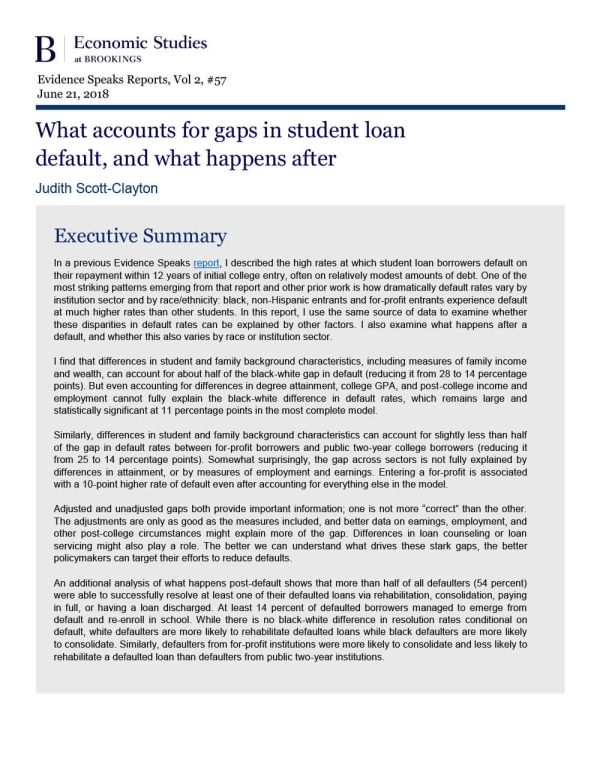
This Brookings Institution report uses data from the U.S. Department of Education to examine whether disparities in student loan default rates by race/ethnicity and institution sector can be explained by other factors, along with what happens after a default and whether this also varies across student subgroups.
The Impact of Occupational Licensing on Labor Market Outcomes of College-Educated Workers
This paper identifies the effects of licenses on a set of labor market outcomes for the college-educated workforce using newly available national Current Population Survey data merged with data from the U.S. Department of Labor on state-level, occupation-specific licensing requirements.
Baseline Trends in Key Performance Indicators Among Colleges Participating in a Technology-Mediated Advising Reform Initiative
This paper looks at baseline key performance indicators (KPIs) for 26 two- and four-year institutions that received grants to implement technology-mediated advising reforms.
Strengthening Transfer Paths to a Bachelor’s Degree: Identifying Effective Two-Year to Four-Year College Partnerships

Using National Student Clearinghouse data, this paper introduces a two-stage, input-adjusted, value-added analytic framework for identifying partnerships of two- and four-year institutions that are particularly effective in enabling students to transfer and earn bachelor’s degrees.
Practitioner Perspectives on the Use of Predictive Analytics in Targeted Advising for College Students

This CCRC working paper examines the perspectives of college personnel engaged in the consideration, launch, and use of predictive analytics tools for targeted advising.