


It is estimated that about a fifth of undergraduates in college are parents.[1] A disproportionate share of student parents attend community colleges, which have more flexible programs that cater to adult students.[2] Though parenting students often have clear goals for what they want out of college—usually related to employment—they face challenges that nonparenting students do not, including financial needs and caregiving responsibilities that can make completing a degree or transferring to a bachelor’s program difficult.[3]
What the Research Tells Us
Many college students are parents, and they disproportionately attend community colleges. They are often very low income.
- Roughly one in five undergraduates—or 3.1 million students—are parents, and nearly half are enrolled at community or technical colleges.[4] [5]
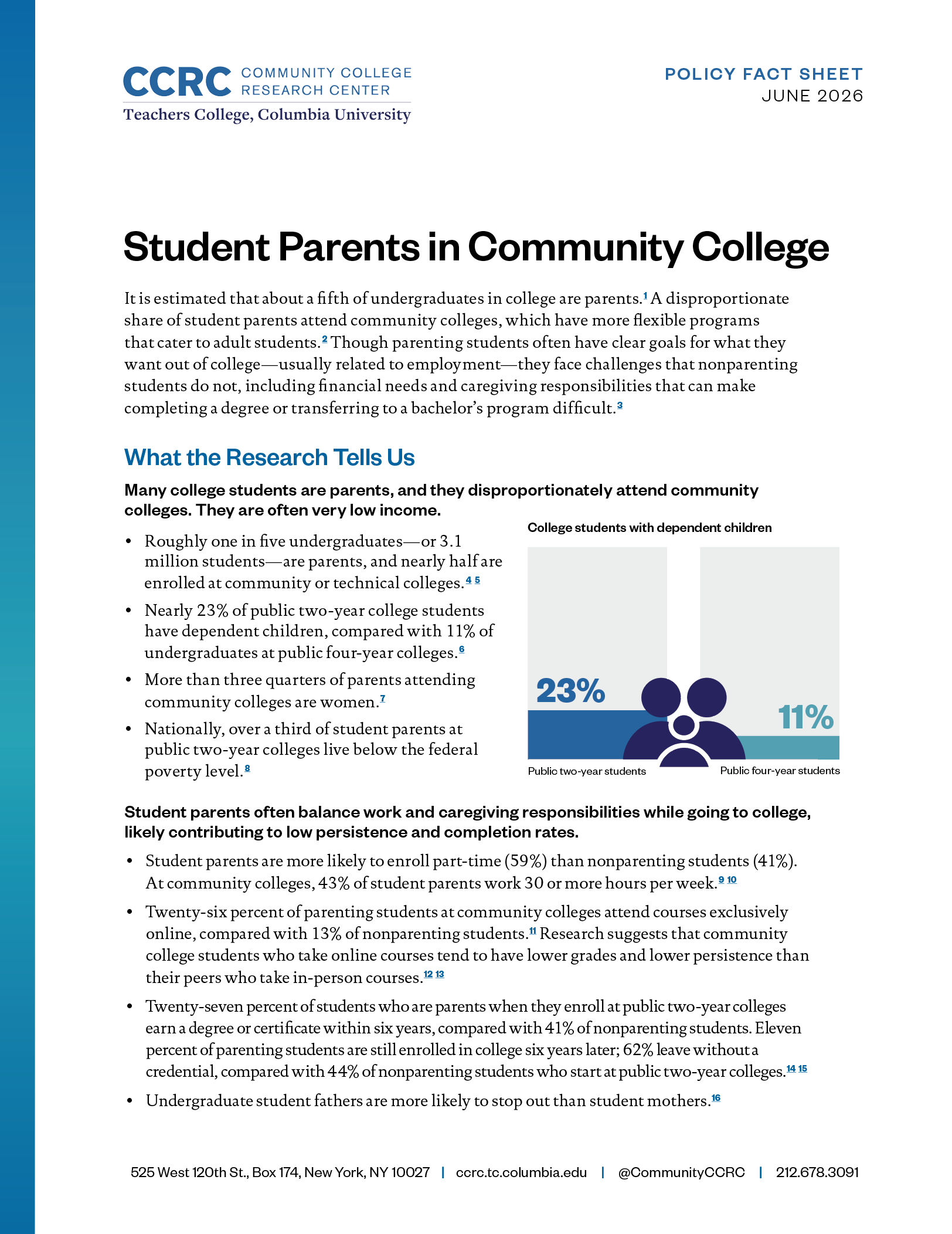
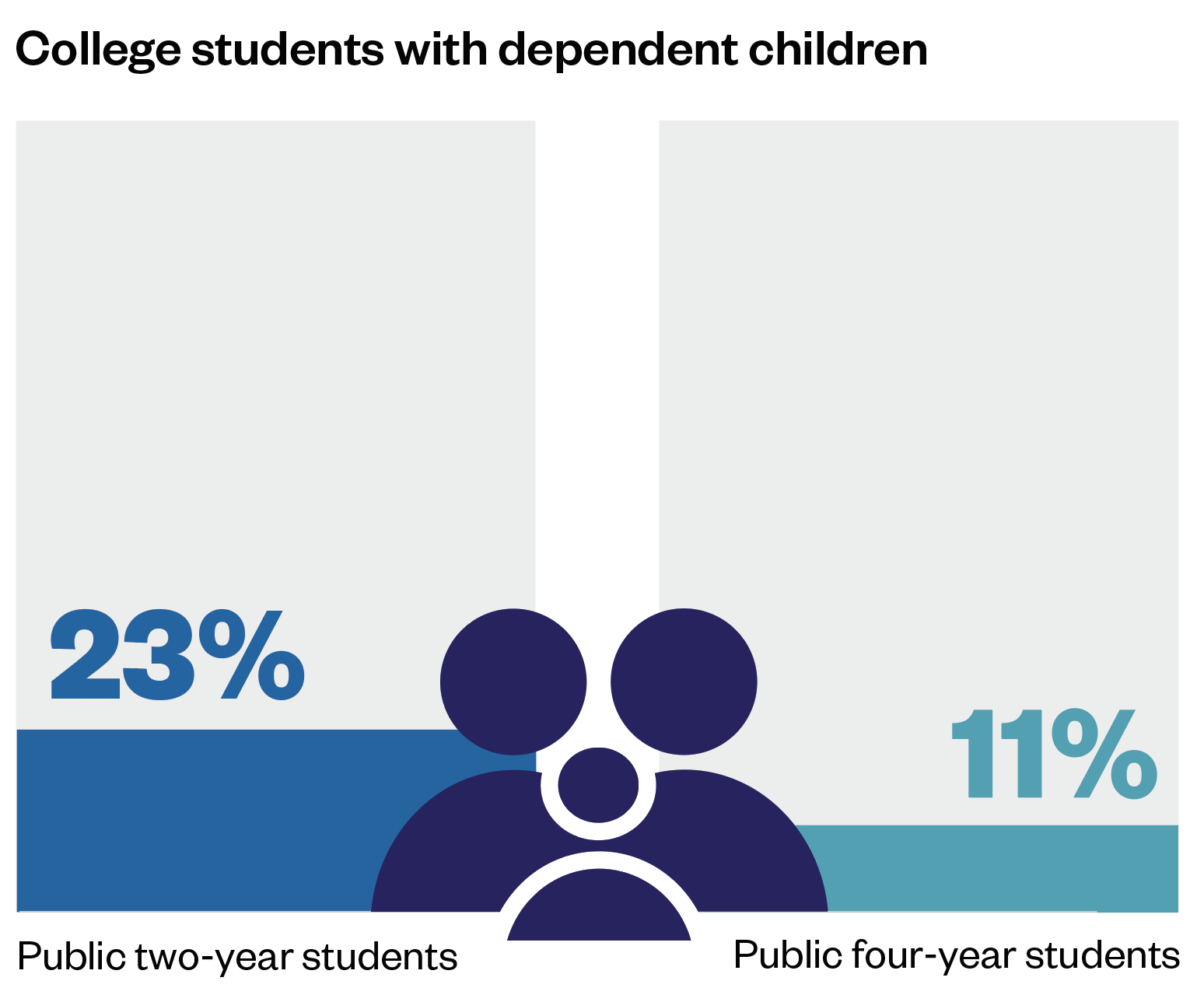
- Nearly 23% of public two-year college students have dependent children, compared with 11% of undergraduates at public four-year colleges.[6]
- More than three quarters of parents attending community colleges are women.[7]
- Nationally, over a third of student parents at public two-year colleges live below the federal poverty level.[8]
Student parents often balance work and caregiving responsibilities while going to college, likely contributing to low persistence and completion rates.
- Student parents are more likely to enroll part-time (59%) than nonparenting students (41%). At community colleges, 43% of student parents work 30 or more hours per week.[9] [10]
- Twenty-six percent of parenting students at community colleges attend courses exclusively online, compared with 13% of nonparenting students.[11] Research suggests that community college students who take online courses tend to have lower grades and lower persistence than their peers who take in-person courses.[12] [13]
- Twenty-seven percent of students who are parents when they enroll at public two-year colleges earn a degree or certificate within six years, compared with 41% of nonparenting students. Eleven percent of parenting students are still enrolled in college six years later; 62% leave without a credential, compared with 44% of nonparenting students who start at public two-year colleges.[14] [15]
- Undergraduate student fathers are more likely to stop out than student mothers.[16]
Many colleges lack services for student parents, or students don’t use them. Affordable childcare is a particular challenge.
- In one survey, more than half of parenting students (56%) in community college cited career change as their main goal in attending college, and 77% said they enrolled in college to obtain or update job skills.[17] Despite these aims, 60% reported never using career counseling services, and 88% said they never used job placement assistance.[18]
- Only 38% of public two-year colleges offer on-campus childcare.[19]
- Many college financial aid offices fail to consider the financial needs of student parents, including reliable childcare. One estimate put the out-of-pocket cost at more than $7,500 more per child annually in California.[20]
- In a survey, more than half of parenting community college students who stopped out said affordable childcare would help them return to college.[21]
- Over 60% of parenting students depend on family, friends, and neighbors for childcare, but these options are not always available or reliable. Problems with childcare can lead students to miss class.[22] [23]
Policy Considerations
- There are compelling reasons to focus on increasing college completion among student parents. Mothers who reenroll earn on average nearly $6,800 more annually after completing an associate or bachelor’s degree. Their children are 38% more likely to complete a college degree.[24]
- Affordable, reliable childcare is arguably the most critical support that student parents need. Student parents who earn a credential are more likely to have attended a college that provides childcare supports like full-time care, drop-in care, or subsidies than student parents who drop out.[25]
- Support for basic needs—including food, housing, and transportation—is also critical for many student parents. Colleges should screen for basic needs and make appropriate referrals to campus and community resources. Information should also be provided on college websites.
- Reliable data on student parents is sparse. Policymakers should prioritize more systematic data collection to identify student parents, track their academic progress, and determine what help they need to complete their programs.[26] [27]
Endnotes
- Baker, S. (2026, February 3). How many college students are parents in your state? New America. https://www.newamerica.org/education-policy/edcentral/how-many-college-students-are-parents-in-your-state/
- Yates, A. S. (2024). Raising expectations for institutional intervention: What colleges and universities can do to support student-parent success. American Council on Education. https://www.acenet.edu/Documents/Raising-Expectations-Student-Parent-Success.pdf
- Contreras-Mendez, S., & Reichlin Cruse, L. (2021). Busy with purpose: Lessons for education and policy leaders from returning student parents. Institute for Women’s Policy Research. https://iwpr.org/wp-content/uploads/2021/03/Busy-With-Purpose-v2b.pdf
- Yates (2024).
- Bitar, J., & Reese, S. (2025). Supporting student-parents at two-year colleges: Addressing the affordability gap. EdTrust. https://edtrust.org/rti/supporting-student-parents-at-two-year-colleges-addressing-the-affordability-gap/
- National Center for Education Statistics (NCES). (n.d.). CCRC PowerStats analysis of National Postsecondary Student Aid Study: 2020 undergraduate students (NPSAS:UG) data. Retrieval code: nzsjsx. https://nces.ed.gov/surveys/npsas/
- Center for Community College Student Engagement (CCCSE). (2025). Multiple responsibilities, single mission: Understanding the experiences of community college parenting students. Department of Educational Leadership and Policy, College of Education at The University of Texas at Austin. https://ccsse.org/reports/parenting-students.pdf
- NCES (n.d.). Retrieval code: niytqs. https://nces.ed.gov/surveys/npsas/
- CCCSE (2025).
- Dundar, A., Anderson, T., & Westaby, K. (2024). Where do student parents attend college? A snapshot of student-parent attendance patterns using 2020 data. Student-Parent Action through Research Knowledge (SPARK) Collaborative. https://studentparentaction.org/assets/r-file/Where-Do-Student-Parents-Attend-College.pdf
- CCCSE (2025).
- Francis, M. K., Wormington, S. V., & Hulleman, C. (2019). The costs of online learning: Examining differences in motivation and academic outcomes in online and face-to-face community college developmental mathematics courses. Frontiers in Psychology, 10(2054). https://doi.org/10.3389/fpsyg.2019.02054
- Xu, D., & Jaggars, S. S. (2013). The impact of online learning on students’ course outcomes: Evidence from a large community and technical college system. Economics of Education Review, 37, 46–57. https://doi.org/10.1016/j.econedurev.2013.08.001
- NCES. (n.d.). CCRC PowerStats analysis of Beginning postsecondary students: 2012/2017 (BPS) data. Retrieval code: ybtlaj. https://nces.ed.gov/surveys/bps/
- Contreras-Mendez & Reichlin Cruse (2021).
- Contreras-Mendez & Reichlin Cruse (2021).
- CCCSE (2025).
- CCCSE (2025).
- Ryberg, R., Rosenberg, R., & Warren, J. (2021). Higher education can support parenting students and their children with accessible, equitable services. Child Trends. https://www.childtrends.org/publications/higher-education-support-parenting-students-and-their-children-with-accessible-equitable-services
- Williams, B., Bitar, J., Polk, P., Montague, G., Gillispie, C., Waller, A., Tadesse, A., Elliott, K. C., & Nguyen, A. (2022). For student parents, the biggest hurdles to a higher education are costs and finding child care. EdTrust. https://edtrust.org/rti/for-student-parents-the-biggest-hurdles-to-a-higher-education-are-costs-and-finding-child-care/
- Caldwell, T., & Nzau, S. (2024, February 26). Student parents who persist with community college are more likely to get help from their school. New America. https://www.newamerica.org/education-policy/edcentral/basic-supports-increase-retention-of-student-parents/
- The Hope Center for Student Basic Needs, Temple University. (2025). The Hope Center 2023-2024 student basic needs survey report. https://hope.temple.edu/sites/hope/files/media/document/Hope%20Student%20Basic%20Needs%20Survey%20Report%20202324.pdf
- Baker, S. (2025, March 11). Parenting students rely on family and friends for care. Here’s how colleges can make that easier. New America. https://www.newamerica.org/education-policy/edcentral/parenting-students-rely-on-family-and-friends-for-care-heres-how-colleges-can-make-that-easier/
- Anderson, T. (2022). What if mom went back to school? Short- and long-term effects for both generations, with policy and practice implications. Urban Institute. https://www.urban.org/sites/default/files/2022-05/What%20If%20Mom%20Went%20Back%20to%20School.pdf
- Caldwell & Nzau (2024).
- Cheuk, T., Meltzer, A., & Salazar, K. (2025, September 17). Why colleges must track, support student parents. EdSource. https://edsource.org/2025/supporting-student-parents-education/740645
- Baker (2026).
