Virginia Workforce Recovery: A Research Partnership to Strengthen G3
Since fall 2022, the Community College Research Center (CCRC) and the University of Pennsylvania Graduate School of Education (Penn GSE) have partnered with the Virginia Community College System (VCCS) to evaluate and improve Get a Skill, Get a Job, Get Ahead (G3), one of the VCCS’s key workforce development strategies. G3, first implemented in fall 2021, is a last-dollar scholarship targeting low-income students in workforce programs in high-demand fields. The program also provides dedicated advising and other resources to eligible students, aiming to increase enrollment, persistence, completion, and labor market success for low-income adults.
With funding from the Institute of Education Sciences (IES) and Lumina Foundation, the project has generated important insights about the early outcomes and implementation of G3.
Two new strands of research, funded by IES, will continue to provide VCCS and the field with valuable evidence on G3 and short-term credentials.
- G3 Follow-Up. The first strand, which began in August 2026, is assessing G3 participants’ longer-term educational and labor market outcomes and examining the expansion of the G3 program into new training programs, including transfer pathways. We will conduct an extended analysis of the outcomes of students who receive G3 funds and, using student data from fall 2024 through fall 2026, we will also conduct a descriptive analysis of student enrollment and completion of G3-eligible transfer programs and the characteristics of students participating in these pathways. This strand will also include implementation research at a select group of colleges to document recent changes in the G3 program, including expansion of eligibility in July 2024 to include additional short-term programs and transfer degrees.
- Workforce Pell Implementation. The second strand, beginning in January 2027, will use multiple methods to examine the early implementation of Workforce Pell (WFP) in Virginia community colleges. We will produce implementation case studies to capture how institutions implement the federal guidelines and respond to the incentives created by WFP, including through program expansion, resource allocation, and capacity shifts. We will also explore institutional strategies, program structures, and supports that influence student success in these programs and address any implementation challenges. We will collect information on program approval processes, data reporting systems, accountability, institutional capacity and staffing, employer engagement, and student recruitment and outreach.
The continued research will produce timely, actionable evidence for colleges, state systems, and policymakers interested in short-term credentials. Findings from the project will be used to:
- Generate longer-term evidence on the implementation and effects of G3,
- Provide practitioners and policymakers with baseline evidence on Workforce Pell–eligible programs (i.e., identify high-performing and low-performing programs), and
- Support VCCS and colleges with capacity building, program redesign, and alignment with federal aid and labor market demand.
This project is supported by the Institute of Education Sciences, U.S. Department of Education, through Grant R305X220024 to Teachers College, Columbia University. Additional funding was provided by Lumina Foundation. For more information on the Virginia Workforce Recovery project, visit the Community College Research Center’s website.
Publications
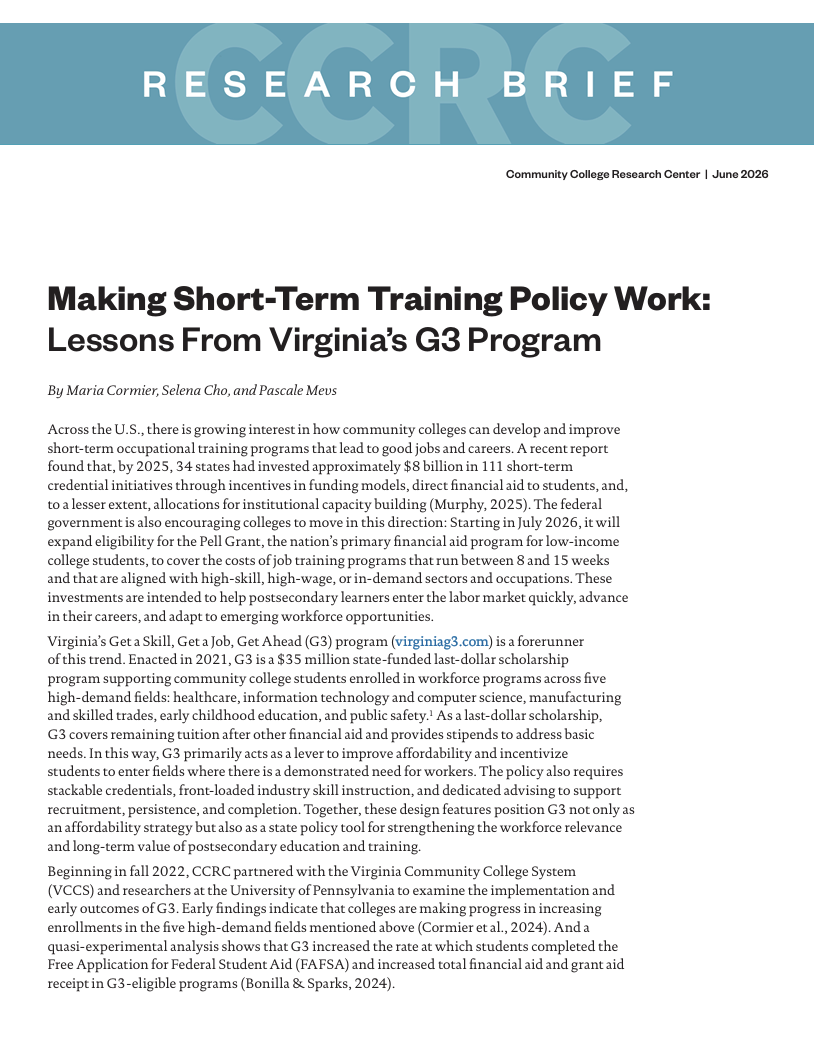
Making Short-Term Training Policy Work: Lessons From Virginia’s G3 Program
Community College Research Center | June 2026
Drawing on three rounds of site visits to eight institutions, this brief examines how Virginia community colleges implemented G3 policy and offers lessons for developing, strengthening, and expanding access to short-term training programs for high-demand jobs.

State Policy for Expanding Access to High-Demand Jobs: The Role of G3, GO Virginia, and Virginia’s Community Colleges
CCRC | July 2025
This brief examines two statewide workforce-focused initiatives, G3 and GO Virginia. The authors present a snapshot of how these initiatives interact on the ground and describe opportunities for more deliberate and strategic efforts to better align their goals and investments.
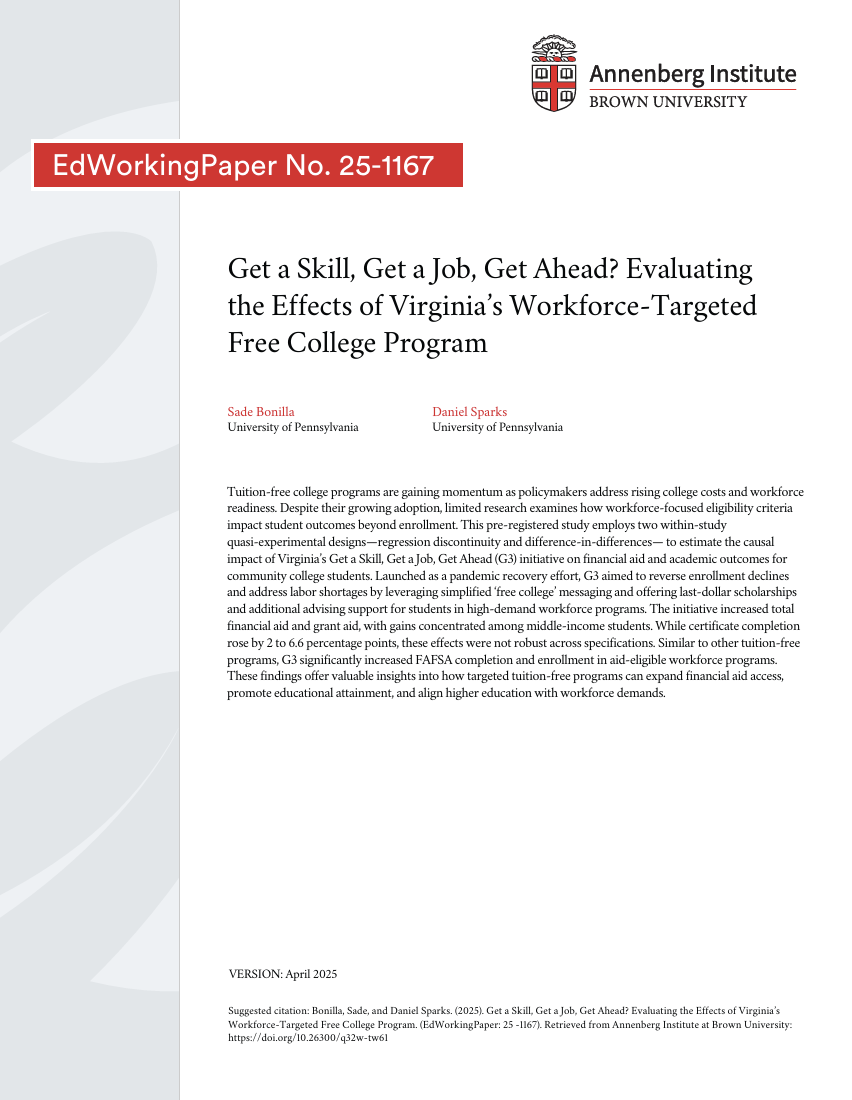
Get a Skill, Get a Job, Get Ahead? Evaluating the Effects of Virginia’s Workforce-Targeted Free College Program
CCRC | April 2025
Using two quasi-experimental methods, this paper estimates the causal impact of Virginia’s Get a Skill, Get a Job, Get Ahead initiative on financial aid and academic outcomes of community college students.
Institutional and Student Responses to Free College: Evidence From Virginia
CCRC | September 2024
Using administrative data, this paper analyzes Get a Skill, Get a Job, Get Ahead (G3)—a free community college initiative that Virginia implemented in 2021—and shows that both institutions and students responded to the tuition-free messaging and eligibility criteria.
Increasing Access to High-Demand Occupational Training: An Exploration of G3’s Recruitment and Enrollment Strategies
CCRC | July 2024
This brief uses enrollment and outcome data as well as interview data from eight colleges implementing the Get A Skill, Get A Job, Get Ahead (G3) program to examine college-level G3 outreach, recruitment, and enrollment strategies and the process for awarding G3 aid.
Lead Researchers
Maria S. Cormier is a senior research associate at CCRC and an expert in community colleges, workforce education, and developmental education reform. She can be reached at cormier@tc.edu.
Sade Bonilla is an assistant professor at the University of Pennsylvania Graduate School of Education. She is an expert in economics of education and education policy and studies local and state policies affecting transitions between high school and college and the labor market. She can be reached at sadeb@upenn.edu.
Catherine Finnegan is the assistant vice chancellor for research and reporting at the Virginia Community College System, where she leads institutional research, data warehousing, and assessment activities.